OCR data extraction: how it works, methods and accuracy checks
For operations and finance teams replacing manual data entry: what OCR reads, what extraction adds on top, and how to get checked data out of scans, photos and PDFs.

Key takeaways
- OCR data extraction reads the text on a scan, photo or PDF with OCR, then turns specific values into named fields and tables a system can use.
- OCR alone returns characters, not meaning: it doesn't know which number is the invoice total. Layout analysis and field extraction add that.
- The main extraction methods are zonal templates, keywords and regular expressions, table extraction and AI models. Templates break when a layout changes; models need a review step for low-confidence values.
- Measure field-level accuracy, not character accuracy, and check every document: totals reconcile, required fields are present and formats are valid.
- A digital PDF already has a text layer and can skip OCR; scans, faxes and phone photos can't.
On this page
OCR data extraction reads the text on scans, photos and PDFs with optical character recognition (OCR), then pulls specific values out of it, such as an invoice number, a closing balance or a policy date, into named fields and tables. OCR supplies the characters; extraction works out what each value is, checks it and sends it where it's used. This guide covers how it works, the main methods, the documents it handles and how to check accuracy.
What is OCR data extraction?#
OCR data extraction, also called OCR extraction or OCR data capture, has two jobs. OCR turns an image of a page into text, but that text is one unlabeled stream: OCR doesn't know that "4,120.50" is the invoice total or that a run of numbers belongs to a table. Extraction adds that knowledge: document layout analysis finds the regions of the page in reading order, and field extraction names each value and checks it.
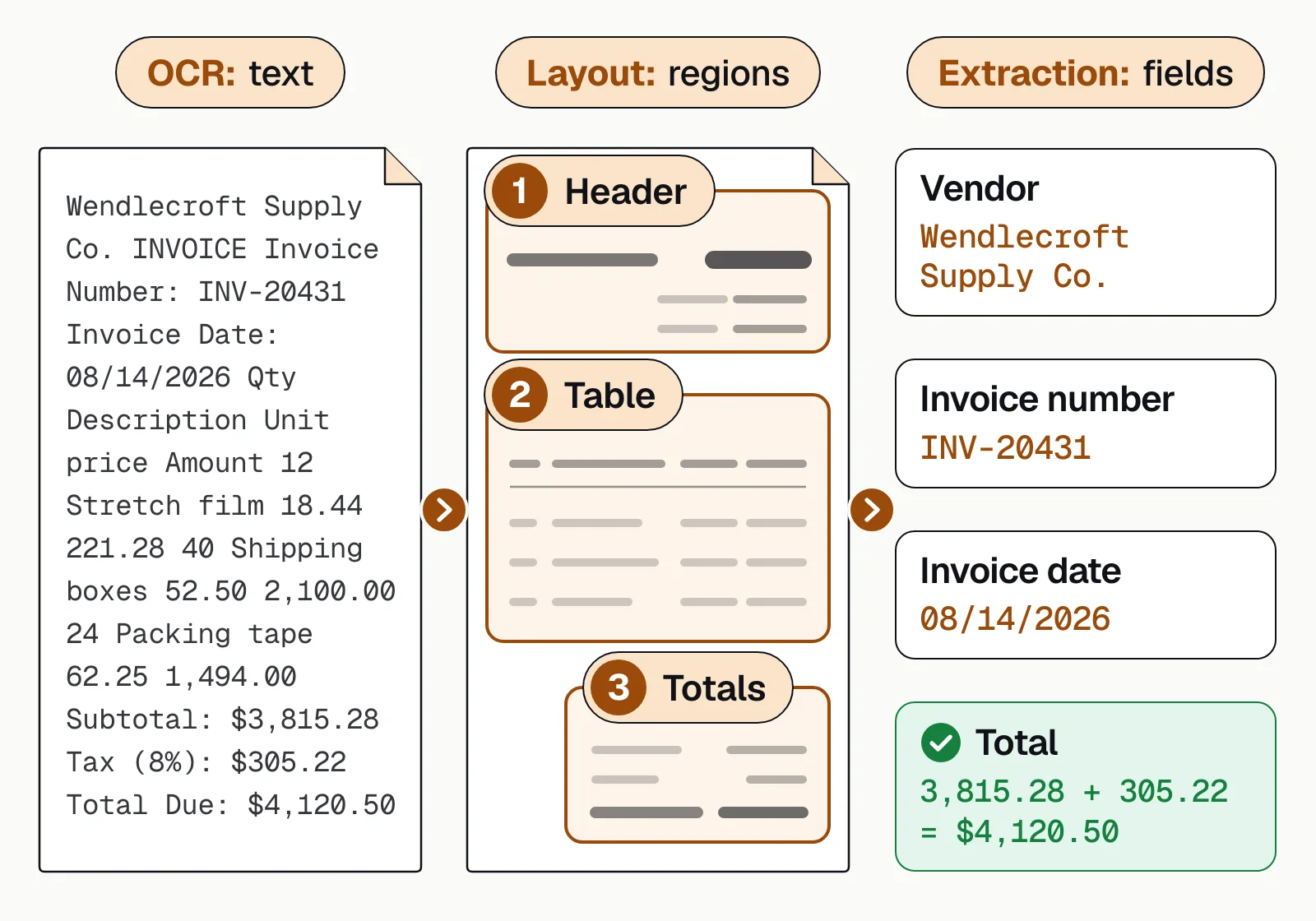
The output is structured data, such as JSON, a spreadsheet row or a record in your system, not a searchable file. A digital PDF already carries a text layer, so it can skip OCR; scans, faxes and phone photos can't.
How OCR data extraction works#
An OCR document processing workflow runs through these stages, from page image to a record in your system:
- Scans
- Phone photos
- PDFs
- 01Read text with OCR
- 02Map the layout
- 03Extract fields and tables
- 04Validate
- 05Review exceptions
Poor scans are straightened and cleaned up first, because OCR errors carry through: a misread digit becomes a wrong amount in the extracted data. Extraction returns each field and table row, usually with a confidence score; validation checks the values against rules, and only values that fail a check or fall below the confidence threshold go to a person. This is the extraction stage on a business bank statement:
| Field | Extracted value | Confidence |
|---|---|---|
| Account holder | Harbor Street Bakery LLC | |
| Address | 118 Harbor St, Portland, ME | |
| Bank name | First Midwest Bank | |
| Account number | •••• 4821 | |
| Account type | Business checking | |
| Statement period | 2026-07-01 → 2026-07-31 |
| Field | Extracted value | Confidence |
|---|---|---|
| Opening balance | 42,180.55 | |
| Total deposits | 88,412.10 | |
| Total withdrawals | 91,686.44 | |
| Closing balance | 38,906.21 | |
| Transaction count | 142 |
| Field | Extracted value | Confidence |
|---|---|---|
| Date | 2026-07-14 | |
| Description | ACH DEPOSIT STRIPE PAYOUT | |
| Amount | +3,284.10 | |
| Debit / credit | Credit | |
| Running balance | 51,902.44 | |
| Category | Card processor payout |
OCR data extraction methods#
OCR-based extraction tools use four methods, often in combination. What separates them is how each copes with a layout it hasn't seen before.
Zonal or template OCR
Reads fixed boxes on a known layout. Fast and cheap for one form version; breaks when a vendor moves a field or a scan shifts. See zonal OCR.Keywords and regular expressions
Finds a label such as "Invoice No." and the pattern after it. Works across layouts; breaks on unusual labels, wrapped lines and look-alike numbers.Table extraction
Rebuilds rows and columns from the position of each word. Needed for line items and transactions; breaks on merged cells, missing ruling lines and tables that run across pages.AI field extraction
A model trained on the document type finds each field from its text, position and context, with a confidence score. Handles new layouts; needs a review step for low-confidence values.
Handwriting and checkboxes need their own readers: intelligent character recognition (ICR) for hand-printed text and optical mark recognition (OMR) for marks. Open-source engines such as Tesseract return text and word positions (plain text, hOCR or TSV), so a do-it-yourself build still needs the field, validation and review layers on top.
What documents can OCR extract data from?#
Any document with text on it. The payoff is biggest on documents that arrive in volume and in many layouts:
Invoices and receipts
Vendor, invoice number, dates, line items, tax and total. See invoice extraction.Bank statements
Account details, balances and every transaction, across banks and formats. See bank statement extraction.Pay stubs
Employer, pay period, gross and net pay, for the period and year to date. See pay stub extraction.Tax forms
W-2s, 1099s and returns, box by box, with mixed packets sorted by form. See IRS tax form extraction.ACORD forms
Certificates and applications: insurers, policy numbers, limits and dates. See ACORD form processing.IDs
Passports and driver's licenses: name, date of birth, document number and expiry. See passport OCR and driver's license OCR.
How to extract data from scanned documents and images#
For a few documents a month, copying values by hand is fine. At hundreds or thousands, set up a pipeline:
- Collect the files in one placeRoute email attachments, uploads and scanner output into one queue, and keep the original image.
- Check what you haveDigital PDFs can be read directly. Scans and photos go to OCR; re-request pages that are cut off or unreadable.
- Classify and splitIdentify each document type and split combined PDFs, such as a loan packet, so each page reaches the right model.
- Extract fields and tablesPull the named fields and every table row, and join tables that run across pages.
- ValidateCheck totals, dates, formats and required fields, and compare values across the documents in one file.
- Review exceptions and exportSend low-confidence or failed fields to a person, then deliver the data to your system through an API.
Manual data entry vs OCR data extraction#
Accounts payable shows the difference clearly, because invoices arrive in every format:
Manual data entry
- Invoices arrive by mail and email and wait in a pile
- Someone sorts them and keys vendor, number, lines and totals
- Mistakes surface later, as rework or a wrong payment
- Payments slip when the backlog grows
OCR data extraction
- Scans and PDFs are read as they arrive
- Fields and line items are extracted and checked against rules
- Only unclear fields go to a person for review
- Clean data posts to the accounting system through an API
Docsumo is an intelligent document processing (IDP) platform. It reads printed and handwritten text in scans, PDFs and phone photos, extracts named fields and multi-page tables, checks them and sends only the fields it isn't sure about to a person. Its reported results:
- 99%field-level accuracy across 250+ document types
- 95%+of documents processed straight through, without manual review
- <5 minper document, down from 2+ hours
How accurate is OCR data extraction?#
Accuracy is measured at two levels. Character accuracy counts the letters and digits OCR reads correctly. Field-level accuracy counts the extracted values that are right, and it's the one your systems feel, because one wrong digit spoils a whole amount. Character accuracy drops with poor scans (low resolution, skew, glare) and handwriting; field-level accuracy also drops with layouts the tool hasn't seen. OCR accuracy covers how to measure both.
Whatever tool you use, run these checks before extracted data posts:
- Totals reconcileLine items plus tax equal the total; opening balance plus deposits minus withdrawals equals the closing balance.
- Required fields are presentEvery document has the fields your process needs, such as an invoice number and a due date.
- Formats are validDates are real dates, amounts are numbers and IDs match their expected pattern.
- Values match your recordsVendor names, account numbers and PO numbers exist in your master data.
- Documents agreeThe same name, amount or date matches across the documents in one file.
- Uncertain fields get a personSet a confidence threshold per field and route anything below it to review.
The bottom line#
OCR turns a page into text; data extraction turns that text into fields and tables you can use, and validation decides which values can skip a person. Start with the documents that arrive in volume, measure accuracy at the field level, and send only the exceptions to review.
Book a demo with a few of your own documents, or start a free trial.
Frequently asked questions#
What does "OCR extracted" mean?
It means the text was read from an image of the page by optical character recognition, rather than typed in or copied from a digital file. OCR-extracted text can contain misreads from poor scans or handwriting, so values that matter should be validated before they're used.
Is OCR the same as data extraction?
No. OCR turns an image of text into characters. Data extraction finds specific values in that text, such as an invoice total or an account number, and puts them into named fields. Intelligent document processing adds classification, validation and review on top: see IDP vs OCR.
Can OCR extract data from handwritten documents?
Standard OCR is built for printed text, so handwriting needs handwriting recognition (ICR) or a model trained on it. Docsumo reads handwritten text and sends any field it isn't sure about to a person for review. More in what is handwriting recognition.
Can OCR extract tables from a PDF or image?
OCR reads a table as lines of text, so table extraction has to rebuild the rows and columns. Tables that run across pages, such as bank statement transactions, also need joining into one table with the headers mapped, which Docsumo does. See table extraction from PDFs and images.
How do I extract data from a scanned PDF or image?
First check whether the PDF has a text layer: if you can select the text, read it directly. If it's a scan or a photo, run OCR, then extract the fields you need and validate them. At volume, use a tool that returns named fields through an API. See how to extract data from a PDF.
What should an OCR data extraction tool do?
Read scans, photos and PDFs, including handwriting; return named fields and whole tables with a confidence score for each value; check values against your rules; send uncertain fields to a review queue; and deliver the data by API or as a file your systems accept.