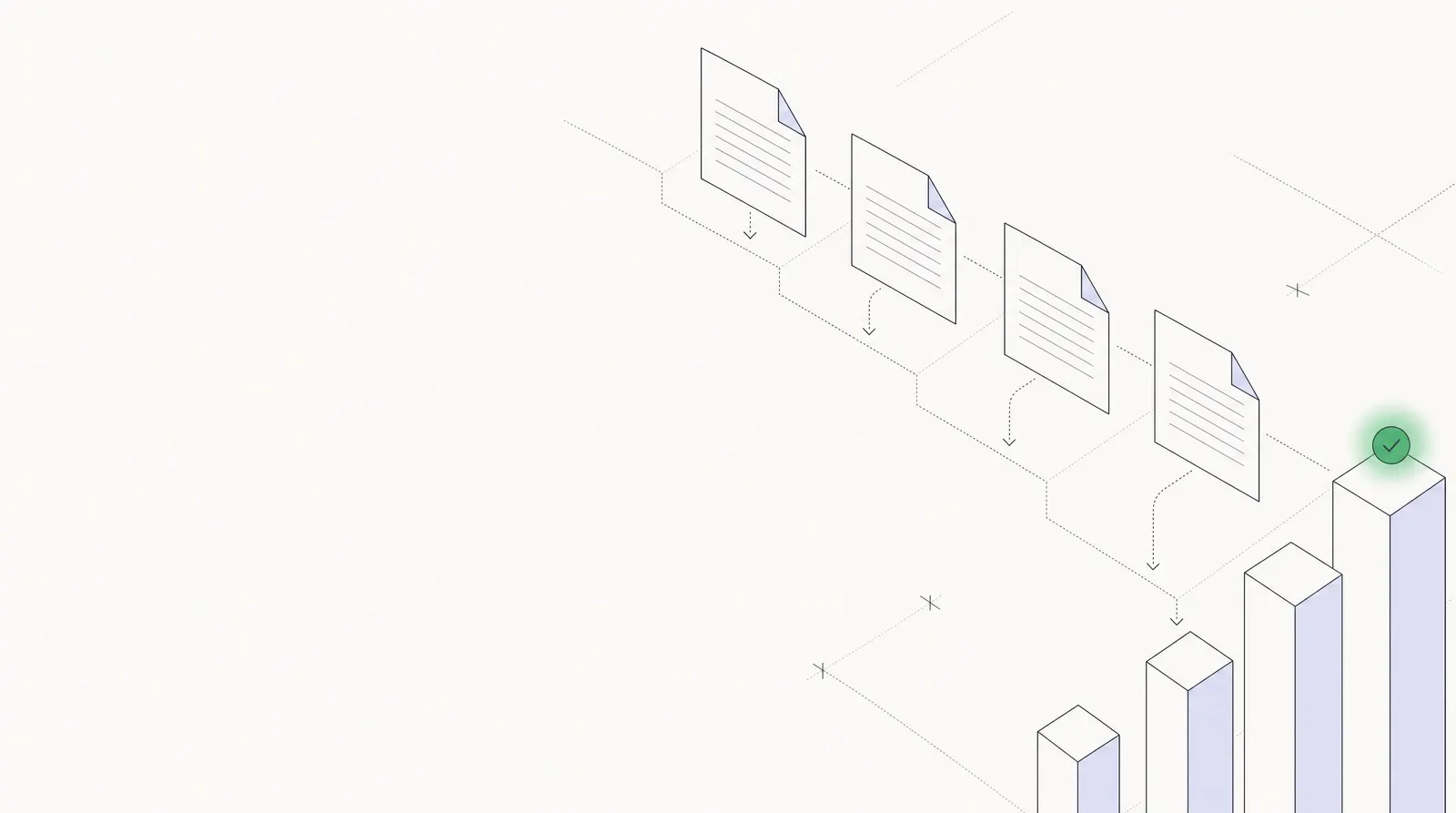
Financial spreading software that reads the statements and returns for you
Automated financial spreading for commercial credit teams. P&Ls, balance sheets and tax returns are read line by line and checked across the borrower file, so analysts review exceptions instead of retyping every line.
- 99% field-level accuracy
- <5 min per document, down from 2+ hours
- SOC 2 Type 2, HIPAA and GDPR
- Revenue
- $4,812,300Deposits 18% below
- Cost of goods sold
- $3,127,99599%
- Gross profit
- $1,684,30599%
- Operating expenses
- $1,085,22597%
- Depreciation
- $186,40098%
- Net income
- $412,68099%
Trusted by 10,000+ mid-sized and enterprise teams, including
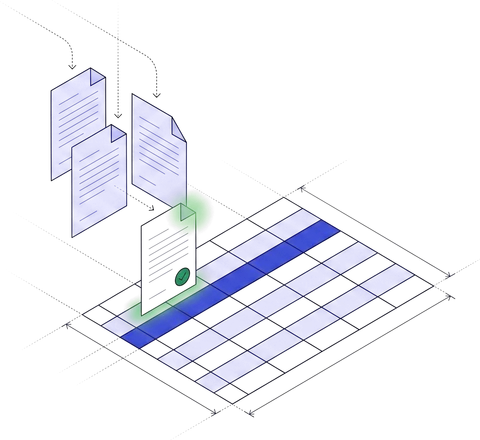
Every statement and return in a borrower package.
Financial spreading automation for banks, credit unions and private lenders starts with reading all of it: scanned or digital, in any layout.
- The books
Financial statements
Audited, reviewed, compiled or management-prepared, whatever the line names.
- Profit and loss
- Balance sheet
- Cash flow
- Interim
- The entity
Business returns →
Every line of each year's return, including the Schedule L balance sheet.
- Form 1120
- Form 1120-S
- Form 1065
- Form 8825
- The people
Owners and guarantors →
The K-1s that tie each owner to the business, and the guarantors' own returns.
- Schedule K-1
- Form 1040
- Schedules C and E
- The cash
Bank statements →
Twelve months of deposits to test the revenue the statements report.
- Business checking
- Every transaction
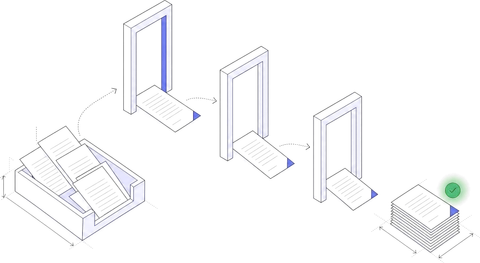
From borrower package to spread-ready data, in five steps.
- 01
Collect
Email, upload or API: one statement, or the whole package.
Collection agent - 02
Classify and split
One upload becomes the statements, returns and schedules inside it.
Classification agent - 03
Extract
Every line and table, each with a confidence score.
Extraction agent - 04
Verify
Against the other documents in the file and your rules.
Verification agent - 05
Review and export
Analysts see the exceptions; data goes to Excel or your credit system.
Review queue · API
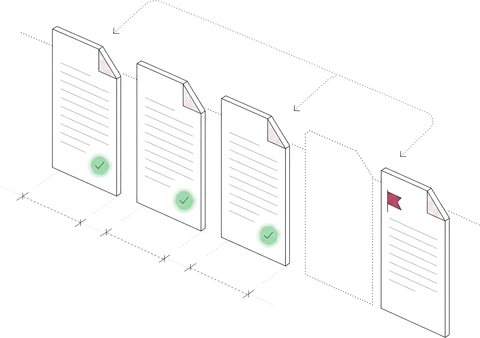
Catch the gap before it reaches the credit memo.
Pick a document to see what Docsumo reads from it and what it's checked against.
Flagged for review · 1 exception
FY 2025 statements
Cedar Ridge Mechanical Inc. · reviewed statements · FY 2025⚑ 1 exceptionWhat Docsumo reads
- Revenue
- 4,812,300
- Gross profit
- 1,684,305
- Net income
- 412,680
- Total assets
- 2,946,120
- Total liabilities
- 1,532,470
- Total equity
- 1,413,650
Checked against
- Bank statementsRevenue against 12 months of depositsFlags deposits further below revenue than your threshold⚑ 18% below
- 2025 returnRevenue and net income against the returnFlags figures that differ for the same year✓ Same on both
- FY 2024Opening equity against last year's closingFlags a balance that doesn't carry forward✓ Carries forward
- InterimInterim period against the fiscal yearFlags a gap or an overlap between periods✓ No gap
Field names and thresholds are yours to set.
The exception is a question for the analyst, not a decline: a business can bank revenue in another account. Cross-document checks are on the Enterprise plan, and you choose which ones apply to each loan product.
Your analysts review exceptions, not every line.
Files that pass every check go straight to export. The rest arrive with the reason and the source line.
Review queue 3 of 8 files
✓ 5 passed every check and moved on
- Revenue, FY 2025
- $4,812,300
- Deposits, Jan–Dec 2025
- $3,946,086
The 1120-S agrees with the statement. Only the deposits fall short.
- Revenue4,812,300
- Cost of goods sold3,127,995
- Gross profit1,684,305
- Net income412,680
- Exceptions onlyClean files don't wait for an analyst.
- Every number traceableClick a value to see the line it came from.
- Thresholds you setPer field, so a faint scan goes to a person.
- On the recordEvery correction logged; corrections improve the model.
What changes when statements stop waiting on people.
Credit and underwriting teams, in production.
- Specialty finance
Uses Docsumo to spread borrowers' financials for loan underwriting.
What they spread- Profit and loss statements
- Financial affidavits
- AccendLending
Uses Docsumo to spread borrowers' financial statements for underwriting.
What they spread- Balance sheets
- Profit and loss statements
- Bank statements
- Lending · credit<1 minper complex bank statement, at 94%+ accuracy
“The accuracy and service have been amazing since day one, and the team is still incredibly responsive a year later.”
 Mark Bentley, Head of CreditRead the Grid Finance story →
Checked data for your spread, audited end to end.
Docsumo reads and checks the package. The spread, ratios and credit memo stay in the tools you already run.
 SOC 2 Type 2Independently audited controls
- ISO 27001Certified security management
 HIPAAFor protected health data
 GDPRFor EU personal data
Encrypted with TLS in transit and AES-256 at rest. Your documents are not used to train shared or third-party models.
How Docsumo protects your data →// POST https://your-credit-system.example.com/hooks/docsumo { "meta_data": { "title": "cedar-ridge-fs-2025.pdf" }, "data": { "Income Statement": { "Revenue": { "value": 4812300, "confidence": 0.98 }, "Cost of Goods Sold": { "value": 3127995, "confidence": 0.99 }, "Net Income": { "value": 412680, "confidence": 0.99 } }, "Balance Sheet": { "Total Assets": { "value": 2946120, "confidence": 0.99 }, "Total Equity": { "value": 1413650, "confidence": 0.99 } } // 2 more sections } }
Excel export
Every line with its statement or form, and its year.
Your credit system
Checked data posted to the system that holds your spread.
A test environment
Your team validates rule changes before they reach production.
Audit log and permissions
By role, team and document type. Every approval recorded.
What credit teams ask about financial spreading.
What is financial spreading software?
Financial spreading software reads a borrower's financial statements and tax returns so analysts don't type each figure into the spread. Docsumo is an intelligent document processing platform: its financial spreading automation reads P&Ls, balance sheets, business and personal returns, K-1s and bank statements line by line, scores its confidence in every value, checks the documents against each other and exports the result to Excel or your credit system. Analysts review only the exceptions, in-house, in software rather than through an outsourced spreading team.
What is financial spreading?
Financial spreading is entering a borrower's figures from financial statements, interim statements and tax returns into a standard template, so several years and entities sit side by side. Lenders use the spread to calculate ratios such as debt service coverage and to write the credit memo. Docsumo's guide to spreading financial statements walks through it step by step.
What is spreading in commercial lending?
In commercial lending, spreading means taking two to three years of a business's financial statements and returns, plus the guarantors' personal returns, and normalizing them into the lender's spread template. The spread feeds commercial underwriting: cash flow analysis, DSCR, global cash flow and the credit decision, at origination and again at every annual review.
Which financial statements and tax forms can be spread automatically?
The documents in a typical commercial loan file. Financial statements: profit and loss statements, balance sheets and cash flow statements, whether audited, reviewed, compiled or management-prepared, plus interim and year-to-date statements. Tax returns: Forms 1120, 1120-S and 1065, Form 8825, Schedule K-1, and the guarantors' Form 1040 with Schedules C and E. Bank statements too. Mixed packets are sorted by form and every line is extracted, from digital files or scans.
Can AI or ChatGPT spread financial statements accurately?
A general AI model can read a financial statement, but a credit file needs more than a reading: a confidence score on every value, a review queue for uncertain ones, checks across documents, an audit log of who approved what, and the same output every time. Docsumo provides that layer, with 99% field-level accuracy on 250+ document types. Examiners and credit committees can see the source line and the review history behind each value.
Does Docsumo replace nCino, Abrigo or Moody's spreading?
No. Docsumo isn't a spreading module. It reads and checks the statements and returns, then exports Excel or sends JSON by API and webhook, so the tool that holds your spread starts from data instead of retyping. Your credit policy, templates and ratios stay where they are.
How are global cash flow and DSCR inputs handled?
Docsumo extracts the inputs global cash flow and DSCR depend on: net income, depreciation, amortization, interest, distributions, each owner's K-1 share, and the guarantors' personal income from their 1040s. Cross-document rules on the Enterprise plan compare K-1 shares with the entity return and each owner's Schedule E. Your spread or credit system then calculates DSCR and global cash flow the way your credit policy defines them.
Can we test it on our own borrower packages?
Yes. Start a free trial: 1,000 pages over 14 days, with pre-trained models, the API and webhooks. Cross-document validation and case management, which check a whole borrower file, are on the Enterprise plan. Or book a demo, bring a real borrower package, and we'll run it live.
Send us a borrower package. We'll run it on the call.
Two years of statements and returns, scanned or digital. We run it live and show every line and every check.