Suggested
What is Agentic Document Processing? The 2026 Definition From Gartner, Forrester, and McKinsey
Picture a loan operations team at 6pm on a Thursday. The underwriting deadline is 9am Friday. On the left monitor: 47 unreviewed loan files, each between 80 and 300 pages. On the right monitor: an inbox with 12 borrower emails, three of which contain document attachments that still need to be sorted, renamed, and matched to the right case. The processor's job for the next three hours is pure data plumbing. Read a bank statement. Open a spreadsheet. Copy transaction amounts. Check if the totals match the tax return from two rows above.
This is not an edge case. It is a Tuesday in most financial services back offices, most insurance underwriting teams, most healthcare revenue cycle departments. And it is exactly the problem that agentic document processing was built to eliminate.
This article defines what agentic document processing actually means in 2026, how it differs from the decade of IDP that came before it, what makes it technically distinct, how the major analyst frameworks evaluate it, and what enterprises should assess before choosing a platform.
If you have been in the IDP space long enough to remember the "Intelligent OCR" rebrand of 2018 or the "Cognitive Capture" phase of 2021, you will recognize the pattern. A new capability arrives, every vendor claims it, and the definitions get muddy within 18 months. This article is an attempt to write the clear version before that happens.
Agentic document processing is an approach to document automation where AI agents independently plan, execute, monitor, and correct multi-step document workflows, without relying on human-defined templates, fixed extraction rules, or predetermined document structures.
The word "agentic" comes from the concept of agency in AI research: the capacity of a system to perceive its environment, make decisions, and take actions toward a goal without requiring step-by-step human instruction. In the context of documents, this means the system does not just extract pre-specified fields from pre-specified locations. It figures out what kind of document it has, determines what data matters given the task context, extracts and validates that data, handles exceptions using reasoning rather than fallback rules, and routes the output to the right downstream system.
The clearest way to understand the definition is by contrast:
Traditional IDP says: "This is a W-2. Extract Box 1 (wages), Box 4 (Social Security), and Box 16 (state wages) from these coordinates."
Agentic document processing says: "Here is a document. Figure out what it is. Determine what data is relevant. Extract it. Check if it makes sense relative to the other documents in this case. Flag anything that looks wrong. Then push the validated data to the right place."
The second approach handles documents the system has never seen before. It corrects its own errors. It understands relationships between documents in the same workflow. And it adapts when a borrower submits a 2025 W-2 with a slightly different layout than the model was originally calibrated on. That adaptability is what separates agentic systems from the rule-based and template-based automation that came before.
According to IDC Senior Research Analyst Andrew Gens, writing in the IDC MarketScape: Worldwide Intelligent Document Processing Software 2025-2026 Vendor Assessment: "We are firmly in the generative AI era, with the agentic future rapidly approaching, and IDC has seen a significant evolution in the capabilities and strategies offered by IDP software vendors." He notes the key shift: the challenge has moved from simply handling unstructured documents to "extracting meaningful insights from documents, regardless of structure, and building out end-to-end automation workflows that can fuel enterprise processes with reliable and insightful data."
That is the operational definition of agentic document processing in a single sentence from the analyst community.
Agentic document processing did not become viable in a vacuum. Four things converged between 2023 and 2026 that made it technically possible at production scale.
The release and rapid improvement of multimodal LLMs gave document AI systems something that OCR and traditional machine learning never had: the ability to reason about what a document means, not just what it says. A model that can read a financial statement and understand that a $2.4 million figure labeled "net revenue" should be reconciled against a line labeled "operating income" is doing something qualitatively different from a model that extracts named fields from fixed positions.
That reasoning layer is what makes agentic behavior possible. Without it, you can automate document extraction. With it, you can automate document understanding.
The second enabler is more specific than "LLMs got better." A class of models called vision-language models (VLMs) that combine visual understanding of document layouts with language reasoning reached production-grade accuracy for enterprise document types in 2024-2025.
Models like mPLUG-DocOwl 1.5, designed for unified structure learning across documents, webpages, tables, and charts, demonstrated the ability to parse complex multi-column layouts, embedded tables, and non-standard form designs that general-purpose OCR consistently mangled. More recent research shows that general-purpose VLMs like InternVL2, Qwen2.5-VL, and GPT-4V now outperform specialized document models on complex layout tasks, which matters for enterprises because it means production document AI is no longer dependent on narrow models that need retraining when document formats change.
The practical result: a single multimodal model can classify a document, read its layout, understand its content, and extract structured data without a separate OCR step feeding text into a downstream language model. That architectural simplification reduces error propagation and improves end-to-end accuracy.
Vision-language models alone don't make a document processing system agentic. The orchestration layer does: the infrastructure that coordinates multiple specialized agents, manages context across a multi-document case, handles error recovery, and routes exceptions to human review when confidence falls below threshold.
LlamaIndex introduced Agentic Document Workflows (ADW) in 2025, combining document processing, retrieval, structured outputs, and agentic orchestration into a single framework. LangGraph, the graph-based agentic layer from the LangChain ecosystem, provides similar multi-agent coordination capabilities. These frameworks reached production stability in 2024-2025. The result: enterprises could deploy multi-agent document workflows without building orchestration infrastructure from scratch.
The event-driven architecture these frameworks enable is particularly important for documents. When a new document enters the system, the orchestrator agent triggers a classification event. The classification result triggers an extraction event. The extraction result triggers a validation event. Each step emits events that the next agent responds to. This means the pipeline handles errors, retries, and confidence-based routing as native workflow behaviors rather than custom exception handling code.
The final factor is the simplest: the old approach stopped scaling.
Rule-based extraction works well for a controlled set of known document formats. It breaks when formats change, when new document types arrive, or when volume grows faster than the rules-maintenance team can keep up. Every new document type requires a new configuration. Every vendor relationship is siloed by document category. Every format change requires a support ticket.
Forrester Vice President and Principal Analyst Boris Evelson, writing in the Document Mining and Analytics Platforms Landscape Q4 2025, identifies this as a structural market shift: generative and agentic AI is acting as an "equalizer that challenges vendors' ability to differentiate," forcing both buyers to reconsider the make-vs.-build question and vendors to rethink architectures built on rules and templates. Enterprises that built their document stacks on OCR vendors and template-based IDP through the early 2020s are now at an architectural inflection point.
Agentic document processing is not a single technology. It is a layered architecture. Understanding each layer is how enterprise buyers separate genuinely agentic platforms from rebadged rule-based systems claiming to be agentic.
The entry point handles getting documents into the system from any channel. Production deployments must handle email attachments, portal uploads, API pushes from LOS or ERP systems, webhook triggers from CRM events, and SFTP batch drops from legacy systems. A document arriving as a 180-page scanned PDF, a 3-page digital PDF, a TIFF image, an Excel file, and a Word document all need to flow into the same processing pipeline.
Normalization at this layer converts every inbound format into a representation the downstream VLM and extraction models can work with. For scanned images, this includes deskewing, denoising, and resolution normalization before passing to the visual model. For digital PDFs with embedded fonts, it includes layout parsing to preserve column structure that flat text extraction destroys.
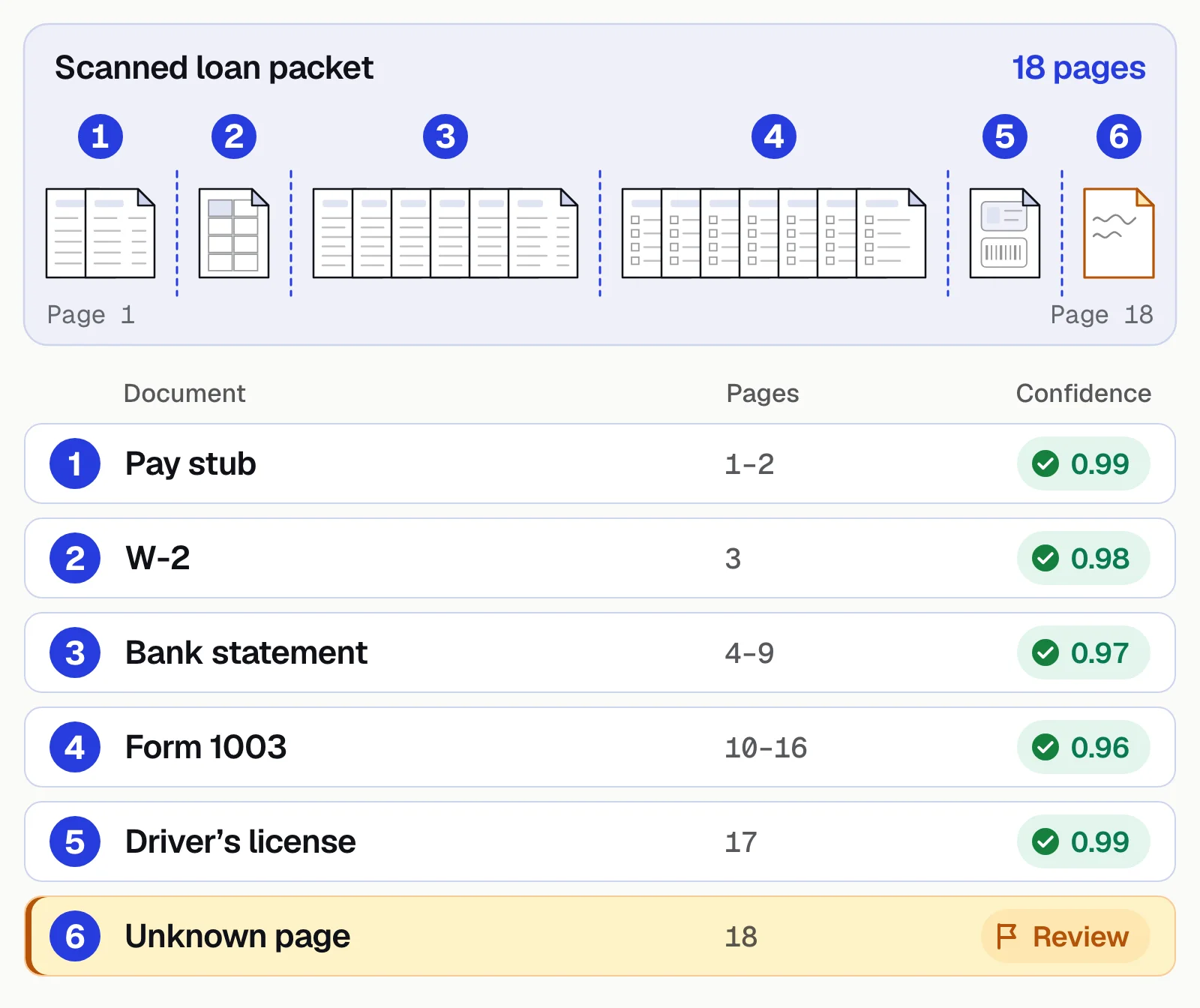
Many real-world documents are compound: a borrower uploads "all my documents" as a single 180-page PDF. Inside it: a bank statement, three months of pay stubs, a W-2, and two pages of something unrelated. Classification in an agentic system identifies not just what type a document is but where page boundaries are between different document types within the same file.
VLMs perform this classification by reading visual layout and content simultaneously. The same model that sees a dense tabular format, a routing number at the bottom of the page, and twelve months of dated rows identifies the document as a bank statement with high confidence. Confidence scores at this layer gate downstream processing: documents below threshold go to a human classification queue, not into an extraction pipeline that would process them incorrectly.
Data extraction is where the primary LLM/VLM reasoning work happens. For each document type, the model extracts structured fields and assigns a confidence score to each extracted value. This is architecturally different from template-based extraction, which assigns a single confidence score to the entire extraction result.
Field-level confidence matters because it enables granular exception routing. A bank statement extraction might have 97% confidence on transaction dates and amounts but 68% confidence on the account holder name because the font is damaged. The former flows straight through. The latter routes to human review with the specific field highlighted. This is a better use of human review time than sending the entire document back.
Retrieval-augmented generation (RAG) plays a role here in multi-document workflows. Rather than processing each document in isolation, the extraction agent can retrieve relevant context from other documents in the same case. When extracting income figures from a pay stub, the agent can retrieve the corresponding W-2 and flag discrepancies before the validation layer sees them. This cross-document retrieval is what enables the kind of reasoning a skilled underwriter does implicitly when reviewing a full loan file.
The validation layer checks extracted data in three ways. First, internal document validation: does the data on this document make sense? Second, cross-document validation: does this figure reconcile with the same figure reported on another document in the case? Third, business rule validation: does this data meet the specific requirements of the downstream workflow?
Internal validation catches simple extraction errors: a phone number field containing 11 digits instead of 10, a date field in an unexpected format, a dollar amount that is negative when it should not be. These are flags the extraction model itself should ideally catch, but a separate validation pass provides a second check.
Cross-document reconciliation is where agentic systems create disproportionate value. An income figure on a pay stub that doesn't match the same figure on a W-2 is either a data entry error or a red flag. Cross-document validation catches it automatically. In a traditional IDP system, that check either doesn't exist or is performed by a human reviewer who has to mentally hold two documents simultaneously.
Business rule validation applies workflow-specific logic: does this applicant's reported monthly income meet the debt-to-income threshold for this loan product? Does the insurance certificate cover the full loan term? Does the business license date predate the loan application date? These rules are configurable per deployment and execute after extraction and cross-document validation are complete.
The orchestration layer coordinates the work of Layers 1-4, manages the human review queue for exceptions, and pushes validated data to downstream systems.
In multi-agent architectures, the orchestrator is a dedicated agent whose job is task assignment and state management. When a 180-page compound document arrives, the orchestrator assigns the splitting and classification task to a document structure agent. When classification completes, it assigns extraction tasks to document-type-specific extraction agents running in parallel. When extraction completes, it triggers the validation agent. Each step's output is logged with confidence scores, timestamps, and agent identifiers. That log is the audit trail.
Exception routing is rule-based at the orchestration layer: documents where field-level confidence falls below a configurable threshold go to a human reviewer with the specific low-confidence fields highlighted. The reviewer corrects the field. That correction feeds back into the model's training data, improving future confidence on similar documents.
Integration handles data delivery. The validated, structured output pushes to the LOS, ERP, CRM, or data warehouse in the target schema. Docsumo's integration layer supports real-time API sync with major platforms including Salesforce, Encompass, SAP, and nCino, alongside webhook-based integrations for custom-built systems.
Understanding where agentic document processing sits in context requires a brief history. The industry has gone through five distinct generations, each claiming to solve what the previous generation could not.
Generation 1: Manual and paper-based (pre-2000). Documents were physically filed, manually reviewed, and data was typed into systems by operators. Error rates were high. Speed was limited by headcount.
Generation 2: Basic OCR (2000-2010). Optical character recognition converted scanned documents to machine-readable text. Accuracy was acceptable on clean, structured documents and poor on anything else. Still required significant human correction.
Generation 3: Template-based IDP (2010-2020). ML models trained on specific document types, combined with rules-based extraction, made OCR "intelligent." Vendors built proprietary models for invoices, W-2s, bank statements, and other high-volume types. Accuracy improved significantly for known document formats. The fundamental limitation: every new document type required a new template, and templates degraded as formats changed.
Generation 4: LLM-augmented IDP (2020-2023). Pre-trained language models were added to extraction pipelines to improve accuracy on ambiguous fields and handle layout variations. This extended the lifespan of template-based systems but didn't replace the underlying template architecture.
Generation 5: Agentic document processing (2024-present). LLMs and VLMs handle classification, extraction, and validation without pre-configured templates. Multi-agent orchestration manages complex, multi-document workflows. The system reasons across documents, improves over time, and integrates into downstream operational systems.
The Gartner Market Guide for Intelligent Document Processing Solutions and the first-ever Gartner Magic Quadrant for IDP Solutions, published in 2025, both reflect this generational shift. For the first time, Gartner created a full Magic Quadrant specifically for IDP, a market it previously covered through market guides. That structural decision signals analyst consensus that the category has reached a maturity level warranting full competitive positioning analysis.
Three major analyst frameworks published in 2024-2025 are shaping how enterprises evaluate IDP vendors. Understanding each framework helps buyers interpret vendor claims correctly.
Gartner's first Magic Quadrant for Intelligent Document Processing Solutions evaluated vendors across completeness of vision and ability to execute. The vendors positioned in the Leaders quadrant of this inaugural report include names that have invested heavily in LLM-native architectures: UiPath, Hyperscience, and others with deep orchestration capabilities.
Gartner also published the Critical Capabilities for Intelligent Document Processing Solutions in September 2025, which complements the MQ by evaluating 18 vendor products across three use cases and 10 critical capabilities. The three use cases Gartner defines are Automated Processing, Augmented Reading and Handling, and Extraction and Retention of Data. The 10 capabilities are Analysis and Reporting, Composable Architecture, Data Enrichment, Data Extraction, Data Review, Integration, ModelOps, Orchestration and Automation, Retrieval and Synthesis, and Secure Handling.
For enterprise buyers, this framework is the right starting point for a vendor evaluation. The Composable Architecture and ModelOps criteria in particular separate vendors with genuine agentic capabilities from vendors with legacy rule-based systems that have added an LLM interface layer.
Forrester classifies IDP within a broader category called Document Mining and Analytics Platforms (DMAPs). The Q2 2024 Forrester Wave evaluated 14 providers on 25 criteria, with UiPath and Hyperscience among the Leaders. The Q4 2025 Landscape report, authored by Boris Evelson, updates this analysis in the context of generative and agentic AI.
Evelson's central argument is worth understanding for any enterprise buyer: AI capabilities have become a commoditizing force in the DMAP market. Features that differentiated enterprise IDP vendors two years ago (high OCR accuracy, configurable extraction models, pre-built connectors) are now table stakes. The differentiation has moved up the stack to agentic orchestration, multi-document reasoning, and the ability to build end-to-end automation workflows, not just extraction pipelines.
He also flags three consequences of this shift: vendor differentiation is harder, buyer decision complexity has increased, and the make-vs.-build question has reopened because accessible LLMs make internal development seem more viable than it was in 2022. His implicit argument, read carefully, is that the platforms with durable differentiation are those with deep workflow orchestration, governance infrastructure, and domain-specific model pre-training, capabilities that take years to build properly, regardless of how accessible general-purpose LLMs have become.
The IDC MarketScape assessed 22 IDP vendors including ABBYY, Google, IBM, Rossum, AWS, Appian, Microsoft, Automation Anywhere, Hyperscience, SAP, EdgeVerve, OpenText, and Iron Mountain. The Leaders designation went to vendors demonstrating strong capabilities in AI-powered extraction and end-to-end workflow orchestration.
The IDC analyst framing is complementary to Forrester's. IDC sees the market shifting from "addressing the processing of unstructured document use cases" to "extracting meaningful insights from documents, regardless of structure, and building out end-to-end automation workflows." The "regardless of structure" phrase is significant: it signals that template-dependency is no longer an acceptable limitation, and vendors still relying on it for primary differentiation are positioned defensively.
IDC's parallel Worldwide IDP Software Forecast 2025-2029 projects the market growing from approximately $3.09 billion in 2025 at a compound annual rate of 29.6%, driven primarily by adoption of agentic and generative AI capabilities in document automation.
A frequent question in enterprise evaluations is how agentic document processing relates to robotic process automation (RPA), since many enterprises already have RPA deployments for document-adjacent processes. The relationship is more complementary than competitive, but the distinction matters.
RPA automates interactions with user interfaces and structured data flows. An RPA bot can open a document, navigate to a specific field, copy the value, and paste it into a target system. It does this reliably as long as the UI doesn't change, the document is in the expected location, and the data is in the expected format.
Agentic document processing handles the step before RPA: it takes unstructured input (a document in any format, layout, or content variation) and produces structured output (a validated data record). RPA can then take that structured output and route it through downstream systems.
The integration pattern in practice: an agentic document processing platform receives a document, extracts and validates structured data, and delivers a clean data record via API. An RPA bot (or a native integration) takes that record and posts it to the LOS, ERP, or CRM. The two systems are complementary, not competitive.
Where they conflict is when enterprises try to use RPA to handle unstructured documents directly. RPA bots are brittle on document layout variations. A one-pixel shift in where a field appears on a form, a new page added to a supplier invoice, or a slightly different table format on a bank statement can break an RPA workflow that was working the previous week. Enterprises that have tried to use RPA as a document processing tool know this failure mode well.
The correct architecture in 2025 is agentic document processing for unstructured input, RPA or native API integration for structured data routing. Platforms like Docsumo are built specifically for the unstructured document layer, with integration outputs designed to feed cleanly into RPA workflows or directly into operational systems.
This comparison matters because "intelligent document processing" has been in use since roughly 2017, and most vendors have been incrementally adding AI capabilities to what are fundamentally template-based systems. Understanding the difference between an IDP platform with AI features and a genuinely agentic document processing system determines whether an enterprise is buying incremental improvement or architectural change.
The deployment gap is where the ROI becomes concrete. A new document type on a traditional IDP platform requires days to weeks of configuration, template training, and QA. A new document type on an agentic platform is processed on first encounter, with accuracy that improves over the first few hundred examples rather than requiring a full training cycle.
For enterprises onboarding new clients, entering new verticals, or adapting to regulatory changes that affect document formats, this difference translates directly into operational speed and competitive advantage.
The market data on agentic AI broadly is unusually consistent across analysts, which is rare. The message from Gartner, Forrester, McKinsey, and the Hackett Group in late 2025 and early 2026 converges on the same thesis: agentic AI is moving from experimentation to production faster than most enterprise transformation cycles can accommodate.
Gartner named agentic AI the number one strategic technology trend for 2025 and has since predicted that 40% of enterprise applications will feature task-specific AI agents by the end of 2026, up from less than 5% in 2025. Their long-range projection: agentic AI could drive approximately 30% of enterprise application software revenue by 2035, roughly $450 billion, up from 2% today.
In their Predicts 2026: The New Era of Agentic Automation Begins, Gartner explicitly includes document processing among the disruptive areas where orchestration and agentic systems are solving painful operational bottlenecks. The Top Strategic Technology Trends for 2026 further identifies multiagent systems and Domain-Specific Language Models as key trends: "modular, specialized agents can boost efficiency, speed up delivery, and reduce risk by reusing proven solutions across workflows."
McKinsey's State of AI 2025 report, drawing on 1,993 respondents across 105 countries, found that 23% of organizations are already scaling agentic AI somewhere in their enterprises, with an additional 39% actively experimenting. Scaling remains the persistent challenge: most organizations have deployed agents in only one or two functions, and fewer than 10% are scaling AI agents in any given business function.
The implication for document processing specifically: the gap between "experimenting with AI" and "running production-grade agentic document workflows at enterprise scale" is where most organizations are stuck. The capabilities exist. The operational infrastructure to run them reliably, with governance and auditability, is where programs stall.
The Hackett Group's 2026 Finance Key Issues Study, released March 2026, contains the most specific data on back-office document automation adoption available from any analyst source.
The headline finding: AI implementation is now the fourth-ranked finance priority, up from 16th in 2025. That jump is not incremental. It reflects a decisive institutional shift from AI as an experiment to AI as a core operational investment.
Specific adoption data from the same study:
That 42% cost-per-invoice gap is the ROI benchmark for AP automation deployments. The difference between Digital World Class and average is almost entirely explained by automation depth on document-heavy processes like invoice processing, expense claims, and remittance matching.
The IDP market is growing at a 33.68% compound annual rate, from approximately $3.09 billion in 2025 to a projected $43.92 billion by 2034. North America accounts for 47.6% of current market share. The transition from rule-based extraction to agentic document processing is the primary growth driver, as enterprises that have exhausted the value of first-generation IDP deployments look for the next architectural step.
Agentic document processing is a horizontal capability. The highest adoption in 2025-2026 is concentrated where document volume, regulatory exposure, and processing cost combine to create the clearest business case.
A single mortgage file contains an average of 23 distinct document types. Processing that file manually, or with template-based OCR, carries an 11.4% combined error rate across the mortgage industry. Those errors contribute to an estimated $7.8 billion in elevated consumer costs annually, according to LoanLogics data covering 1.34 billion processed documents. It also costs an average of $11,600 to originate a single mortgage today, up 35% in three years, with personnel representing 67% of that cost.
The mortgage document workflow is also a textbook case for why agentic architecture specifically matters, not just any form of automation. A standard loan file contains a bank statement, W-2, two years of tax returns, pay stubs, a VOE letter, an appraisal report, a title commitment, and several property insurance documents. Each of those documents needs to be individually extracted. But the useful data from a mortgage underwriting perspective is relational: does the income figure on the W-2 match the income figure on the tax return? Does the property value from the appraisal support the requested loan amount? Does the insurance coverage date extend past the expected closing date?
Those cross-document questions are what agentic systems answer automatically. A template-based IDP system extracts each document's fields. An agentic system extracts them and validates the relationships between them.
Lending teams using Docsumo's agentic document processing report processing 3x more loan applications with the same headcount and reducing manual review time by over 80%. For lending-specific IDP deployment patterns, Docsumo's lending solution overview details how the workflow maps to common LOS environments.
The Hackett Group data on AP is the clearest industry benchmark available. The 42% lower cost per invoice for Digital World Class organizations is well-documented across multiple research cycles, and the primary driver is automation depth on invoice processing.
The challenge in AP automation is format diversity. Corporate supplier invoices come in structured PDFs with consistent layouts. Small supplier invoices arrive as scanned paper, as images in email bodies, as Excel files, as hand-formatted Word documents. Template-based IDP handles the large suppliers adequately and creates exception queues for everyone else. Those exception queues are where the processing cost sits.
Agentic document processing handles the long tail without a growing exceptions backlog. This is why 33% of finance organizations are already scaling AI specifically for AP, making it the most mature process for AI deployment in finance.
Healthcare documents are among the most challenging for rule-based systems. Prior authorization forms vary by payer and update quarterly. Clinical notes are free-form text. Explanation of Benefits documents arrive in formats that differ by payer, region, and claim type. A single patient record can aggregate data from 20+ source systems.
The accuracy requirements in healthcare are also the highest of any vertical. A misread medication dosage is not a data quality issue. It's a patient safety issue. Agentic systems address this through field-level confidence scoring, explicit uncertainty flagging, and human-in-the-loop escalation protocols with context provided. When a clinical note field has low extraction confidence, the reviewer sees not just "please review this field" but "the model read 'mg' but could not confirm whether the preceding number was 10 or 100."
Insurance underwriting involves dozens of document types with complex interdependencies: policy applications, loss run reports, inspection reports, financial statements, and prior coverage certificates. Manually reconciling these takes days per case. Agentic document processing handles the reconciliation automatically, validates that reported figures are internally consistent, and flags the exceptions that require underwriter judgment.
In compliance-heavy industries (legal services, government contracting, regulated financial products), agentic systems provide the audit trail that regulators require. Every extraction decision is logged with a timestamp and confidence score. Every human override is recorded. Every correction feeds back into the improvement loop. This governance layer is what makes agentic document processing acceptable to risk and compliance teams, not just operations teams.
Enterprises deploying agentic document processing at scale face three infrastructure decisions that don't come up in proof-of-concept evaluations.
Batch processing runs document workflows on a scheduled cycle, typically nightly or at end-of-day. It works for AP invoice matching, where data needs to be in the ERP before the 9am posting run. It does not work for mortgage lending, where a borrower is waiting for a same-day approval decision.
Real-time processing handles documents immediately as they arrive, with results available in seconds. This is the right architecture for customer-facing workflows where processing delay affects the customer experience or the business outcome. It requires infrastructure that can handle irregular spikes (end-of-month invoice surge, Monday morning email backlog) without queue buildup.
Hybrid architectures use real-time processing for priority document types and batch for everything else. A mortgage lender might process W-2s and bank statements in real-time while running property appraisals and title reports in nightly batch. Most enterprise deployments settle into a hybrid pattern within the first six months of production.
Most agentic document processing platforms in 2025-2026 are cloud-native. The VLMs and orchestration infrastructure that underpin agentic workflows are computationally intensive, and cloud deployment allows elastic scaling without fixed hardware investment.
Some regulated industries, particularly defense contractors, certain healthcare providers, and financial services firms with specific data residency requirements, need on-premises deployment. Most platforms now offer containerized deployment options that can run on-premises with feature parity to the cloud version.
Hybrid deployment, where ingestion and some processing happens on-premises while LLM inference happens in a cloud environment, is an emerging pattern for enterprises that need data residency for document storage but want cloud-scale compute for the inference layer.
This is the production concern that most vendor demos don't address, and it is the one most likely to cause problems at 12 months.
Document format drift is real. Payers update EOB formats. Tax authorities update form layouts. Suppliers change invoice templates. Each format change degrades extraction accuracy on the affected document type. In a template-based system, format drift is catastrophic: the template breaks and every document in that category fails until someone updates the template. In an agentic system, format drift causes accuracy degradation that is detectable through confidence score monitoring before it causes downstream data quality problems.
A production governance program for agentic document processing includes: ongoing confidence score monitoring by document type, automated alerting when confidence on a document type drops below a threshold, a human review sampling protocol to catch cases where confidence scores are overestimated, and a feedback loop that gets corrections from human reviewers back into the model training pipeline within a defined SLA.
Platforms that provide built-in monitoring dashboards for confidence score trends are significantly easier to govern than platforms that require custom monitoring builds. This is one of the evaluation criteria that belongs in any enterprise RFP.
Three questions come up in almost every serious enterprise evaluation of agentic document processing.
The governance concern is legitimate but addressable. With template-based IDP, every extraction decision is explainable by a specific rule or template configuration. With an agentic system, the basis for a decision is the model's reasoning, which is less legible to a human auditor.
The answer is not to make the system less autonomous. It's to make the audit trail more complete. A well-architected agentic document processing platform logs every extraction decision with a confidence score, every validation check and its outcome, and every instance of human review. The governance layer should be more transparent than a rule-based system, not less. A rule is a black box too. You just previously agreed on it.
Docsumo's enterprise security and compliance infrastructure includes SOC 2 Type 2, GDPR, and HIPAA compliance, role-based access controls, and exportable audit trails for every document action. The confidence scoring is field-level and exportable, which means your compliance team can sample-audit the system's decisions the same way they would audit a human reviewer's work.
The more useful question is not "what's the ROI?" but "what's the ROI timeline?" Agentic document processing investments typically have a non-linear payoff curve.
Configuration time is short compared to template-based systems. But model accuracy on specific document types improves over the first 60-90 days as the system processes real production documents and human reviewers correct edge cases. The platforms with the fastest ROI timelines are those with pre-trained models for the document types used most heavily in the target vertical, short feedback loops between human corrections and model updates, and clean API integrations with the operational systems the data flows into.
Most enterprise deployments report measurable productivity impact within the first 30 days. Back-office cost reduction at the scale that makes a CFO's slide deck typically takes 90-180 days as accuracy matures and workflow integrations go live. For enterprises with AP as the primary use case, the Hackett Group's 42% cost-per-invoice benchmark for Digital World Class organizations is a reasonable long-run target.
Forrester's Q4 2025 landscape analysis explicitly flags "make vs. build" as a strategic reconsideration that generative AI has reopened. With powerful LLMs accessible via API, some enterprises believe they can build document extraction pipelines internally.
The cases where building is realistic: an engineering team with production ML experience, a small and stable set of document types, a defined tolerance for ongoing model maintenance and retraining, and a clear understanding that what you're building is an operational system, not a data pipeline.
The underestimated costs in a build scenario are not the initial accuracy. They are the operational infrastructure that surrounds production document processing: confidence threshold management, exception routing logic, human review queue management, integration maintenance across multiple systems, model drift detection, active learning implementation, and regulatory audit documentation. A 2025 Google Cloud study found that 88% of early agentic AI adopters achieved positive ROI, but the companies that reported best results were those that deployed purpose-built platforms rather than assembled bespoke pipelines.
Production-grade agentic document processing is not a prompt and an API call. It is an operational system that needs to run reliably at scale, with predictable accuracy and a complete audit trail. Most enterprises find that the build path reaches acceptable accuracy in months but takes 12-18 months to reach production-grade operational reliability.
Docsumo's approach is to provide the pre-built operational infrastructure while allowing enterprise buyers to configure extraction logic for proprietary document types, bring custom validation rules specific to their industry, and integrate with their existing systems through documented APIs.
The Gartner Critical Capabilities framework identifies 10 evaluation criteria for IDP platforms: Analysis and Reporting, Composable Architecture, Data Enrichment, Data Extraction, Data Review, Integration, ModelOps, Orchestration and Automation, Retrieval and Synthesis, and Secure Handling. That framework is the right starting checklist. Translated into buyer-friendly evaluation questions, here is how to apply it.
The defining test of an agentic system is performance on novel inputs. In any vendor evaluation, bring 10-15 document types you process regularly, including at least three that are unusual or have non-standard layouts. A system that requires template setup before processing these documents is not agentic. A system that processes them on first sight, at production-acceptable accuracy, is.
Ask specifically: can the system identify inconsistencies between two documents in the same case? Can it flag a bank statement income figure that doesn't reconcile with the tax return in the same file? If the vendor demo shows only single-document extraction, their validation layer is rules-based, not reasoning-based.
Every agentic document processing platform should expose confidence scores at the individual field level, not just at the document level. If a vendor cannot show field-level confidence in their demo, you cannot audit the system's decisions. This is non-negotiable for any regulated industry.
How does human correction feed back into model accuracy? What is the latency between a reviewer correcting an error and the correction improving future extractions? This maps to the ModelOps criterion in Gartner's Critical Capabilities framework. Platforms with tight feedback loops, where corrections improve model behavior within days rather than queuing for a future training cycle, reach production accuracy faster and sustain it better as document formats evolve.
Can the platform's components be assembled into custom workflows, or is it a black-box service? The Composable Architecture criterion in Gartner's framework specifically evaluates whether the platform can be integrated with other systems and whether individual components (classification, extraction, validation, routing) can be configured or replaced independently. For enterprise buyers with specific document types or workflow patterns, composability is the difference between a platform that fits and a platform that requires workarounds.
A vendor might list 50 integrations. What matters is whether those integrations are real-time or batch, whether they support bidirectional data flow, and whether the API is documented well enough for your engineering team to build custom connections. Check whether the vendor's documentation includes webhook support, schema definitions for output data, and error handling specifications. Shallow integrations create maintenance debt. Deep, well-documented integrations reduce it.
For regulated industries, ask the vendor to walk you through their compliance documentation process, not just their certifications. SOC 2 Type 2 is expected. What matters beyond that is whether audit trail data is exportable in formats your compliance team can use, whether data retention policies are configurable at the document type level, and whether the vendor can provide a data processing agreement that satisfies your legal team's requirements.
Agentic AI is the general capability: AI systems that perceive, decide, and act autonomously toward goals. The category includes coding agents, research agents, customer service agents, and many others. Agentic document processing is a specific application to the problem of extracting, understanding, and routing structured data from unstructured documents.
Agentic document processing is ahead of the broader agentic AI adoption curve for one reason: the problem is bounded. The inputs are documents. The outputs are structured data records. The value is directly measurable through accuracy rates, processing time, and operational headcount. The risk profile is manageable because human review catches high-uncertainty outputs before they affect downstream decisions.
Enterprises that aren't ready to deploy AI agents that send autonomous emails or make procurement decisions are often ready to deploy agents that process invoices. This bounded, measurable, reviewable nature is why Docsumo positions its AI agents as the enterprise-safe entry point for organizations moving from AI experimentation to production agentic workflows in back-office operations.
The enterprises deploying agentic document processing in 2025-2026 are also acquiring operational muscle memory for agentic workflows generally: learning how to manage model governance, exception routing, human-in-the-loop review, and feedback loops at production scale. That experience will position them to deploy more ambitious agentic systems in adjacent operations. The companies still manually processing loan files and invoices in 2027 will not be ready for the broader agentic transformation.
Most 2025 enterprise deployments use a single orchestration layer coordinating multiple specialized extraction models. The next phase is multi-agent systems where distinct AI agents with different specializations collaborate and check each other's work within a single workflow.
Gartner's 2026 Strategic Technology Trends report identifies multiagent systems as a top trend: "Agents may be delivered in a single environment or developed and deployed independently across distributed environments. Adopting multiagent systems gives organizations a practical way to automate complex business processes." In document processing terms, this means a fraud detection agent, a data extraction agent, and a cross-validation agent operating in parallel, with an orchestration agent making routing decisions based on their combined outputs.
General-purpose LLMs are strong at document understanding. Domain-specific models trained on industry-specific document corpora are more accurate on the documents that actually matter for a given vertical. Gartner identifies Domain-Specific Language Models (DSLMs) as a top 2026 technology trend, noting they provide "higher accuracy, lower costs, and better compliance" for specialized applications.
For lending, this means models pre-trained on millions of mortgage files, calibrated to the specific field names, layout conventions, and cross-document relationships that appear in US mortgage underwriting. For healthcare, models trained on clinical documentation and payer-specific EOB formats. Platforms investing in domain-specific pre-training will widen their accuracy advantage over general-purpose LLM wrappers as the category matures.
The current architecture keeps document processing as a discrete step that feeds into downstream systems. The next phase integrates document processing as a native capability within broader agentic back-office platforms: a loan origination agent that reads documents, validates data, communicates with borrowers, updates the LOS, and triggers downstream compliance checks, all as a single coordinated workflow.
Docsumo's agentic AI agents for document processing are already moving in this direction to coordinate complex commercial lending workflows instead of a standalone extraction service.
Intelligent document processing (IDP) is the broader category of AI-powered document automation that has been in commercial use since roughly 2017. Traditional IDP relies on template-based configuration, ML models trained on specific document types, and rule-based exception handling. Agentic document processing is a newer architectural approach within IDP that replaces templates and fixed rules with AI agents capable of autonomous reasoning, cross-document validation, and self-improvement over time. Every agentic document processing system is a form of IDP, but not every IDP system is agentic. The practical difference: a traditional IDP system processes documents it was configured for. An agentic system processes any document, including ones it has never seen before.
When a human reviewer corrects an extraction error, that correction feeds back into the model as a labeled training example. The model's accuracy on similar documents improves over subsequent processing cycles. This is called active learning or human-in-the-loop training. The speed of improvement depends on the platform's feedback loop architecture: some platforms apply corrections in near-real-time, others batch corrections into periodic retraining cycles. Platforms with faster feedback loops reach production accuracy faster and respond to document format changes more quickly.
Well-built agentic systems handle any document type containing structured or semi-structured information. Common enterprise categories include bank statements, tax returns (1040s, 1120s, Schedule C/E/K-1), invoices, pay stubs, loan applications (1003s), W-2s and W-9s, insurance policies and certificates, prior authorization forms, EOBs, clinical notes, contracts, property appraisals, title reports, and business financial statements. The system can also be configured for proprietary or custom document types specific to a particular institution or industry.
At current benchmarks, production-grade agentic document processing platforms reach 95%+ accuracy on standard financial documents, improving over time as human corrections feed back into model training. For comparison, KlearStack's research benchmarks modern IDP accuracy at 95%+ against traditional OCR. LoanLogics data puts the combined mortgage document error rate from manual processing at 11.4%. For high-volume, repetitive extraction tasks, automated systems routinely exceed human accuracy because people fatigue, rush, and make transcription errors in ways that systems don't.
The Gartner Critical Capabilities for IDP Solutions framework evaluates platforms across 10 criteria: Data Extraction, Composable Architecture, Orchestration and Automation, ModelOps, Integration, Retrieval and Synthesis, Data Enrichment, Data Review, Analysis and Reporting, and Secure Handling. For most enterprise buyers, the most important criteria are the quality of novel document handling (test with unseen document types), field-level confidence scoring, feedback loop speed for model improvement, integration depth with their operational systems, and compliance audit trail export. For regulated industries, add Secure Handling as a priority evaluation criterion.
Most lending and financial services teams are processing live documents within days of onboarding, not months. Enterprise deployments with custom LOS or ERP integrations typically reach full production in two to six weeks. The significant advantage over template-based IDP is that agentic platforms require no model training phase for each new document type: the system processes new document types from day one, with accuracy improving over the first 60-90 days of production use. For the technical specifics of Docsumo's deployment process, the agentic document processing FAQ covers integration patterns and onboarding timelines in detail.
The vendor landscape is more fragmented than it was three years ago, which the Forrester Q4 2025 analysis explains as a consequence of AI commoditization: IDP-like capabilities now appear in RPA platforms, ERP systems, CRM vendors, and specialized vertical applications. The Gartner 2025 Magic Quadrant for IDP identified Leaders, Challengers, Visionaries, and Niche Players across 18 evaluated vendors. The IDC MarketScape 2025-2026 assessed 22 vendors. The Forrester Wave Q2 2024 evaluated 14 providers. Cross-referencing all three gives the most complete picture of vendor capability depth and market positioning. Vendors appearing as Leaders across multiple analyst frameworks have demonstrated consistent capability across the criteria dimensions, though specific use case fit matters more than aggregate market positioning.
Yes, provided the platform has the right compliance architecture. Financial services and healthcare deployments require SOC 2 Type 2 certification, data encryption at rest and in transit (bank-grade SSL is the standard), role-based access controls with granular permission levels, SAML 2.0 or OAuth 2.0 SSO, and comprehensive audit trails that are exportable in auditor-readable formats. Data residency requirements vary by industry and geography: enterprises with EU data must ensure GDPR-compliant data handling. Healthcare data requires HIPAA Business Associate Agreements from any cloud-based vendor. Review the vendor's data processing agreement carefully before deployment in any regulated context.
Docsumo is an enterprise-grade intelligent document processing platform built for the agentic AI era. It processes 150+ document types with 95%+ accuracy, integrates with major LOS, CRM, and ERP systems, and includes the governance, compliance, and human-in-the-loop infrastructure that enterprises in regulated industries require. Get started with 1000 free pages today.