Agentic document extraction: what it is and how it changes document workflows
For operations and engineering teams evaluating AI for document-heavy work: what "agentic" extraction actually means, how it compares with OCR and general-purpose LLMs, and how to put it into a production workflow.

Key takeaways
- Agentic document extraction uses AI that plans and checks its own work: it breaks a document into parts, picks the right method for each, extracts the data and verifies it, instead of running a single OCR pass or prompt.
- Its main advantages over OCR are layout awareness (tables, checkboxes and sections keep their structure) and visual grounding, where every value links back to its location on the page.
- Compared with prompting a general-purpose LLM, it returns structured, schema-shaped data with sources, which makes review and audit possible.
- Extraction alone isn't a workflow. Production use still needs validation rules, cross-document checks, exception routing and integrations.
- The term was popularized by LandingAI's Agentic Document Extraction API in 2025; many IDP platforms now apply similar agent-style steps inside larger document workflows.
On this page
Agentic document extraction is a way of pulling data from documents in which AI works in steps, like an agent. It analyzes the layout, splits the document into parts such as text blocks, tables, checkboxes and charts, extracts each part with the right method, and checks the result before returning structured data linked to its source on the page. It handles complex layouts better than OCR, and it's more reliable and easier to audit than asking a general-purpose LLM to read a PDF.
This article explains how it works, how it compares with OCR and LLM prompting, five ways it changes document workflows, and what to check before you rely on it.
What is agentic document extraction, and how does it work?#
Traditional OCR turns a page into lines of text and keeps little of the structure around them, such as which cell a number sits in or which box is ticked. Template-based capture adds rules that say where a field sits on a known layout, and those rules break when the layout changes.
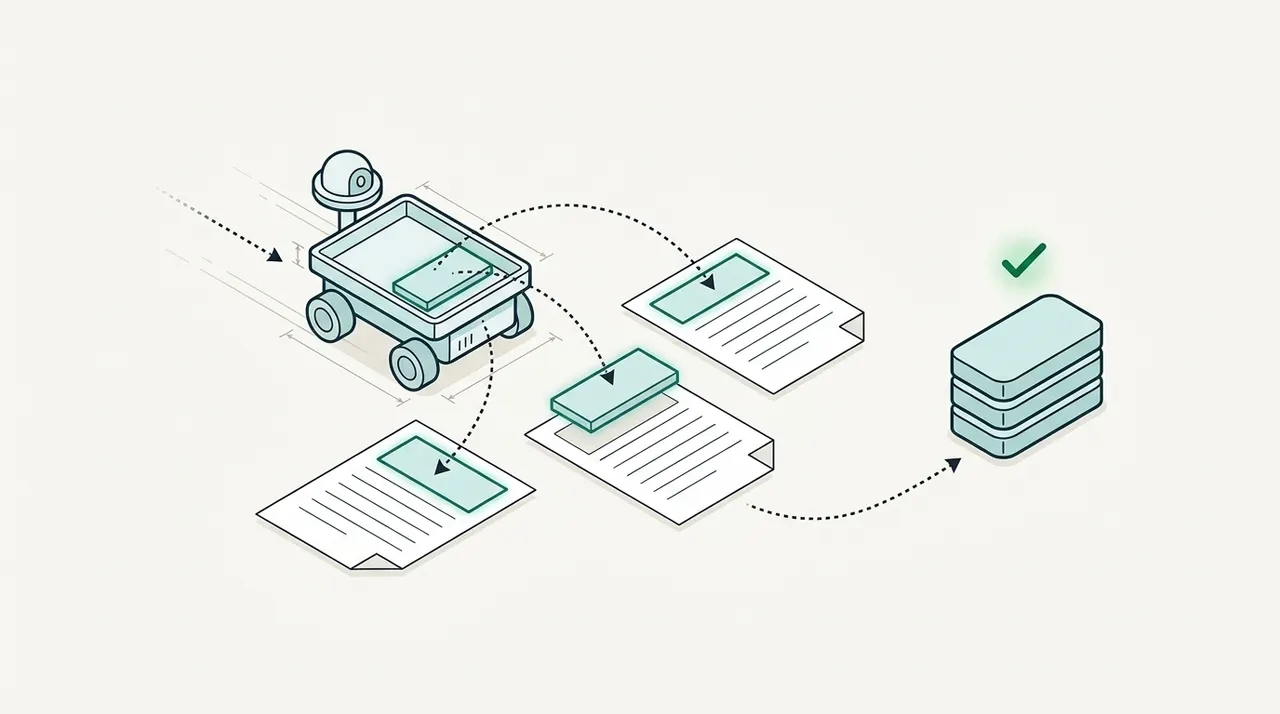
Agentic extraction (you'll also see agentic data extraction or agentic OCR) treats a document as a visual structure and works through it in stages, checking its own output before it hands anything back. LandingAI popularized the term in 2025 with its Agentic Document Extraction API; its site now describes the approach as planning, deciding and verifying until quality thresholds are met. The same idea shows up across document AI platforms.
- Scanned forms
- Multi-page statements
- Invoices
- 01Analyze the layout
- 02Pick a method per part
- 03Extract to a schema
- 04Ground each value
- 05Verify the output
The method per part matters most on hard pages: a table that runs across pages is rebuilt as one table, and a checkbox is read as checked or not rather than as a stray character. Grounding gives every value its page and position, so a reviewer can see where it came from. Verification re-checks values that fail a rule or conflict with each other before anything is returned.
Agentic extraction vs OCR vs a general-purpose LLM#
OCR reads characters, a general-purpose LLM answers questions about a page, and agentic extraction returns checked, structured data with sources.
| Feature | Agentic extraction | OCR | General-purpose LLM |
|---|---|---|---|
| Output | Structured fields and tables against a schema | Raw text, sometimes with positions | Free text or loosely structured JSON |
| Layout and tables | Preserves structure and relationships | Loses most structure | Varies; often struggles with long or multi-page tables |
| Source tracking | Each value linked to its location on the page | Character positions only | Usually can't point to the exact source |
| Handling uncertainty | Confidence and verification steps | Per-word confidence only | Can be confidently wrong |
| Best for | Production extraction with review and audit | Digitizing text for search | Ad hoc questions about a document |
5 ways agentic extraction changes document workflows#
Each one removes a step that OCR or template capture leaves to a person: building templates, fixing tables, finding where a value came from, checking totals and rekeying data.
Classification without templates
Files are recognized by content rather than a fixed layout, so a new bank's statement or a new carrier's form doesn't need a template first, and multi-document packets can be split automatically.Reliable table extraction
Rows that wrap, headers that repeat on each page and merged cells come back as a table with its columns intact, which matters for bank statements, long invoices and loss runs.Answers you can verify
Every value links to its place on the page, so a reviewer checks a flagged field against the source and an auditor can see where a number came from.Validation built into extraction
Rules run as data is extracted: line items must add up to the total, a date must fall within a policy period, an account number must match across documents.Straight into downstream systems
Documents arrive by email, upload or API and leave as structured data through APIs and webhooks. Exceptions go to a person; everything else moves on.
Where it's used#
It pays off wherever layouts vary from sender to sender and the extracted data feeds a decision.
| Industry | Typical documents | Example workflow |
|---|---|---|
| Lending | Bank statements, pay stubs, tax returns, financial statements | Income verification and financial spreading |
| Insurance | ACORD forms, loss runs, certificates of insurance, claims documents | Submission intake and COI tracking |
| Accounts payable | Invoices, purchase orders, receipts | Invoice capture and matching |
| Commercial real estate | Rent rolls, operating statements, leases | Underwriting and asset management |
| Healthcare | Claim forms, intake forms, eligibility documents | Intake and billing |
What to check before adopting it#
- Accuracy on your documentsEspecially scans, handwriting and long tables. Test on your own files, not a vendor's samples.
- Confidence and reviewHow uncertain values are flagged, and how fast a reviewer can fix them.
- ValidationWhether you can add your own rules and cross-document checks.
- GroundingWhether every value links to its source for audit.
- SecurityA SOC 2 Type 2 report, HIPAA and GDPR compliance where they apply, and data retention controls.
- Cost and speedAt your real volume, including reprocessing.
Docsumo, our product, applies these ideas inside a full document workflow. Pre-trained models cover 250+ document types at 99% field-level accuracy. Fields the model is unsure about go to a review queue, with a confidence threshold set for each field, and clicking a field highlights its source line in the document. Auto-classification and splitting are on the Business plan. Master data lookup, case management, cross-document validation and automated workflows are on the Enterprise plan. Checks of your own can be added as workflow steps, as an AI step or your own Python code. For the wider picture, see what agentic document processing is.
The bottom line#
Agentic document extraction is a real step up from OCR and from pasting documents into a chatbot: it keeps structure, shows its sources and checks its own work. It is still one part of a workflow. Pair it with validation, exception review and integrations, and measure it on your own documents before you trust it with decisions.
Book a demo with a few of your own documents, or start a free trial.
Frequently asked questions#
What is agentic OCR, and how is it different from OCR?
Agentic OCR is a name some vendors use for the same approach. Plain OCR converts an image of text into characters. Agentic extraction also understands layout and meaning, keeps tables and form elements structured, and checks its own results, so it returns usable data rather than raw text.
How is it different from asking ChatGPT or another LLM to read a document?
A general-purpose LLM returns free text or loosely structured JSON, and it can't reliably show where each answer came from. Agentic extraction returns structured fields against a schema and links each value to its location on the page, which people can review and systems can trust.
Can agentic document extraction handle handwriting and scans?
Modern systems handle handwriting, skewed scans and complex layouts much better than template OCR, but accuracy still varies by document. Docsumo reads handwritten as well as printed text. Test any tool on your own files and keep a review step for low-confidence values.
Does agentic document extraction still need human review?
Yes. No extraction method is 100% accurate on real documents, so values the system is unsure about, and decisions that need judgment, still go to a person. The goal is to review only exceptions: Docsumo reports 95%+ straight-through processing, with a review step for the rest.
What are the best tools for agentic document extraction?
Docsumo (our product) is a document processing platform that puts extraction inside a workflow, with a review queue, checks you set up as workflow steps, and API and webhook delivery; it runs in the cloud only. Developer APIs such as LandingAI's Agentic Document Extraction return parsed text, tables and schema-based fields with visual grounding for your own code. In our 2025 OCR benchmark, reviewers preferred Docsumo's text output on 116 of 120 documents over the first versions of LandingAI's ADE and Mistral OCR.
Is Agentic Document Extraction a LandingAI product?
Yes. Agentic Document Extraction (ADE) is the name of LandingAI's document API, introduced in 2025 and now in its second generation; its official site is landing.ai. The phrase is also used for the general approach this article describes. For how Docsumo compares, see LandingAI alternatives.