Agentic process automation: where agents fit in document-heavy work
For operations and automation leads in lending, insurance and AP. See which steps of a document-heavy process an agent should run, and how to test a platform on your own files.

Key takeaways
- Agentic process automation uses AI agents for the steps of a business process that need judgment. Rules-based automation and people handle the other steps.
- In document-heavy work, most steps that need judgment are about the documents, such as where each form starts and whether one is missing.
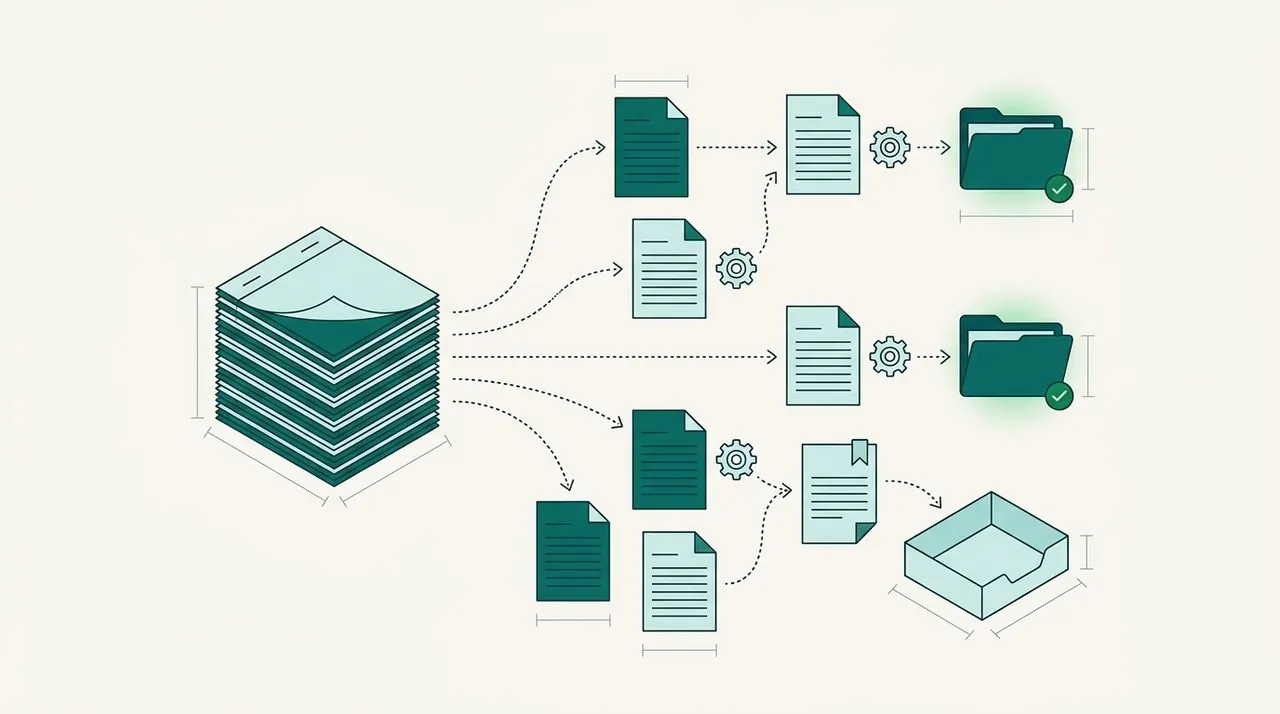
- Agents split one 38-page PDF from a loan file into nine tax forms and read each one. Rules then check the forms against each other, and the one $5,500 gap goes to a person.
- In 2025, Gartner estimated that only about 130 of the thousands of vendors that claim to sell agentic AI actually sell it. So the label tells you little about what a tool does.
- Test each platform on one of your own files with a known problem, and compare what each one hands to a person.
On this page
- What agentic process automation means
- Why documents are the hard part
- One loan file, step by step
- Which steps need an agent, a rule or a person
- Where Docsumo's agents sit
- What the agentic label covers
- How to test a platform on one of your files
- Before you sign for an agent platform
- Frequently asked questions
Agentic process automation uses AI agents for the steps of a business process that need judgment. Rules-based automation and people handle the other steps. In lending, insurance and AP, most of the judgment is about documents. Agents work out what each page is, split the file into documents and notice what's missing. Rules then check that the figures match across documents, and a person gets the exceptions.
What agentic process automation means#
Traditional process automation follows a script. A robotic process automation (RPA) bot copies a value from one screen to another, and a workflow tool sends a form to the next approver. Both work well until an input doesn't match what the script expects.
An AI agent chooses its next step from what it finds, within limits you set. Agentic process automation (APA) puts agents on the steps that need that kind of choice. Fixed rules and people handle the other steps. Most organizations don't use AI agents yet. In Gartner's 2026 survey of CIOs and technology executives, 17% of organizations had deployed AI agents. More than 60% expected to deploy them within two years.
Scripted automation
- Follows steps someone wrote in advance
- Stops when an input doesn't fit the script
- A person rewrites the steps when a form changes
Agentic automation
- Chooses the next step from what it finds, within your limits
- Can handle a layout or a case it hasn't seen before
- Hands what it can't settle to a person, with the reason
The scripts don't go away. A step that never needs judgment should still run on a fixed rule, which does the same thing every time.
Why documents are the hard part#
Most automation was built for data that arrives clean, such as a field on a web form or a row in a database. A loan file or an insurance claim arrives as a set of documents instead.
Documents cause four kinds of trouble. One PDF often holds several documents, so something has to find where each one starts. A document the process needs is often missing. Some fields are hard to read, so the software needs to know when it isn't sure. And the same number appears on several documents, so it has to match on all of them.
A fixed script can't do the first three jobs reliably, because the answer depends on what's on each page. Those are the steps where agents help most. The last job suits a fixed rule. Once an agent has read the numbers, the rule checks that they match. For the document side in more depth, see agentic document processing and agentic document extraction.
One loan file, step by step#
Take the 2025 tax forms of a married couple applying for a loan. One spouse has a salary and owns 25% of an S corporation. The other spouse owns a small business as a sole proprietor. Their tax forms arrive as one 38-page PDF, along with the other documents in the loan file.
Individual and wage forms
Business returns
Form W-2: Wage and Tax Statement
Employers send one to each employee every January.✓ 3 passedWages one employer paid one employee in the tax year, and the taxes withheld from them.
What Docsumo reads
- Employee, box e
- Elena M. Ruiz
- Employee's SSN, box a
- XXX-XX-4127
- Employer, box c
- Front Range Dental Group PC
- Employer EIN, box b
- 84-3150792
- Wages, box 1
- 136,500.00
- Federal tax withheld, box 2
- 24,180.00
- Social security wages, box 3
- 160,000.00
- 401(k) deferrals, box 12a code D
- 23,500.00
Checked against
- Form 1040Box 1 against wages on line 1a✓ 136,500 on both
- Form 1040Box 2 against withholding on line 25a✓ 24,180 on both
- ItselfBox 3 against box 1 plus the 401(k) deferrals✓ Adds up
SSNs shown truncated. Field names and the output schema are configurable.
An agent splits the PDF into nine forms. They are the W-2, two 1099-NECs, Form 1040, Schedules 1, C and E, a K-1 and Form 1120-S. The 1120-S is the tax return of the S corporation that sent the K-1. The agent then reads each box and line.
Next, rules check the forms against each other. Wages on the W-2 match line 1a of the 1040, at $136,500 on both. The K-1 shows $103,000, which is 25% of the S corporation's $412,000 in ordinary business income. Schedule E shows the same $103,000.
One check fails. The two 1099-NECs add up to $46,800, but Schedule C reports $41,300 in gross receipts. So the file goes to a person, who has to find out why Schedule C is $5,500 lower. The gap may be fine. A 1099 can include payment for work that was recorded as income in another year. The underwriter decides whether the gap matters, then works out qualifying income and makes the credit decision.
Which steps need an agent, a rule or a person#
In June 2025, Gartner analyst Anushree Verma suggested a simple split. Use AI agents when a decision is needed, automation for routine workflows and AI assistants for looking up information. In a loan file, the decisions an agent can take on are small ones, such as what a page is or what a box says. The credit decision stays with a person. Gartner's 2026 Hype Cycle for Agentic AI maps how mature each agentic AI technology is. It says agents that work entirely on their own aren't ready for most business uses.
Here is who or what runs each step in that one loan file.
| Step | Run by | Why |
|---|---|---|
| Receive the file by email, upload or API | Rule | Nothing to decide |
| Split the 38 pages into nine forms and name each one | Agent | Deciding where one form ends takes judgment. Documents it can't classify wait as Unclassified for a person to assign. |
| If a form is missing, ask the sender for it | Agent | It has to know what the file should hold, then write to the sender. |
| Read each box and line | Agent | Layouts vary. Fields it's unsure of go to a person. |
| Check the forms against each other | Rule | The calculation is always the same. For example, 25% of $412,000 must equal the amount on the K-1. |
| Explain the $5,500 gap | Person | The answer may not be in the file. |
| Work out qualifying income and decide | Person | The lender makes the credit decision under its own credit policy. |
| Send the checked data to the loan system | Rule | It sends the same fields to the same place every time. |
Three of the eight steps need an agent. You can sort the steps the same way for an insurance claim packet or an invoice that doesn't match its purchase order.
Where Docsumo's agents sit#
- Upload
- API
- 01Split and classify
- 02Ask for missing documents
- 03Extract every field
- 04Check across documents
In Docsumo, files come in by email, upload or the API. AI Split takes a plain-English definition of each document type, so it can split a loan application binder or an insurance claim packet. To classify documents, you name the document types you want, with no training set of sample files. Documents Docsumo can't classify wait as Unclassified for a person to assign. Auto-classification and splitting are on the Business plan.
The Document Collection and Email agents email the sender to ask for a document missing from the file. For example, they can ask a broker or carrier for a missing loss run year. You set a confidence threshold for each field, which is how sure Docsumo must be. When Docsumo is less sure than that, the field goes to your own reviewers.
On the Enterprise plan, Docsumo groups a file's documents into a case, and cross-document validation checks them against each other. For a check or calculation your process needs, you can set up a workflow step. The step can use a large language model (LLM) or run your own Python code. Checked data goes to your systems through the API and webhooks.
Docsumo extracts the data that income verification needs, but it doesn't produce Fannie Mae Form 1084 or Freddie Mac Form 91 income calculations. It runs in the cloud only. It supplies the software, and your own staff do the review. Pricing shows what each plan includes.
What the agentic label covers#
Many kinds of software now carry the agentic label. In its June 2025 release on agentic AI, Gartner warned about "agent washing", where vendors rebrand existing tools as agentic without adding much agentic ability. It estimated that only about 130 of the thousands of vendors that claim to sell agentic AI actually sell it. Most tools you'll meet fall into four groups.
RPA suites with agents added
Bots that repeat steps across screens and systems, now with AI agents and document modules alongside. Built to run a process across many systems.Workflow and low-code platforms
Forms and approvals, with AI steps added to the flow. Built for designing a process and its approvals.Agent builders
Toolkits for building your own agents on large language models. Built for teams that want to design each agent themselves.Document AI platforms
Tools that read and check each document in a file, then send the exceptions to people. Built for the document steps. Docsumo is one of these.
Our take. Don't build a shortlist from these labels. The four groups overlap, and "agentic" can mean one AI step in a script or a system that checks a whole file. Put the same real file through each tool instead, and compare what each one does with it.
How to test a platform on one of your files#
The same Gartner release predicted that over 40% of agentic AI projects would be canceled by the end of 2027. It named rising costs, unclear business value and weak risk controls as the causes. A test on a real file shows whether a tool is worth it before you sign. Run these checks with each tool.
- A file with a known problemUse a file your team has already processed, such as a tax return whose 1099s don't match Schedule C. See whether the tool finds the problem without help.
- The splitsCheck where each document starts and ends. Pages the tool can't classify should wait for a person, not join the wrong document.
- A missing documentTake one document out of the file. The tool should notice, then hold the file or ask the sender.
- What reaches a personEach exception should arrive with its reason and the line on the page it came from.
- What reaches your systemFollow the checked data into your loan, claims or AP system, and look at what arrives.
Before you sign for an agent platform#
Pick the process where documents slow your team down most. Bring one of its files to every demo. Ask each vendor to mark which steps its agents run, which run on rules and which go to a person. That map will tell you more than the name of the product.
Book a demo with one of your own files, or start a free trial.
Frequently asked questions#
What is agentic process automation?
Agentic process automation (APA) uses AI agents to run the steps of a business process that need judgment. The agents read what comes in, choose the next step and act in other systems. Rules-based automation and people handle the other steps.
Is agentic AI the same as automation?
No. Traditional automation follows steps someone wrote in advance, and it stops when an input doesn't fit. Agentic AI chooses its next step from what it finds, within limits you set. Most processes need both kinds.
Will RPA be replaced by AI?
Not for routine steps. Gartner advises using AI agents when decisions are needed and using automation for routine workflows. So RPA bots and APIs still move data between systems. Agents take the steps that need judgment, such as splitting one PDF that holds several documents.
How does agentic process automation work?
An event starts the process, such as a file arriving by email. Agents sort and read what came in, and rules check the results. Each file then moves to the next system or to a person. Every step should leave a record.
What are agentic process automation tools?
Four kinds of software use the label: RPA suites with agents added, workflow and low-code platforms, agent builders, and document AI platforms. They overlap, so compare them on one of your own files, not on the label.