The best healthcare data extraction software in 2026: 13 tools for claims, EOBs and medical records
For medical billing and records companies, provider operations teams and case reviewers. What 13 tools read, how each one words HIPAA and the BAA, and how to test accuracy on your own payers' documents.

Key takeaways
- Healthcare data extraction software turns claim forms, EOBs, referrals and medical records into structured data for a billing, records or EHR system, and sends the fields it's unsure about to a person.
- The 13 tools here fall into four groups: document AI platforms (Docsumo, Hyperscience, ABBYY Vantage, Tungsten TotalAgility), document APIs (Extend, Sensible, Veryfi, Amazon Textract, Google Document AI, Azure Document Intelligence), intake automation (Tennr) and medical record review (Wisedocs, ChartSwap Insights).
- Check the BAA first. Docsumo, Veryfi, AWS, Google and Microsoft say they sign one, Extend and Sensible offer it on higher plans, and the other six don't state it on their sites.
- Two answers that still circulate are out of date. Google deprecated Document AI's human-in-the-loop review in January 2024 and shut down its Healthcare Natural Language API on May 27, 2026.
- Measure accuracy on your own payers' documents by counting the fields a person had to fix, rather than trusting a figure on a vendor's website.
On this page
- What healthcare data extraction software does
- Claim forms, EOBs and remittances
- Referrals, intake packets and faxes
- Medical record review: summaries or fields
- The 13 best healthcare data extraction tools
- Healthcare data extraction software compared
- How to measure accuracy on healthcare documents
- What to ask about HIPAA before a pilot
- Which tool to trial first
- Frequently asked questions
Healthcare data extraction software reads the documents a healthcare back office runs on, such as claim forms, EOBs, referrals and medical records, and turns them into structured data for a billing, records or EHR system. The right tool depends on who processes the documents. Medical billing and records companies need a configurable platform such as Docsumo, Hyperscience or ABBYY Vantage, provider front offices an intake tool such as Tennr, case reviewers a record-review tool such as Wisedocs, and engineering teams an API such as Extend or Amazon Textract.
Vendor details below come from each vendor's own website, checked on September 28, 2026, including how each one words HIPAA and the Business Associate Agreement (BAA). Links are in the sources at the end.
Which team are you?
What healthcare data extraction software does#
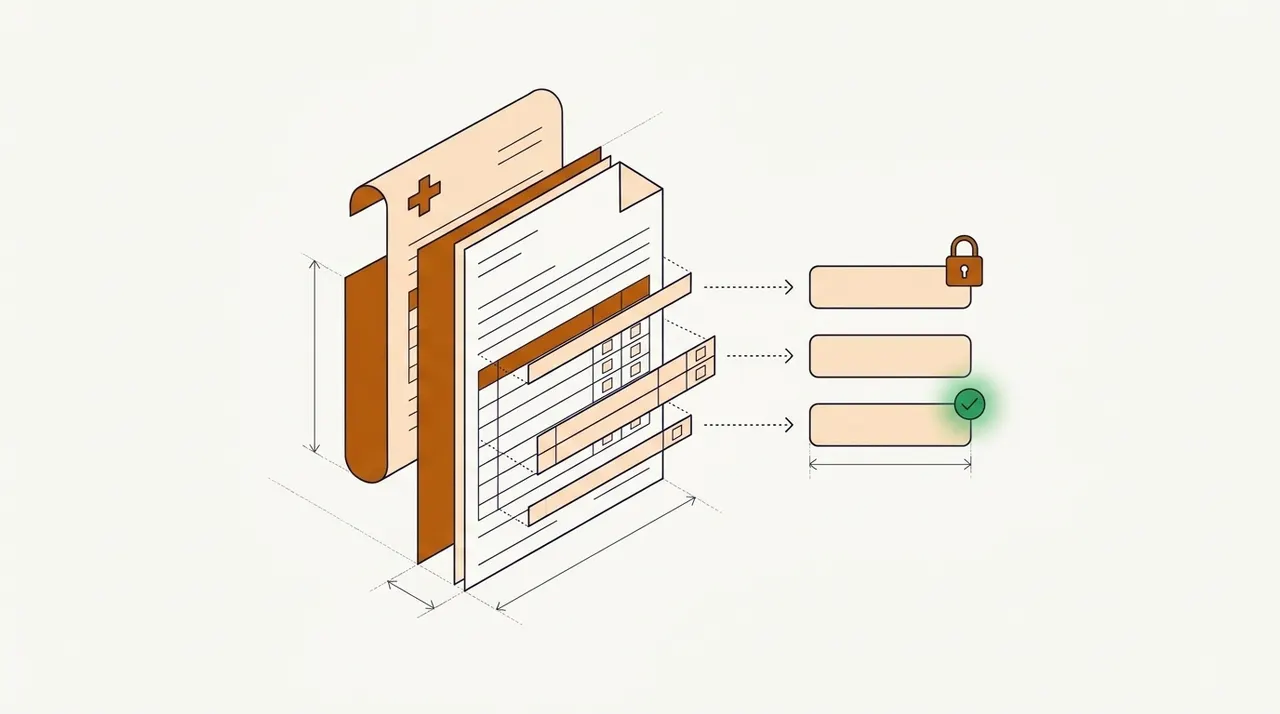
OCR turns a scan into text. Extraction software goes further. It works out which document is which, pulls named fields and table rows out of each one, scores its confidence in every value, and checks the values against the rest of the file before anything reaches your system.
- Claim forms
- EOBs
- Referral faxes
- Medical records
- 01Classify and split
- 02Extract fields and lines
- 03Check against the file
- 04Route exceptions
Which documents matter depends on the team. Billing companies live on claim forms and EOBs, provider front offices on referrals and intake packets, and case reviewers on record sets that run to hundreds of pages.
Claim forms, EOBs and remittances#
| Document | Fields billing teams need | Where extraction goes wrong |
|---|---|---|
| CMS-1500 | Member ID, patient, diagnosis codes, service lines with CPT or HCPCS codes, modifiers, units and charges, rendering NPI, total charge | Service lines drift out of their columns on a skewed scan |
| UB-04 | Type of bill, statement period, revenue codes, HCPCS codes, units, charges, principal diagnosis | Long line lists that run across pages |
| EOB or remittance advice | Payer claim number, billed, allowed and paid amounts, patient responsibility, adjustment reason and remark codes | Every payer's layout differs, and one page can hold several patients' claims |
| Member card | Payer, member ID, group number, plan | Small print, and phone photos of the card |
EOBs are the hardest of these to automate. No two payers lay them out the same way, one page can carry several claims, and each adjustment code has to land on the right service line before a payment can be posted. Test any tool on EOBs from your five largest payers, not on the vendor's samples.
The claim forms are more regular, and our guide to health insurance claim form extraction goes through the CMS-1500 and UB-04 box by box.
Referrals, intake packets and faxes#
Referrals, orders and intake packets still reach many practices by fax, often as one long file with several documents inside. The work is splitting that file, finding the patient, the ordering provider and the requested service, and getting them into the EHR before anyone calls the patient back.
Tennr is built around that flow and files the data into the EHR itself. Extraction platforms such as Docsumo read the same pages and hand the fields to your EHR or practice management system through an API. Either way, handwriting is the part to test. An intake form filled in by hand and faxed twice is where tools differ most.
Medical record review: summaries or fields#
Medical-legal teams, IME firms and claims reviewers read compiled record sets that can run to thousands of pages, full of duplicates and handwritten notes. They usually want a summary or a chronology, and Wisedocs and ChartSwap Insights produce those.
Billing, eligibility and records teams need the opposite, with dates of service, providers, diagnoses and codes as fields in their system. That's what extraction platforms return. Our guide to medical records OCR covers the scanning side of record sets.
The 13 best healthcare data extraction tools#
Docsumo is our product, so we've put it first and said plainly what it doesn't do. The others are grouped by what they're built for.
Document AI platforms
1. Docsumo
Document AI platformOur product- Reads
- CMS-1500 and UB-04 claim forms, EOBs and remittance advice, medical records such as visit notes and discharge summaries, referral and prior authorization forms, intake forms, member cards
- Output
- JSON through the API and webhooks into your EHR, practice management or billing system, with a confidence score on every field; cloud only
- HIPAA and BAA
- HIPAA compliant; signs a BAA with customers who process protected health information; SOC 2 Type 2 and ISO/IEC 27001:2022 (security)
- Pricing
- A free 14-day trial for up to 1,000 pages (ask for the BAA before sending PHI); Business and Enterprise plans are quoted; cross-document checks are on Enterprise
- 99%field-level accuracy across 250+ document types
- 95%+of documents processed straight through, without manual review
2. Hyperscience
Document AI platform- Reads
- Claims forms, EOBs, clinical notes, discharge summaries, patient intake and enrollment forms, member records
- HIPAA and BAA
- Describes safeguards "to help protect personal health information"; SOC 2 Type II audited; BAA not stated
- Pricing
- Not published; volume-based
- Watch for
- Machine confidence is an internal number you can't configure, so you set accuracy targets per field instead
3. ABBYY Vantage
Document AI platform- Reads
- Claims forms, EOBs, patient records, referrals and surveys; a pre-trained skill for US health insurance cards
- HIPAA and BAA
- Not stated on its current pages; its trust center lists a SOC 2 Type II report and ISO/IEC 27001:2022
- Pricing
- Not published; trial on request
- Watch for
- Confirm HIPAA terms and a BAA directly, since ABBYY's current pages don't state them
4. Tungsten TotalAgility
Document AI platform- Reads
- UB-04 and CMS-1500 forms, health insurance cards, medical records
- HIPAA and BAA
- Says it puts "a strong emphasis on enabling compliance" with HIPAA; BAA not stated
- Pricing
- Not published
- Watch for
- Ask for the BAA terms directly, since its site describes HIPAA support rather than a signed agreement
Document APIs for engineering teams
5. Extend
Document API- Reads
- CMS-1500 claim forms, EOBs, prior authorization forms, referrals, patient charts; handwriting through vision-language models
- HIPAA and BAA
- BAA included on Enterprise, an add-on on Scale, not available on Pay As You Go
- Pricing
- 10,000 free credits, then $0.0125 a credit; Scale $500 a month; Enterprise quoted
- Watch for
- A pilot with PHI needs the Scale or Enterprise plan, because pay-as-you-go has no BAA
6. Sensible
Document API- Reads
- Pre-built CMS-1500 and UB-04; ADA dental and NCPDP pharmacy claims; EOBs from 40+ payers, prior authorizations and medical records
- HIPAA and BAA
- "HIPAA-ready", with BAAs on Enterprise plans; SOC 2 Type 2
- Pricing
- Growth $449 and Scale $1,349 a month, billed annually; Enterprise quoted; 14-day trial
- Watch for
- The BAA comes only with the Enterprise plan
7. Veryfi
Document API- Reads
- EOBs, insurance cards, superbills and medical bills, medication labels
- HIPAA and BAA
- Says it signs the BAA; SOC 2 Type II audited
- Pricing
- Free for up to 100 documents a month; Starter from a $500 monthly minimum; EOB rates on request
- Watch for
- Its EOB API page says there are no humans in the loop, so any review step is yours to build
8. Amazon Textract and Comprehend Medical
Cloud API- Reads
- Medical records, insurance claims, intake forms and prescriptions (Textract); clinical text such as doctors' notes (Comprehend Medical)
- HIPAA and BAA
- Both are HIPAA eligible under an executed BAA with AWS
- Pricing
- Textract from $0.0015 a page for text and $0.05 for forms (US West); Comprehend Medical per 100-character unit
- Watch for
- AWS's A2I human review service is closed to new customers, so review screens are yours to build
9. Google Document AI
Cloud API- Reads
- Any document through OCR, the form parser or a custom extractor trained on your samples
- HIPAA and BAA
- Covered by Google's BAA, though Google says not to use pre-GA (preview) features with PHI
- Pricing
- OCR $1.50 per 1,000 pages after 1,000 free; form parser and custom extractor $30 per 1,000
- Watch for
- Its human-in-the-loop review was deprecated in January 2024, and the Healthcare Natural Language API shut down on May 27, 2026
10. Azure Document Intelligence and Text Analytics for health
Cloud API- Reads
- US health insurance cards (prebuilt), other forms and tables through custom models, clinical text
- HIPAA and BAA
- Microsoft's BAA comes through its Product Terms by default for covered entities and business associates
- Pricing
- Pay as you go, on Azure's pricing page
- Watch for
- No review screen is included, and Microsoft advises adding human review yourself
Intake and referral automation
11. Tennr
Intake automation- Reads
- Patient intake forms, referral forms, insurance forms, faxes and charts
- HIPAA and BAA
- Says it applies HIPAA privacy and security standards to all health data it collects; BAA not stated
- Pricing
- Not published
- Watch for
- EOBs and remittances aren't named on its site
Medical record review
12. Wisedocs
Record review- Reads
- Claim medical records, handwritten notes, co-mingled and duplicate records
- HIPAA and BAA
- SOC 2 Type II attested and aligned with HIPAA; BAA not stated
- Pricing
- Not published; the first 500 pages free
- Watch for
- Part of the review is a service from Wisedocs's in-house specialists, on top of the software
13. ChartSwap Insights (formerly DigitalOwl)
Record review- Reads
- Medical records for underwriting, claims and legal review
- HIPAA and BAA
- States compliance with HIPAA and SOC 2; BAA not stated
- Pricing
- Not published
- Watch for
- It's built for insurers and law firms, so provider billing documents aren't its focus
Healthcare data extraction software compared#
HIPAA and BAA terms as each vendor states them on its own site, checked September 28, 2026. "Not stated" means we couldn't find it on the vendor's pages, not that the vendor refuses one.
| Tool | Documents | HIPAA and BAA | Review | Pricing |
|---|---|---|---|---|
| Document AI platforms4 tools | ||||
| DocsumoOur productBilling, records and eligibility companies | HIPAA compliant; signs a BAA | Your reviewers; thresholds per field | Free trial; quoted plans | |
| HyperscienceLarge providers and payers | HIPAA safeguards; BAA not stated | Supervision tasks | Not published | |
| ABBYY VantageProvider revenue cycle teams | Not stated | Human-in-the-loop skills | Not published | |
| Tungsten TotalAgilityClaims operations, on-premises | HIPAA support; BAA not stated | Case management tasks | Not published | |
| Document APIs3 tools | ||||
| ExtendHealth-tech engineering teams | BAA on Scale (add-on) and Enterprise | Flags for review | Free credits; Scale $500/mo | |
| SensibleBilling and health-tech engineers | BAA on Enterprise | Review queue | From $449/mo | |
| VeryfiCard and EOB capture in apps | Signs a BAA | Not described | Free tier; from $500/mo | |
| Cloud APIs3 tools | ||||
| Amazon Textract and Comprehend MedicalEngineering teams on AWS | HIPAA eligible under an AWS BAA | Build your own | Per page | |
| Google Document AIEngineering teams on Google Cloud | Google BAA; no preview features with PHI | Build your own | Per 1,000 pages | |
| Azure Document IntelligenceEngineering teams on Azure | Microsoft BAA via Product Terms | Build your own | Pay as you go | |
| Intake automation1 tool | ||||
| TennrReferral-driven providers | HIPAA standards; BAA not stated | Staff make the final call | Not published | |
| Record review2 tools | ||||
| WisedocsClaims, legal and IME review | Aligned with HIPAA; BAA not stated | Vendor's medical specialists | Not published | |
| ChartSwap InsightsInsurers and law firms | HIPAA compliance stated; BAA not stated | Not stated | Not published | |
How to measure accuracy on healthcare documents#
Accuracy figures on these vendors' sites run from 90% to above 99%, Docsumo's own 99% field-level accuracy included. Each was measured on that vendor's own documents, so none of them tells you how your payers' EOBs or your clinics' referral faxes will come out.
Three numbers from your own pilot say more. The first is field-level accuracy, per document type and per payer. The second is the share of documents no one touched, and the third is the minutes a person spends on each one that was touched. The calculator below turns the last two into hours a month.
Your straight-through processing rate
Straight-through processing (STP) is the share of documents no person touches. Count a document as touched if anyone opened it to fix, check or key a value.
- Straight-through rate
- Hours of hands-on work per month
- Hours per year
How it's worked out
- STP rate = (documents processed − documents touched) ÷ documents processed.
- Hours are touched documents times minutes each. Raising the rate by cutting touches is where the hours come back.
Our take. Judge a tool by what your billers had to fix, not by the number on its website. Run a few hundred of your own claims and EOBs through each shortlisted tool, from your largest payers and your worst fax lines, and count the corrections field by field. A tool that shows exactly which fields to check can cost less than one with a higher headline figure that doesn't.
What to ask about HIPAA before a pilot#
- A signed BAA before any PHIThat includes trial data. Several vendors here offer a BAA only on higher plans, and some don't state one at all.
- Which features the BAA coversGoogle, for one, says not to use preview features with PHI, so check each feature you plan to use.
- Who sees the documentsSome tools add the vendor's own reviewers, while with others only your staff do.
- Where data is stored, and for how longAsk about the region, the retention period and whether your documents train shared models.
- Which subprocessors touch PHIMany tools call third-party OCR or LLM services. Ask for the list.
- The audit logEvery view, correction and export should be recorded per user.
Docsumo signs a BAA with customers who process protected health information, and your documents aren't used to train shared or third-party models. The details are on our security page, and our guide to HIPAA compliance covers what the rule asks of your vendors.
Which tool to trial first#
Pick by who processes the documents. Billing, records and eligibility companies handling many payers' claims and EOBs should trial a configurable platform, such as Docsumo, Hyperscience or ABBYY Vantage, or Tungsten TotalAgility if it has to run on-premises. Provider front offices buried in referral faxes should look at Tennr, and case reviewers who want summaries at Wisedocs or ChartSwap Insights. Engineering teams building their own pipeline can start with Extend, Sensible or their cloud's API.
If your team reads claim forms, EOBs and records for many clients and wants only the uncertain fields in front of your reviewers, with a BAA in place, that's where Docsumo fits. Insurance claims teams have their own shortlist in our guide to claims data extraction tools.
Book a demo and bring a few of your own claims and EOBs, or start a free trial once your BAA is in place.
Frequently asked questions#
What does healthcare data extraction software do that OCR alone doesn't?
OCR turns a scan into text. Extraction software also knows which number is the member ID and which is the claim number, splits a fax packet into its documents, returns named fields and table rows with confidence scores, and checks them against the rest of the file. Our guide to medical records OCR covers the OCR step itself.
Which healthcare documents can these tools read?
Most read CMS-1500 and UB-04 claim forms, EOBs and member cards. Coverage of referrals, prior authorizations and long medical records varies more, so check each vendor's own list and test your handwritten and faxed pages. Our claim form guide covers the CMS-1500 and UB-04 box by box.
How accurate is data extraction on claims and EOBs?
It depends on your payers, your scans and how you count. Vendors in this list publish figures from 90% to above 99%, each measured on their own documents. Test a few hundred of your own claims and EOBs, and count the fields a person had to fix and the share of documents no one touched.
Is healthcare data extraction software HIPAA compliant, and will the vendor sign a BAA?
Some vendors sign a BAA and some don't say. Docsumo, Veryfi, AWS, Google and Microsoft state that they sign one, Extend and Sensible offer it on higher plans, and the other vendors here don't state it on their sites. Get the BAA signed before you send protected health information, including during a trial.
Can it read handwritten intake forms and faxed packets?
Most platforms here read handwriting and faxes, but results vary by form and by fax line, so put your worst pages in any test. Docsumo reads handwritten text, splits fax packets into their documents and sends low-confidence fields to your reviewers.
Can AI summarize a medical record for case review, or do we need extracted fields?
It depends on who reads the output. Case reviewers and attorneys usually want a summary or a chronology, which Wisedocs and ChartSwap Insights produce. Billing, eligibility and records teams need fields in a system, such as dates of service, providers and codes, which is what extraction platforms return.
Sources
- Hyperscience: healthcare
- Hyperscience: security
- Hyperscience: Hypercell platform
- ABBYY: healthcare
- ABBYY: Vantage
- ABBYY: trust center
- Tungsten Automation: healthcare claims processing
- Tungsten Automation: TotalAgility Document Library
- Tungsten Automation: about (formerly Kofax)
- Extend: healthcare
- Extend: pricing
- Sensible: healthcare
- Sensible: claims forms
- Sensible: pricing
- Sensible: security overview
- Veryfi: healthcare
- Veryfi: health insurance EOB API
- Veryfi: pricing
- AWS: Amazon Textract FAQs (HIPAA eligibility)
- AWS: Amazon Textract pricing
- AWS: Amazon Comprehend Medical
- AWS: Amazon Comprehend Medical pricing
- AWS: Amazon A2I human review loops (no longer open to new customers)
- Google Cloud: Document AI
- Google Cloud: Document AI pricing
- Google Cloud: Document AI Human-in-the-Loop deprecation
- Google Cloud: HIPAA compliance (BAA and pre-GA offerings)
- Google Cloud: Healthcare Natural Language API shutdown
- Microsoft: Azure Document Intelligence
- Microsoft: health insurance card model
- Microsoft: Text Analytics for health
- Microsoft: HIPAA and the BAA
- Tennr: home page
- Tennr: privacy policy (HIPAA)
- Wisedocs: home page
- Wisedocs: enterprise
- DigitalOwl: becoming ChartSwap Insights (March 11, 2026)
- Datavant: completes acquisition of DigitalOwl (October 8, 2025)
First published .