Financial document verification software: 14 tools that check a borrower's documents against each other
For underwriting, loan operations and QC leads. Follow one pay stub through the checks, then compare 14 tools by what they check, what they work from and who clears the exceptions.

Key takeaways
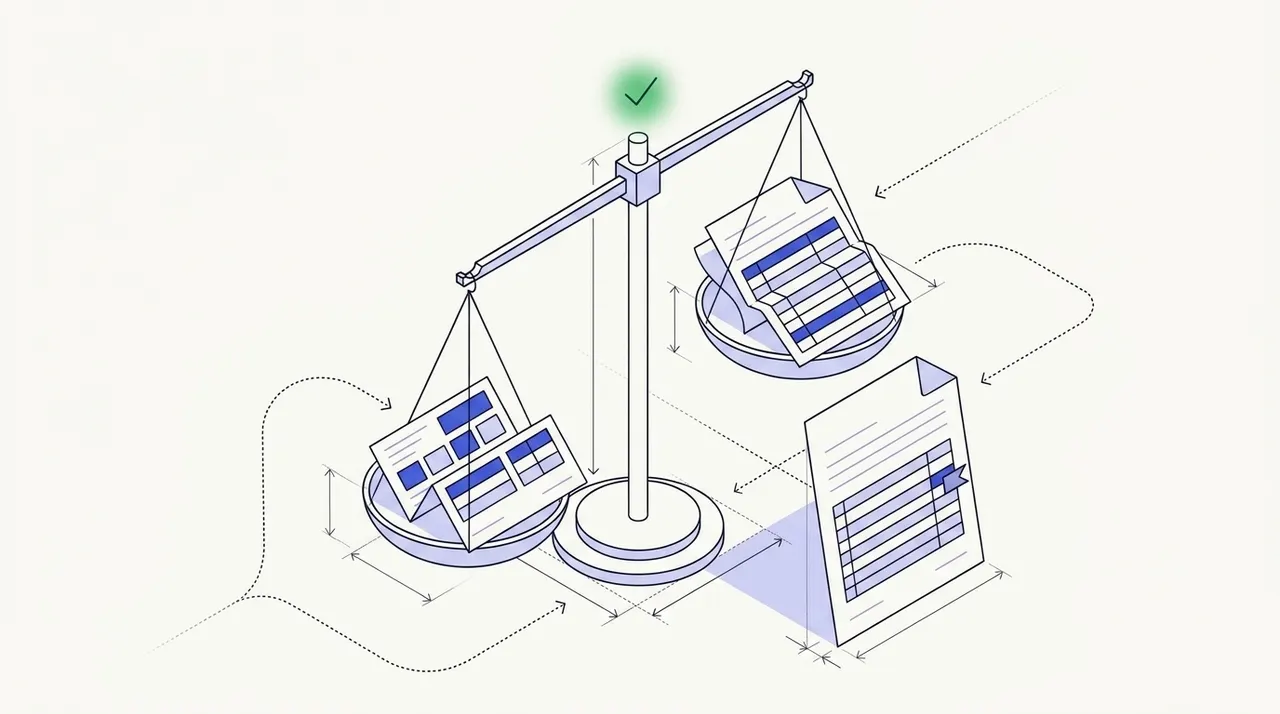
- Financial document verification software reads a borrower's pay stubs, W-2s, tax returns and bank statements. It checks that each one adds up, and that all of them agree with each other and with the application.
- A useful check names the figures that disagree. In the example below, the pay on a pay stub comes to $5,590 a month, but the application states $6,200. So the file goes to a reviewer with one question about why the two figures differ.
- The tools fall into four groups. Loan file verification platforms compare the documents in a loan file. Enterprise platforms run the checks your team or an integrator sets up. Cloud APIs return the data and leave the checks to you. Source-data services skip the documents and get the data from a payroll provider or a bank.
- Ask who clears the exceptions. Some vendors send edge cases to their own staff. Docsumo sends them to your own reviewers.
- Test each tool on closed loan files where you already know the right figures and the problems. Then count the fields a person had to correct and the checks the tool got wrong.
On this page
- One borrower, four documents
- What financial document verification software checks
- Which kind of tool fits what you verify
- The 14 best financial document verification tools
- Financial document verification tools compared
- How to test financial document verification software
- How to buy financial document verification software
- Checks for invoices and IDs
- If your underwriters still compare stubs and statements by hand
- Frequently asked questions
Financial document verification software reads a loan file and checks that the figures in it add up and agree. It compares pay stubs, W-2s, tax returns and bank statements with each other and with the application. Only the documents that fail a check go to a person.
The tools fall into four groups. Loan file verification platforms, such as Docsumo, Ocrolus and Informed.IQ, compare the documents in a loan file. Enterprise platforms, such as UiPath and Hyperscience, run the checks your team or an integrator sets up. Cloud APIs from Amazon, Microsoft and Google return the data, and your team builds the checks. Services such as Plaid and The Work Number skip the documents and get the data from a bank or a payroll provider.
Vendor details below come from each vendor's own website, checked on October 21, 2026. Links are in the sources at the end. Checking IDs at account opening is a different job. Our list of KYC document verification software covers it.
One borrower, four documents
| Field | Extracted value | Confidence |
|---|---|---|
| Employer | Northfield Freight LLC | |
| Employer EIN | ••-•••3082 | |
| Employee | Aisha K. Warren | |
| Employee ID | 20417 | |
| Period start | 2026-08-17 | |
| Period end | 2026-08-30 | |
| Pay date | 2026-09-04 | |
| Pay frequency | Biweekly |
| Field | Extracted value | Confidence |
|---|---|---|
| Regular hours | 80.00 | |
| Regular rate | 30.00 | |
| Regular pay | 2,400.00 | |
| Overtime hours | 4.00 | |
| Overtime rate | 45.00 | |
| Overtime pay | 180.00 | |
| Gross pay | 2,580.00 |
| Field | Extracted value | Confidence |
|---|---|---|
| Federal income tax | 227.98 | |
| Social Security | 159.96 | |
| Medicare | 37.41 | |
| State income tax | 122.14 | |
| Roth 401(k) | 129.00 | |
| Total deductions | 676.49 | |
| Net pay | 1,903.51 |
| Field | Extracted value | Confidence |
|---|---|---|
| YTD regular hours | 1,440.00 | |
| YTD gross pay | 44,910.00 | |
| YTD federal income tax | 3,927.46 | |
| YTD Social Security | 2,784.42 | |
| YTD Medicare | 651.20 | |
| YTD total deductions | 11,731.39 | |
| YTD net pay | 33,178.61 |
Here's what verification looks like on one file. Aisha K. Warren states an income of $6,200 a month on her application. Her file also holds a pay stub from Northfield Freight LLC, her 2025 W-2 and a bank statement.
First, the software checks the pay stub by itself, without the other documents. The stub covers two weeks, with gross pay of $2,580.00. Take away $676.49 in deductions and you get the net pay of $1,903.51. The year-to-date gross of $44,910.00 is the last stub's total plus this period's pay.
Next, it compares the stub with the rest of the file. The W-2 shows 2025 wages of $61,425.00. If she keeps earning at this year's rate, her pay for the full year will be $64,870.00. The two figures are close, so they agree. The bank statement shows a payroll deposit of $1,903.51 on September 4, the stub's pay date. That matches the net pay to the cent.
The only check that fails is the one against the application. Pay of $2,580.00 every two weeks comes to $5,590.00 a month, 10% below the $6,200.00 she stated. You set a rule for how big a gap can be, and this gap is bigger than the rule allows. The software can't tell why the figures differ. She may have a second job, or a bonus this stub doesn't show. So the software sends the file to a reviewer, with both figures and one question about why they differ. The underwriter answers that question. The gap alone isn't a reason to decline the loan.
Every tool in this list does part of that work. Some return the figures and stop. Some run the checks. A few also send the reviewer the failed check with its evidence.
What financial document verification software checks
The checks fall into five kinds. Ask each vendor which of them it runs, and which ones your team would have to build.
- Each document adds upGross pay minus deductions equals net pay, and year-to-date totals roll forward. On a bank statement, each running balance follows from the line before.
- The documents agreeW-2 wages are close to a full year of pay at the pay stubs' rate. Net pay shows up as a deposit on the bank statement. Wages on line 1a of Form 1040 match box 1 of the W-2s.
- The file matches the applicationThe name, employer, address and stated income are the same wherever they appear.
- Nothing is missingEvery page and month is there. Each borrower with income has documents that show it.
- The documents are recentEach document is dated within the time limit set by your credit policy, or by the investor that buys the loan.
For bank statements on their own, bank statement verification software goes deeper, from missing pages to large deposits.
Which kind of tool fits what you verify
What do you need to verify?
The 14 best financial document verification tools
Docsumo is our product, so we've put it first and said plainly what it doesn't do. The others are grouped by the job they do. For AI agents that review a whole mortgage file against investor guidelines, see AI loan file review software.
Loan file verification platforms
1. Docsumo
Loan file verificationOur product- Reads
- 250+ document types, including pay stubs, W-2s, tax returns, bank statements, IDs and the application, in printed or handwritten text
- Checks
- Running balances on every bank statement. On the Enterprise plan, any check across documents, such as net pay against the payroll deposit. Calculations, such as monthly income from pay every two weeks, run as workflow steps you set up
- Exceptions
- Your own reviewers clear them, and clicking a field highlights its source line in the document. On the case review screen, a "Show only failed" switch hides everything that passed (Enterprise plan)
- Output
- API and webhooks, or Excel. It works with Encompass, MeridianLink, nCino and any other system with an API, through the API and webhooks
- Pricing
- A free 14-day trial for up to 1,000 pages, with your own checks; Business and Enterprise plans are quoted
- 99%field-level accuracy across 250+ document types
- 95%+of documents AI Approved, extracted and checked with no manual review
- <1 minper complex statement at Grid Finance
2. Ocrolus
Loan file verification- Reads
- Bank statements, pay stubs and tax forms; it sorts 2,000+ mortgage document types
- Checks
- Documents against the 1003 loan application in Encompass, for mismatches and missing documents. It also calculates income and checks documents for tampering
- Exceptions
- Ocrolus's own data professionals resolve extraction edge cases, and your staff review the mismatches it flags
- Output
- API and dashboard, with a direct Encompass integration
- Pricing
- Not published
3. Informed.IQ
Loan file verification- Reads
- Pay stubs, bank statements, W-2s, tax returns, SSI award letters, and identity, residence and insurance documents, out of 200+ document types
- Checks
- Calculated income against stated income; employer name and income mismatches; stipulations against the values the lender expects
- Exceptions
- Informed's staff or the lender's own team, depending on the setup
- Output
- By API to the lender's loan, point-of-sale or dealer system, or in a portal the lender can embed
- Pricing
- Not published
4. Blend Autopilot
Loan file verification- Reads
- W-2s, pay stubs, 1099s, bank statements and tax returns uploaded in Blend
- Checks
- Extracted income against stated income, missing or inconsistent information, and Fannie Mae, Freddie Mac and lender rules
- Exceptions
- Your loan officers and underwriters, with settings for what runs on its own and what waits for review
- Output
- Inside the Blend platform for Blend customers; a software kit for lenders' own systems is in private beta
- Pricing
- Not published; commercially available since July 2026, after a free preview
Enterprise platforms with checks you set up
5. UiPath Solution for Loan Origination
Enterprise platform- Reads
- Bank statements, payslips, W-2s, 1040s, IDs and passports; Schedules C, D and E, the 1003 and the closing disclosure are in preview
- Checks
- Rules on one document or across two; documents against loan system and core data; missing required documents
- Exceptions
- Your own reviewers confirm or dismiss each finding
- Output
- Integrations with Encompass, nCino, MeridianLink, FIS and OnBase
- Pricing
- Not published for the solution; UiPath's Standard and Enterprise plans are quoted. See Docsumo vs UiPath.
6. Instabase AI Hub
Enterprise platform- Reads
- Loan applications, identity documents, financial statements and invoices; its docs list prebuilt classes such as pay stubs and bank statements
- Checks
- Matching fields across documents, business rules and custom code, on its Enterprise tier
- Exceptions
- Your own staff, in review queues
- Output
- API and SDK, with storage and database connectors
- Pricing
- Not published; its docs say new self-serve sign-ups have ended. See Docsumo vs Instabase.
7. Hyperscience
Enterprise platform- Reads
- Pay stubs, loan applications, invoices, and mortgage and KYC documents, including handwriting
- Checks
- Checks across documents that you build in a custom code block; access depends on your license
- Exceptions
- Your own staff, in Hyperscience's review tasks
- Output
- API-first, with integrations for FIS, Bloomberg Terminal and Salesforce
- Pricing
- Not published. See Docsumo vs Hyperscience.
8. ABBYY Vantage
Enterprise platform- Reads
- US bank statements, pay stubs, tax forms and mortgage forms, with some skills in preview
- Checks
- Rules inside each document, such as sums and comparisons; its pages don't describe checks across documents
- Exceptions
- Your own operators, in Manual Review
- Output
- REST API and connectors for Power Automate, UiPath, Blue Prism and Automation Anywhere
- Pricing
- Not published; trial on request. See Docsumo vs ABBYY FlexiCapture.
Cloud extraction APIs
9. Amazon Textract
Cloud API- Reads
- The 1003 loan application, 1005 and 1008 forms, pay stubs, bank statements, W-2s, 1040s, 1099s and IDs
- Checks
- None across documents; your team builds them
- Exceptions
- Not included, and AWS's human review service is closed to new customers
- Output
- Fields through an API, from files stored in Amazon S3
- Pricing
- Analyze Lending $0.07 a page for the first million pages (US West); 2,000 free pages a month for three months. See Docsumo vs Amazon Textract.
10. Azure Document Intelligence
Cloud API- Reads
- US bank statements, pay stubs, mortgage forms such as the 1003, 1004, 1005 and 1008, closing disclosures, W-2s, 1040s and 1099s
- Checks
- None across documents; your team builds them
- Exceptions
- Confidence scores only, which Microsoft suggests using to route fields to human review
- Output
- Fields through an API and developer kits
- Pricing
- The Read model costs $1.50 per 1,000 pages. Prebuilt models such as the W-2 cost $10 per 1,000 pages, with 500 free pages a month. See Docsumo vs Azure Document Intelligence.
11. Google Document AI
Cloud API- Reads
- Bank statements, pay slips, W-2s and US driver's licenses
- Checks
- None across documents; your team builds them
- Exceptions
- Not included
- Output
- Fields through an API, with links to BigQuery
- Pricing
- Bank statement parser $0.75 and pay slip or W-2 parser $0.30 per classified document; $300 in free credit for new customers. See Docsumo vs Google Document AI.
Data from the source
12. Plaid
Source data- Reads
- Mostly no documents; Document Income reads uploaded pay stubs as a fallback
- Checks
- Identity Match compares the bank's account-holder details with what the applicant entered; income streams from bank data
- Exceptions
- Your team reviews flagged matches and mid-range risk scores
- Output
- API; Asset Reports can be shared with Fannie Mae, Freddie Mac and other loan buyers
- Pricing
- Not published; free sandbox testing
13. The Work Number
Source data- Reads
- No documents; 839 million+ employee records from 5 million+ employers
- Checks
- The applicant's income and employment against employer records, and their name and Social Security number against employer data
- Exceptions
- Not described
- Output
- REST API, batch file transfer and a web portal, with integrations for Encompass and other loan systems
- Pricing
- Pay-as-you-go reports from $73.45; enterprise prices by contract
14. Truv
Source data- Reads
- Payroll and bank data first; uploaded pay stubs, W-2s, 1099s and 1040s as the fallback
- Checks
- Name and Social Security number across the documents and against the application; tampering checks on uploads
- Exceptions
- No person reviews uploaded documents, according to Truv
- Output
- API, with integrations for Encompass and other loan systems
- Pricing
- Not published
Financial document verification tools compared
| Tool | Works from | Checks across documents | Exceptions | Pricing |
|---|---|---|---|---|
| Loan file verification4 tools | ||||
| DocsumoOur product | Yes, by rules you set (Enterprise plan) | Your team | Free trial; quoted plans | |
| Ocrolus | Documents against the 1003 in Encompass | Ocrolus staff and your team | Not published | |
| Informed.IQ | Income against stated income | Informed staff or your team | Not published | |
| Blend Autopilot | Documents against the application | Your team | Not published | |
| Enterprise platforms4 tools | ||||
| UiPath loan origination | Rules across two documents and loan system data | Your team | Quoted | |
| Instabase AI Hub | Matching fields and custom rules | Your team | Not published | |
| Hyperscience | Custom code you build | Your team | Not published | |
| ABBYY Vantage | Rules within each document | Your team | Not published | |
| Cloud APIs3 tools | ||||
| Amazon Textract | None; you build them | Not included | $0.07 a page (lending) | |
| Azure Document Intelligence | None; you build them | Not included | $10 per 1,000 pages (prebuilt) | |
| Google Document AI | None; you build them | Not included | $0.75 per statement | |
| Data from the source3 tools | ||||
| Plaid | Identity match | Your team | Not published | |
| The Work Number | Employer records | Not described | From $73.45 a report | |
| Truv | Identity fields | Your team (Truv's checks are automated) | Not published | |
How to test financial document verification software
- Pick files you've already decided onTake 20 to 50 closed loan files, including the hard ones. You know which files had problems, so you can compare each tool's results with what you found.
- Write down your checks firstList the comparisons your underwriters make today. Ask each vendor which ones it runs, and which ones you'd have to build.
- Count what a person had to fixCount wrong fields, missed mismatches and false alarms, file by file. That count is the number to compare.
- Open the exceptionsEach one should name the figures that disagree and show the page they came from. A score with no evidence sends the reviewer back through the whole file.
- Ask who clears themIt could be your staff, the vendor's staff or a mix. That changes the price, the speed and who sees your borrowers' data.
Our take. We'd judge these tools by what your reviewers still had to fix, not by an accuracy figure on a vendor's website. Run your own closed files through each one. Then count the wrong fields, the missed mismatches and the false alarms. That count is the review work you'd still be paying for.
How to buy financial document verification software
Most platforms in this list don't publish prices. You book a demo, and the vendor quotes a price for your volume. The cloud APIs are the exception. Amazon's Analyze Lending costs $0.07 a page, and Google's bank statement parser costs $0.75 a statement. Those prices cover reading the documents, and your team still builds the checks and the review screen. The Work Number also sells pay-as-you-go reports, from $73.45.
Docsumo has a free trial for 14 days and up to 1,000 pages, with the API and webhooks. You can run your own checks on your own documents during the trial. Business and Enterprise plans are quoted, and checks across documents are on the Enterprise plan. To compare quotes fairly, add your team's review time to each one.
Checks for invoices and IDs
"Financial documents" covers more than a loan file, and two neighbors have checks of their own. Before an invoice is recorded in your books, it's checked against the purchase order (PO) and the goods receipt. Docsumo flags duplicate invoices, and on the Enterprise plan it also matches invoice lines to the PO and goods receipt. Invoice validation walks through those checks in order.
IDs are checked at account opening, often with a selfie and a liveness check. That's a job for an identity verification platform, and our KYC document verification software list compares them. Docsumo reads the IDs in a file, with pre-trained models for passports and driver's licenses, but it doesn't run liveness checks.
If your underwriters still compare stubs and statements by hand
Start with the comparison they make most often, such as net pay against the payroll deposit. Ask each vendor to run that check on your own closed files and to show you the exception it raises. Then pick by the job. For loan files your own team reviews, choose a loan file verification platform such as Docsumo. To get income data without documents where the employer or bank can be reached, add a source-data service. To build the checks yourself, start from a cloud API.
Book a demo and bring a few masked loan files, or start a free trial and run your own checks.
Frequently asked questions
What is financial document verification?
It's checking that the financial documents in a file can be relied on together. Each document has to add up. Pay stubs, W-2s, tax returns and bank statements also have to agree with each other and with the application. Lenders do it before a file goes to underwriting.
Which software validates financial documents automatically?
Loan file verification platforms such as Docsumo, Ocrolus and Informed.IQ read the documents and compare them. Docsumo's checks across documents are on its Enterprise plan. Enterprise platforms such as UiPath and Hyperscience run the checks your team sets up. Cloud APIs from AWS, Microsoft and Google return the data, and your team builds the checks. For invoices, see invoice validation.
Can AI verify scanned financial documents?
Yes, once it has read the scan. Document AI reads printed and handwritten text from scans and phone photos, then runs the same checks as on a digital PDF. Fields it's unsure about should go to a person, with the source line shown. Test it on your worst scans, not on clean samples.
What's the difference between document verification and payroll or bank data?
Document verification reads what the borrower uploads and checks it. Services such as The Work Number, Truv and Plaid get income or account data from the employer's payroll provider or the bank instead. You may need both, because not every borrower's employer or bank can be reached.
Where can you buy financial document verification software, and how is it priced?
Most vendors sell it after a demo, with a quoted price. The cloud APIs publish per-page or per-document prices. Docsumo has a free 14-day trial for up to 1,000 pages, and you can run your own checks on your own documents in it. Its Business and Enterprise plans are quoted. See pricing.
Does verification software make the credit decision?
No. It checks the documents and shows what failed, and the underwriter decides. Docsumo also doesn't produce Form 1084 or Form 91 income calculations. It extracts the tax return data that goes into them.
Sources
- Docsumo: income verification
- Docsumo: pay stub data extraction (the example pay stub and its checks)
- IRS: 2025 Instructions for Form 1040 (line 1a, total amount from Form(s) W-2, box 1)
- Ocrolus: home page
- Ocrolus: mortgage
- Ocrolus: platform
- Ocrolus: Inspect (documentation)
- Ocrolus: Detect (documentation)
- Informed.IQ: home page
- Informed.IQ: FAQ
- Informed.IQ: human in the loop
- Blend: Autopilot pre-underwriting
- Blend: Blend launches Autopilot (March 3, 2026)
- Blend: Autopilot commercially available (July 2026)
- UiPath: lending automation
- UiPath: launches agentic solutions for fraud prevention and bank loan origination (March 25, 2026)
- UiPath: loan origination quality control (documentation)
- UiPath: Document Understanding pre-trained ML packages
- UiPath: pricing
- Instabase: Instabase is now SuperApp, AI Hub continues to be fully supported (August 17, 2026)
- Instabase: AI Hub automate
- Instabase: validating packets (documentation)
- Instabase: subscriptions (documentation)
- Hyperscience: financial services
- Hyperscience: custom supervision (documentation)
- ABBYY: Vantage
- ABBYY: financial services
- ABBYY: manual review (documentation)
- ABBYY: Marketplace (trial requests)
- AWS: Analyze Lending (documentation)
- AWS: Amazon Textract pricing
- AWS: Amazon A2I with Textract (no longer open to new customers)
- Microsoft: Document Intelligence overview
- Microsoft: Document Intelligence accuracy and confidence
- Microsoft: Document Intelligence pricing
- Google Cloud: Document AI processors list
- Google Cloud: Document AI deprecations
- Google Cloud: Document AI pricing
- Plaid: Income (documentation)
- Plaid: Identity
- Plaid: Assets
- Plaid: pricing
- Equifax: The Work Number
- Equifax: The Work Number pricing
- Blend: Autopilot document review examples (W-2, bank statement, tax return; extracted vs stated income)
- Blend: first customers sign on to Autopilot (press release)
- Blend: Autopilot site (documents read; SDK in private beta)
- Instabase: document schemas (prebuilt classes such as paystubs and bank statements)
- Instabase: data connections (documentation)
- Instabase: financial services
- Ocrolus: importing Plaid data (documentation)
- Hyperscience: Hypercell platform
- ABBYY: Personal Earnings Statement skill (documentation)
- ABBYY: rule verification (documentation)
- Plaid: Consumer Report by Plaid Check (documentation)
- Plaid: Document Income (documentation)
- Equifax: The Work Number for mortgage verification
- Truv: home page
- Truv: document fraud detection
- Truv: pricing
First published .