ACORD 131 form: the umbrella and excess application, section by section
For umbrella and excess underwriters, brokers and submission teams: what's on each page of the ACORD 131, how the underlying insurance schedule works, and how to process it without rekeying.

Key takeaways
- The ACORD 131 is the Umbrella / Excess Section: the form a broker attaches to the ACORD 125 to request umbrella or excess liability coverage. The current edition, 2017/11, runs to 6 pages.
- Its core is the schedule of underlying insurance: each primary auto, general liability and employers' liability policy the umbrella sits above, with carrier, policy number, dates and limits.
- An umbrella adds limits and covers some claims the primary policies don't, subject to a retained limit. An excess policy adds limits and usually follows the terms of the policy beneath it.
- The key check is that underlying limits and dates line up with the umbrella's minimums and with the primary policies in the same submission.
- Automation extracts every page, cross-checks the underlying schedule and sends only the mismatches to an underwriter.
On this page
The ACORD 131 is the Umbrella / Excess Section of a commercial insurance application: the form a broker attaches to the ACORD 125 to request umbrella or excess liability coverage. It records the limits and retained limit requested, the applicant's exposures, and a schedule of the primary auto, general liability and employers' liability policies the umbrella will sit above. That schedule matters most, because the umbrella attaches above those policies' limits.
What is an ACORD 131 form?#
ACORD 131 is the standard Umbrella / Excess Section published by ACORD, the insurance industry's nonprofit standards body; its forms index lists it simply as the Umbrella Section. A complete umbrella application is the ACORD 125 plus the 131, read together.
Page 1 asks what kind of coverage is wanted and on what terms:
Umbrella
Adds limits above the primary policies, drops down when an underlying aggregate is used up, and covers some claims they don't.Excess
Adds limits above the primary policies and usually follows their terms and conditions.Retained limit
The self-insured retention the insured pays on a claim the umbrella covers but no underlying policy does.First dollar defense
Whether the umbrella insurer pays defense costs inside the retained limit.
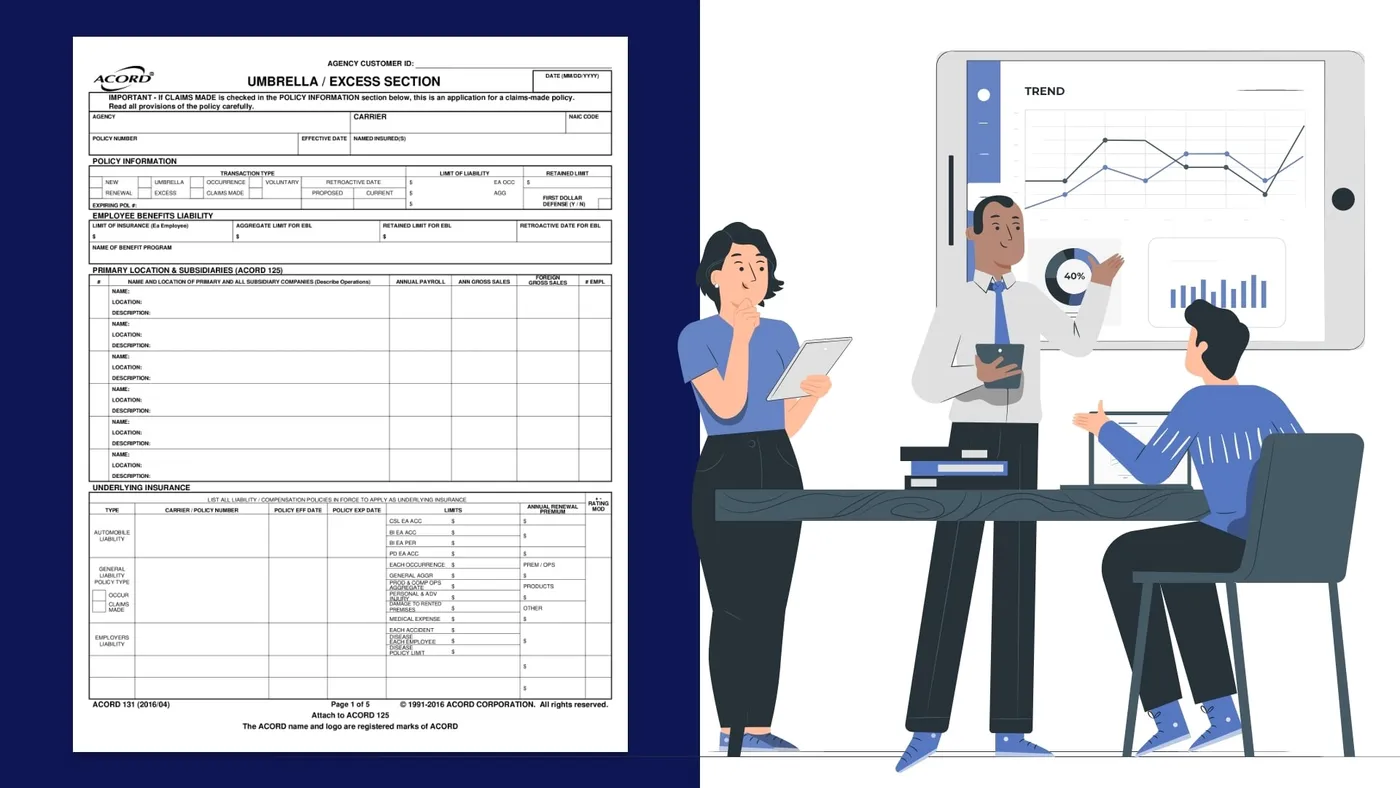
The header image shows page 1 of the 5-page 2016/04 edition. ACORD's forms index, revised September 2026, lists the 6-page 2017/11 edition as current, so extraction can't rely on fixed positions.
How an umbrella submission moves#
An umbrella request is only as complete as the primary policies beneath it, so the ACORD 131 is read and checked alongside the rest of the submission.
- ACORD 125 application
- ACORD 131 umbrella section
- ACORD 126 and 127
- Loss runs
- 01Classify and split the packet
- 02Extract every page
- 03Check the underlying schedule
- 04Refer mismatches
The sections of an ACORD 131, and what to extract#
On the 2017/11 edition, page 1 carries the coverage requested and the underlying insurance, and the pages after it carry the loss history, exposures, remarks and signatures:
| Section | Page | Fields to extract |
|---|---|---|
| Policy information | 1 | New or renewal, umbrella or excess, occurrence or claims-made, each occurrence and aggregate limits, retained limit, first dollar defense, retroactive dates; employee benefits limits |
| Locations and subsidiaries | 1 | Each entity's name, location and operations; annual payroll, gross sales, foreign gross sales, employees |
| Underlying insurance | 1–2 | Each primary policy's carrier, policy number, dates, limits, renewal premium and rating modifier; how defense costs apply; the coverages and exposures checked |
| Previous experience | 2 | Liability claims over $10,000 in the past five years, insured or not, or "no such claims" |
| Exposures and remarks | 2–4 | Care, custody and control; vehicles by type, radius and property hauled; 28 numbered questions by line, with explanations; free-text remarks |
| Signature | 6 | UM, UIM and medical payments limits where offered; producer and applicant signatures |
The underlying insurance schedule
Each row is one primary policy, and each line reports limits its own way: auto as a combined single limit or split limits, general liability as each occurrence and aggregates, employers' liability as each accident and disease limits.
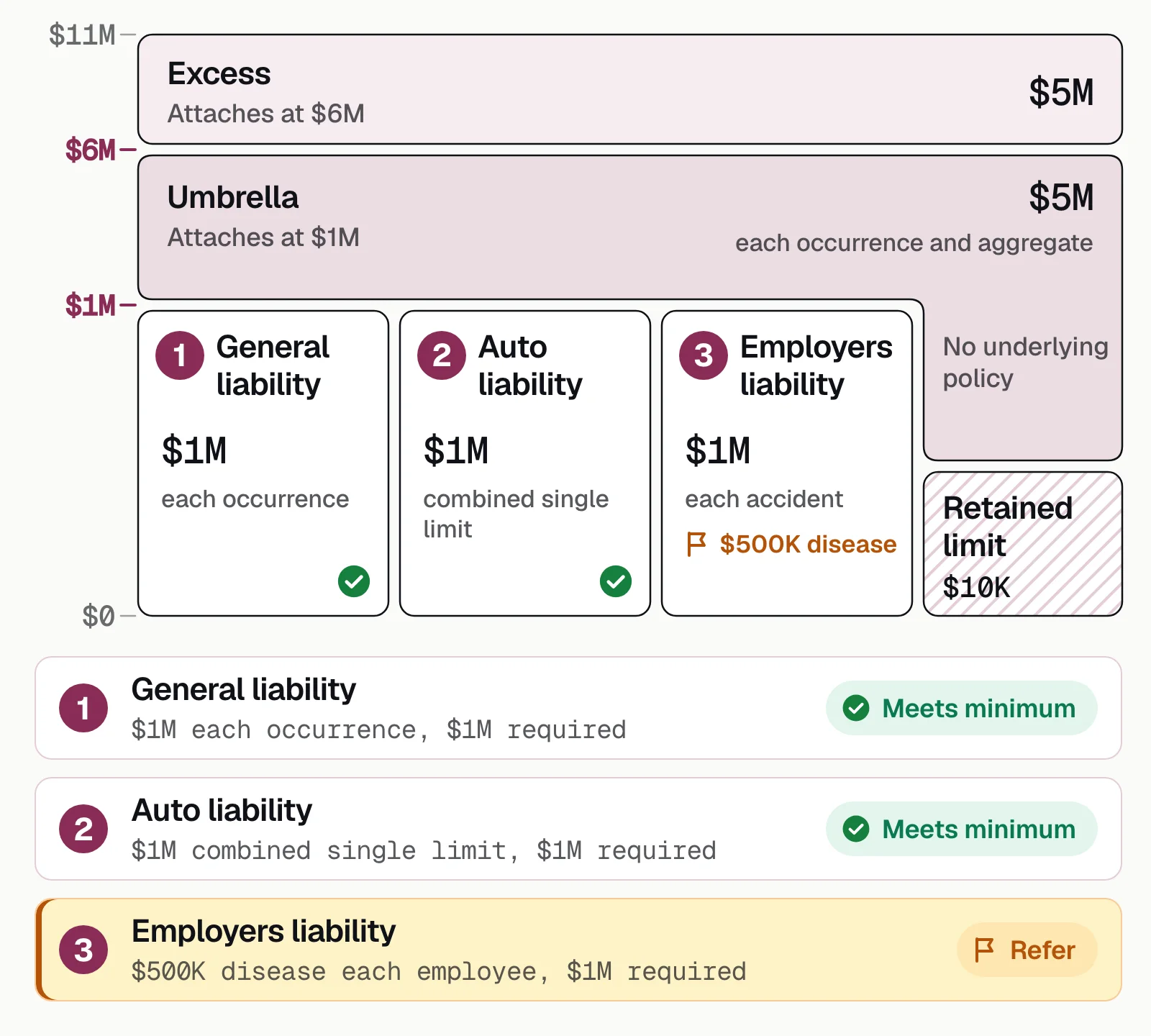
Umbrella policies usually require the insured to keep the scheduled policies in force at those limits, so a misread limit can mean a wrong quote or a gap in coverage.
The checks to run on every ACORD 131#
Each check compares the form with itself, the rest of the submission or your minimums, and says what to do when it fails.
- Match to ACORD 125Named insured, agency, effective date and locations agree. If not, confirm with the broker.
- Underlying limitsEach underlying limit meets the carrier's minimum for that line. If not, refer, or ask for higher primary limits.
- Underlying datesPrimary policies are in force for the whole umbrella term. If not, ask for renewal details or align terms.
- Underlying vs line sectionsLimits and carriers match the ACORD 126 and 127 when they're in the submission. If not, flag the mismatch.
- Coverage basisIf claims-made, the retroactive dates are complete. If not, request them.
- ExposuresPayroll, sales and vehicle counts agree with the other sections. If not, ask the broker to confirm.
- Previous experienceClaims over $10,000 are listed, or "no such claims" is checked, consistent with loss runs. If not, request loss runs.
- Yes answersEvery yes has an explanation. If not, request it.
Why ACORD 131 is hard to process by hand#
Tables and free text
Locations, underlying policies and vehicles are tables whose rows must stay intact; claims history and coverage details are free text.Cross-form dependencies
Many checks need data from the ACORD 125, 126 and 127 or the loss runs in the same submission.Mixed formats
Brokers send fillable PDFs, flattened PDFs, scans and forms from different agency systems.Conditional fields
Claims-made dates, employee benefits and care, custody and control apply only to some risks.
How to automate ACORD 131 processing#
- Collect submissions in one queueBroker email and portal uploads land in one place.
- Classify and splitSeparate the ACORD 125, 131, other line sections, loss runs and supplementals.
- Extract every pageRead scans as well as fillable PDFs, and keep each table row together.
- Cross-check the underlying scheduleSet up the checks above as workflow steps: an AI step or your own Python code.
- Send exceptions to a personMismatches and low-confidence fields go to a reviewer, with the rest of the submission in a case view.
- Push clean dataSend it to your rating or policy system through an API or webhook, or download it to Excel.
Docsumo is an intelligent document processing (IDP) platform that runs all six steps. It reads ACORD forms and the rest of the submission, printed or handwritten. Classification and splitting are on the Business plan; cross-document validation and case management are on the Enterprise plan. It doesn't rate or quote the umbrella: data goes to your systems through the API and webhooks.
- 99%field-level accuracy across 250+ document types
- 95%+of documents processed straight through, without manual review
- <5 minper document, down from 2+ hours
See document processing for insurance for the full submission flow, and the guides to the ACORD 125 application and the ACORD 126 general liability section.
The bottom line#
An ACORD 131 is only as good as the underlying policies it lists. Extract every page, keep the underlying schedule rows intact, check them against the rest of the submission and your minimums, and let underwriters focus on the risks that need judgment.
Book a demo with a few of your own submissions, or start a free trial.
Frequently asked questions#
What is an ACORD 131 form used for?
It's the Umbrella / Excess Section of a commercial insurance application. A broker attaches it to the ACORD 125 to request umbrella or excess liability coverage. It lists the limits requested, the applicant's exposures and loss history, and the primary policies the umbrella will sit above.
What is the difference between umbrella and excess coverage on the ACORD 131?
An excess policy adds limits and usually follows the terms of the policy beneath it. An umbrella adds limits, drops down when an underlying aggregate is used up, and covers some claims the underlying policies don't, subject to a retained limit. The form has a box for each.
What are the retained limit and first dollar defense on an ACORD 131?
The retained limit is the self-insured retention the insured pays on a claim the umbrella covers but no underlying policy does. First dollar defense (Y/N) says whether the umbrella insurer pays defense costs inside that retention. Both affect price and coverage.
Which forms come with an ACORD 131?
It always comes with the ACORD 125 application. When the primary lines are quoted too, their sections come with it, such as the ACORD 126 for general liability and the ACORD 127 for business auto. Remarks that don't fit go on an ACORD 101, and a yes on foreign operations or products calls for an ACORD 815.
Where can I get an ACORD 131 form?
From ACORD's forms library, which offers its forms as printable PDFs, electronic fillable forms and eForms. Downloading requires a subscription to an eligible ACORD forms program. The current edition is ACORD 131 (2017/11).
Can ACORD 131 data be extracted automatically?
Yes. Document AI reads every page, scans included, keeps each underlying policy row intact and checks it against the rest of the submission, so underwriters see only the mismatches. See ACORD form processing.
Sources
- ACORD Forms Index (rev. 9/8/2026)
- ACORD 131 Umbrella / Excess Section (2017/11 edition, via BTIS)
- ACORD: Forms library
- IRMI: Umbrella liability policy
- IRMI: Excess liability follow form policy
- IRMI: First dollar defense, umbrella
- IRMI: Self-insured retention
- IRMI: Commercial umbrella policy, a few things to consider (2024)
First published . Last updated .