ACORD 126 form: the general liability section, fields and checks
For underwriters, brokers and submission teams that handle commercial general liability: what's on each page of the ACORD 126, which fields drive the price, and how to process it without rekeying.

Key takeaways
- The ACORD 126 is the Commercial General Liability Section: the form a broker attaches to the ACORD 125 application to request a general liability quote. The current edition is ACORD 126 (2025/03).
- Carriers rate from the coverage basis, limits, deductibles and the schedule of hazards, where each operation has a class code, a premium basis such as payroll or gross sales, and an exposure amount.
- The schedule of hazards carries the rating data, so it's where a misread value costs most: a wrong class code, or payroll read as gross sales, changes the price.
- Check every ACORD 126 against the ACORD 125 and itself: the applicant, dates and location numbers should agree, and every yes answer needs an explanation.
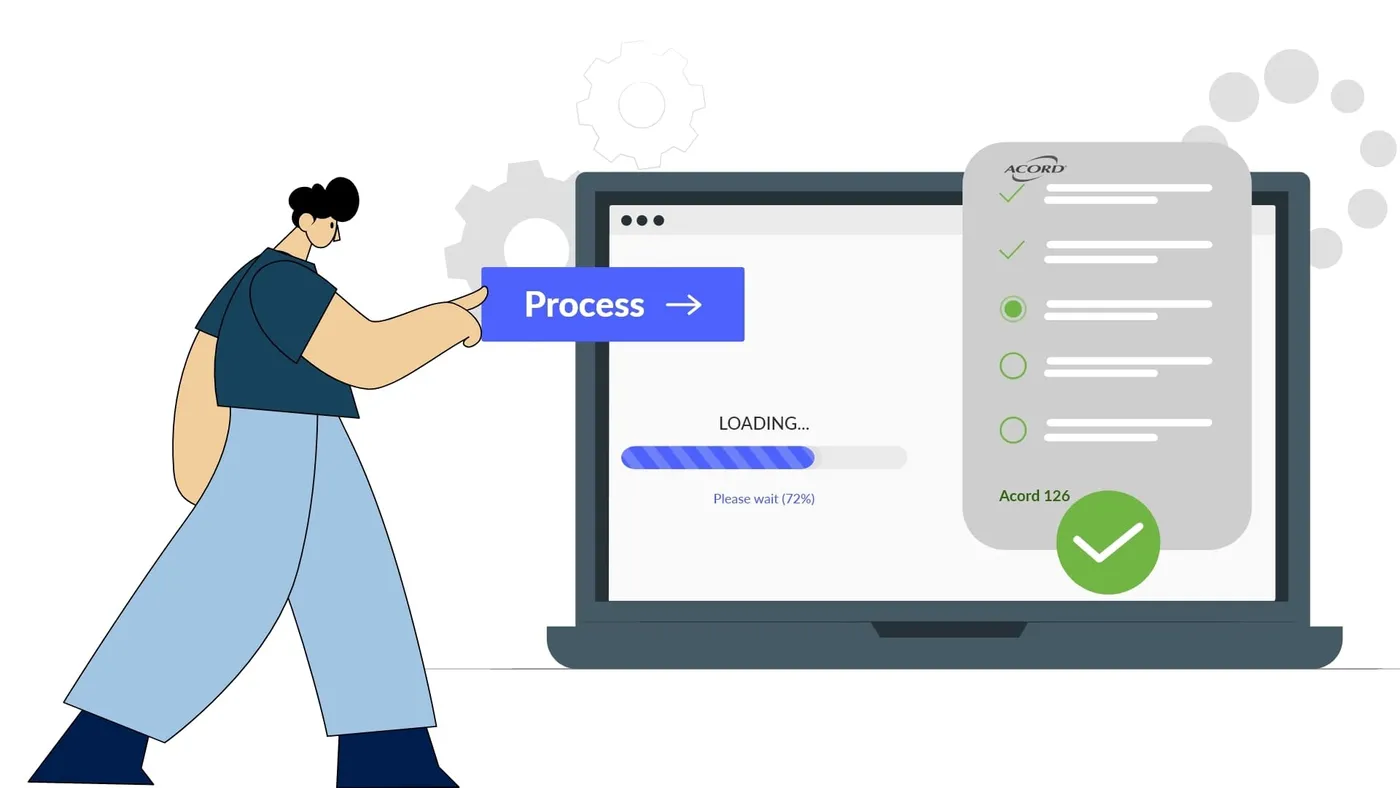
- Automated processing splits the packet, extracts each section, runs the checks and sends only the exceptions to an underwriter.
On this page
The ACORD 126 is the Commercial General Liability Section of a commercial insurance application: the standard form a broker attaches to the ACORD 125 to ask a carrier for a general liability quote. It records the coverage basis, limits and deductibles, and a schedule of hazards that lists each operation with its class code, premium basis and exposure. Carriers and MGAs automate ACORD 126 processing so that data reaches rating without anyone retyping it.
What is an ACORD 126 form?#
ACORD 126 is one of the standard insurance forms published by ACORD, a nonprofit, industry-owned standards body that has issued forms for applications, certificates and claims since 1971. Its first page says "Attach to ACORD 125". The 125 describes the applicant and the lines requested; the 126 adds what a carrier needs to price general liability, in four parts:
Coverage, limits and premiums
Occurrence or claims-made, the limits and deductibles requested, and the premium by premises and operations, products and other.Schedule of hazards
One row per rated operation and location, with the class code, premium basis and exposure the carrier prices from.Conditional sections
Claims-made, employee benefits, contractors, and products and completed operations. Each applies only to some risks.Interests, questions and signatures
Additional interests, 22 yes/no general information questions, remarks and signatures.
ACORD's forms index, revised September 2026, lists 2025/03 as the current edition. It updates the logo and the state fraud warnings of the 2016/09 edition and keeps its sections, so expect both editions in submissions.
How an ACORD 126 moves through submission intake#
The form never travels alone: it arrives in a packet built around the ACORD 125, with other line sections such as the ACORD 127, loss runs and supplementals.
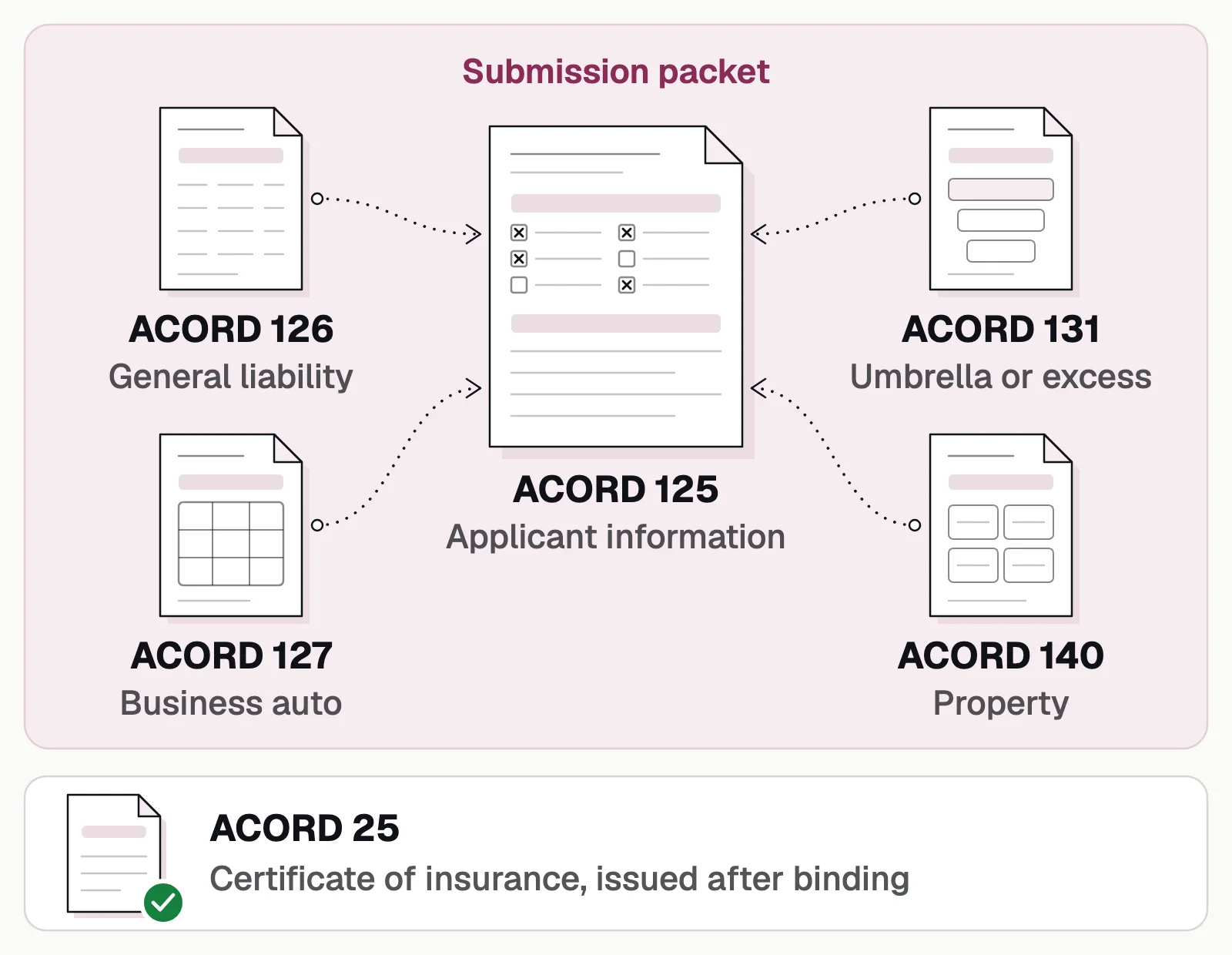
Each line checked on the ACORD 125 should have its section attached; the ACORD 25 comes only after binding.
At the carrier, the packet is split, each form is read, and the 126 is checked against the 125 before rating:
- ACORD 125 application
- ACORD 126 GL section
- Loss runs
- Supplementals
- 01Classify and split the packet
- 02Extract each section
- 03Check against the ACORD 125
- 04Refer exceptions
The sections of an ACORD 126, and what to extract#
On the 2025/03 edition, page 1 holds everything from the agency and applicant to employee benefits, page 2 the contractor and products sections, and pages 3 to 5 the additional interests, general information questions, remarks and signatures.
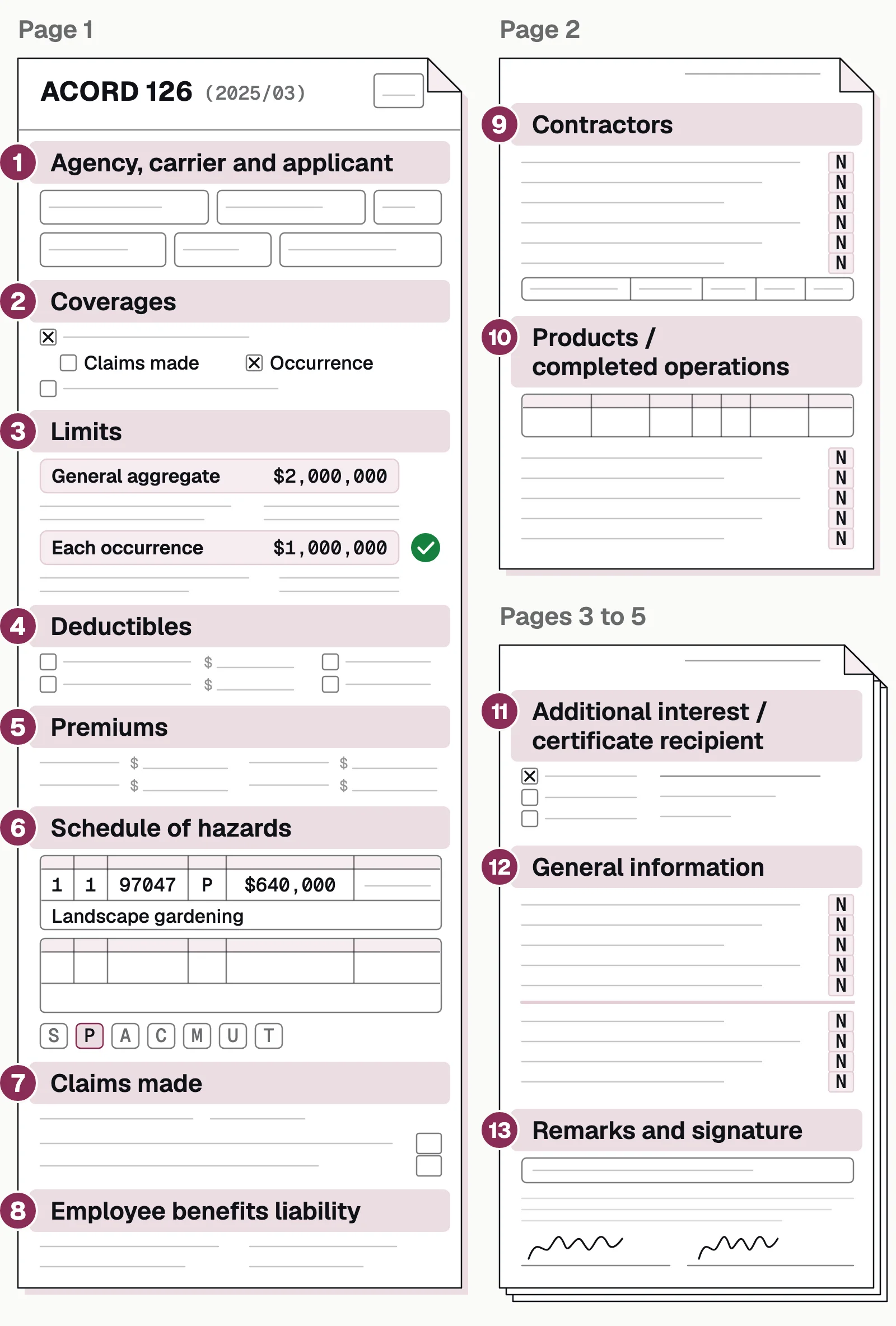
The fields a carrier rates from:
| Section | Fields to extract |
|---|---|
| Coverages | Commercial general liability or owner's and contractor's protective; occurrence or claims-made |
| Limits | Each occurrence; general aggregate (per policy, project or location); products and completed operations aggregate; personal and advertising injury; damage to rented premises; medical expense; employee benefits |
| Deductibles and premiums | Property damage and bodily injury deductibles, per claim or per occurrence; premiums for premises and operations, products and other |
| Schedule of hazards | Location and hazard number, classification, class code, premium basis, exposure, territory, rates and premiums |
| Claims made and employee benefits | Retroactive date, entry date into claims-made coverage, tail coverage; employee benefits deductible, employee counts and retroactive date |
| Contractors and products | Share of work subcontracted and amount paid to subcontractors; each product's annual gross sales, units, time in market and expected life |
The schedule of hazards
Each row carries a class code, usually ISO's, and one of the premium basis codes printed under the schedule: (S) gross sales, (P) payroll and (C) total cost, each per $1,000; (A) area per 1,000 square feet; (M) admissions per 1,000; (U) units; and (T) other. A misread class code, or payroll read as gross sales, changes the price, so extraction has to keep each row intact and flag values that don't fit the code.
The checks to run on every ACORD 126#
Each check compares the form with itself, the ACORD 125 or your appetite, and says what to do when it fails.
- Match to ACORD 125Applicant, agency, effective date and policy number agree. If not, ask the broker to confirm the right forms are attached.
- Coverage basisIf claims-made is checked, the claims-made section has a retroactive date. If not, request it.
- LimitsEach occurrence isn't above the general aggregate, and limits are within appetite. If not, refer to an underwriter.
- Class codesEvery class code is valid and matches its classification and premium basis. If not, flag the row for review.
- ExposuresFilled in and in line with the revenues and employee counts on the ACORD 125. If not, ask the broker to confirm.
- LocationsEvery location number on the schedule exists on the ACORD 125. If not, request the location details.
- General informationEvery yes answer has an explanation. If not, request it.
- SignaturesProducer and applicant signatures and dates are present. If not, return the form for signature.
Commercial applications
Evidence of property insurance
ACORD 125: Commercial insurance application
Agents and brokers send it to carriers and MGAs, with the line sections.✓ 3 passedThe first section of a commercial submission: the applicant, its premises and the lines it wants quoted.
What Docsumo reads
- Applicant
- Keystone HVAC LLC
- FEIN
- ••-•••6120
- NAICS
- 238220
- Proposed term
- 2026-07-01 → 2027-07-01
- Sections attached
- GL, property, auto, umbrella
- Full-time employees
- 46
- Annual revenues
- 8,450,000
- Premises 1
- 2150 Liberty Ave, Pittsburgh, PA 15222
Checked against
- SubmissionEvery section ticked is attached✓ 4 of 4 in
- Every sectionApplicant, FEIN and proposed term✓ Same on all
- Your rulesNAICS code against the classes you write✓ Accepted
The rules each form is checked against are yours to set.
Why ACORD 126 is hard to process by hand#
Rows that must stay together
The schedule of hazards can run to many rows across several locations, each with eight or more values.Several editions and layouts
Editions from 2016 and 2025 arrive as fillable PDFs, flattened PDFs, scans and agency-system printouts.Conditional sections
Claims-made, contractor and products sections apply only to some risks, so a blank can be correct or a gap.Free text that matters
Remarks and the explanations for yes answers often decide whether a risk needs referral.
How to automate ACORD 126 processing#
- Collect submissions in one queueBroker email and portal uploads land in one place, so submissions are processed in bulk.
- Classify and split the packetSeparate the ACORD 125, the 126, other line sections, loss runs and supplementals.
- Extract every sectionRead scans as well as fillable PDFs, and keep each schedule of hazards row together.
- Run the checksSet up the checks above as workflow steps: an AI step or your own Python code.
- Send exceptions to a personLow-confidence fields and failed checks go to a reviewer, and clicking a field highlights its source line on the page.
- Push the dataSend it to your rating engine or policy admin system through an API or webhook, or download it to Excel.
Docsumo is an intelligent document processing (IDP) platform that runs all six steps. It reads ACORD forms and the rest of the packet, printed or handwritten. Classification and splitting are on the Business plan; cross-document validation and case management are on the Enterprise plan. It doesn't rate or quote the risk: data goes to your systems through the API and webhooks.
- 99%field-level accuracy across 250+ document types
- 95%+of documents processed straight through, without manual review
- <5 minper document, down from 2+ hours
See document processing for insurance for the rest of the submission, and the ACORD 125 guide for the application the 126 attaches to.
The bottom line#
The ACORD 126 turns a general liability request into something a carrier can price. Extract every section, keep the schedule of hazards rows intact, check the form against the ACORD 125, and let underwriters spend their time on the risks that need judgment.
Book a demo with a few of your own submissions, or start a free trial.
Frequently asked questions#
What is an ACORD 126 form used for?
It's the Commercial General Liability Section of a commercial insurance application. A broker attaches it to the ACORD 125 to request a general liability quote, and it gives the carrier the coverage basis, limits, deductibles and every rated operation with its class code and exposure.
What is the difference between ACORD 125 and ACORD 126?
The ACORD 125 describes the applicant and lists every line of coverage requested. The ACORD 126 adds the details a carrier needs for general liability only. A general liability submission needs both, and the 126 is checked against the 125.
What is the schedule of hazards on an ACORD 126?
It lists each rated operation by location and hazard number, with its classification, class code, premium basis (such as gross sales, payroll or area) and exposure amount. Carriers classify and price the risk from it. When the rows don't fit, the ACORD 211 Schedule of Hazards carries the rest.
How do you fill out an ACORD 126?
Start from the ACORD 125, so the applicant, dates and location numbers match. Mark occurrence or claims-made, enter the limits and deductibles, list every operation on the schedule of hazards, and answer the contractor and products questions where they apply. Complete the claims-made section only for a claims-made policy, explain every yes answer, and have the producer and applicant sign.
What is an ACORD form?
It's a standard insurance form published by ACORD, a nonprofit, industry-owned standards organization that released its first paper form in 1971. Agents, brokers and carriers use ACORD forms for applications such as the ACORD 125 and 126 and certificates such as the ACORD 25, so carriers get the same fields in the same layout, whichever agency sends them. Blank forms come from ACORD's forms library, which requires a forms subscription.
Can AI complete or read an ACORD 126?
Brokers complete the form, and some quoting platforms let them enter the data once and reuse it across carriers. On the carrier side, document AI reads the completed form, scans included, extracts each section and checks it against the ACORD 125, so underwriters review only the exceptions. See ACORD form processing.
Sources
- ACORD Forms Index (rev. 9/8/2026)
- ACORD Forms Notification Service, March 2025 release: ACORD 126 (2025/03) changes
- ACORD 126 Commercial General Liability Section (2016/09 edition, via Universal Shield)
- ACORD: Forms library
- ACORD: About ACORD
- First Connect: ACORD 126 guide
First published . Last updated .