ACORD 127 processing: business auto fields, checks and automation
For commercial auto underwriters, brokers and submission teams: what's on an ACORD 127, which fields drive the quote, and how to process driver and vehicle data without retyping it.

Key takeaways
- The ACORD 127 is the Business Auto Section: a supplement to the ACORD 125 that gives a carrier the drivers, vehicles and operations it needs to quote commercial auto.
- The key fields are driver details (license number and state, date of birth, experience, date hired, vehicle assigned), vehicle descriptions, additional interests and the general information answers.
- It works with other forms: state coverages and limits on the ACORD 137, extra drivers on the ACORD 163, larger fleets on the ACORD 129 vehicle schedule, and the ACORD 194 truckers supplement when filings are required.
- Driver license numbers make it sensitive data, so extraction and storage need access controls and an audit trail.
- Automation keeps each driver and vehicle row intact, checks drivers against motor vehicle records and vehicles against VINs, and sends only exceptions to a person.
On this page
ACORD 127 processing means reading the Business Auto Section of a commercial submission and turning its drivers, vehicles and operations answers into structured data an underwriter can rate. It's the form carriers and MGAs rely on to understand who drives, what they drive and how the vehicles are used. Automating it matters because driver and vehicle tables are long, sensitive and tedious to retype.
This guide covers what the form is, the fields to extract, the checks to run and how to automate processing.
What is an ACORD 127 form?#
ACORD 127 is the standard Business Auto Section published by ACORD. It attaches to the ACORD 125 commercial insurance application when a business applies for commercial auto coverage. A broker or agent completes it and sends it to carriers with the rest of the submission.
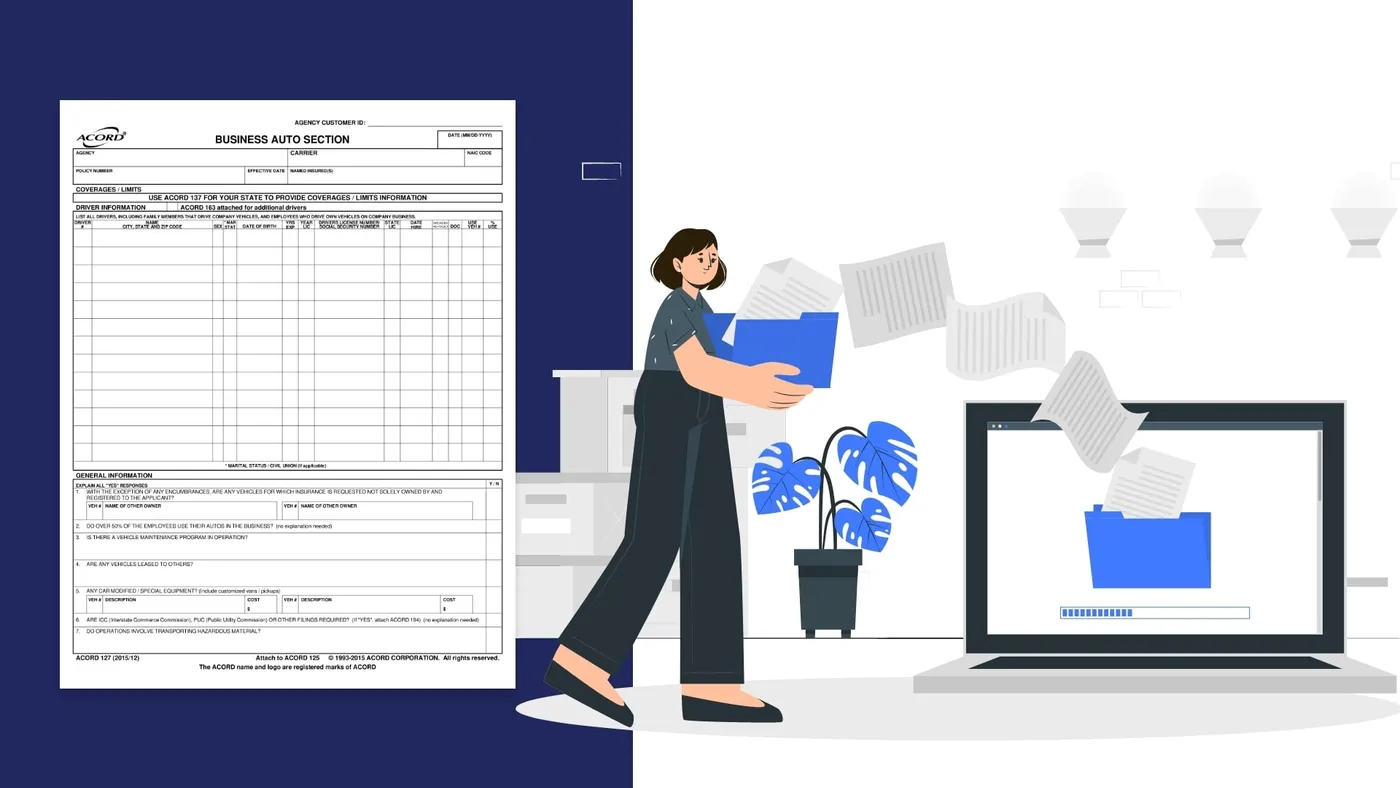
The header image shows page 1 of the 2015/12 edition, which ACORD's forms index still lists as current in September 2026. On that edition, the coverages and limits block simply says to use the ACORD 137 for your state, so state-specific coverages and limits come on a separate form. The ACORD 127 then focuses on drivers, vehicles and exposure questions.
Related forms often travel with it:
ACORD 137
State-specific business auto coverages and limits.ACORD 163
Commercial auto driver information schedule, for additional drivers.ACORD 129
Vehicle schedule for larger fleets.ACORD 194
Truckers / motor carrier supplement, which the form asks for when ICC, PUC or other filings are required.ACORD 45
Additional interest schedule for extra lienholders or lessors.
How an ACORD 127 moves through submission intake#
The ACORD 127 arrives with the application and its schedules. Each is split out and read, drivers and vehicles are checked, and clean data goes to rating.
- ACORD 125 application
- ACORD 127 business auto
- ACORD 137 / 163 / 129 schedules
- Loss runs
- 01Classify and split the packet
- 02Extract each driver and vehicle row
- 03Check drivers and VINs
- 04Refer exceptions
The sections of an ACORD 127, and what to extract#
| Section | Fields to extract | Used for |
|---|---|---|
| Header | Agency, carrier and NAIC code, policy number, effective date, named insured | Matching to the ACORD 125 and submission |
| Driver information | Driver number, name, city, state and ZIP, sex, marital status, date of birth, years of experience, year licensed, driver's license number, state licensed, date hired, vehicle assigned and percentage of use | Driver eligibility and rating |
| General information | Yes/no answers with explanations: vehicles not solely owned by the applicant, employees using their own autos, vehicle maintenance program, vehicles leased to others, modified vehicles or special equipment, required filings, hazardous materials | Referral triggers and exposure |
| Vehicle description | Vehicle number, year, make, model, body type, VIN, garaging location, use, radius, cost new or value, and physical damage coverage requested | Rating each unit |
| Additional interests | Name, address and type of interest (for example lienholder, lessor, loss payee) for each vehicle | Endorsements and certificates to issue |
| Remarks and signature | Free-text remarks, signatures and dates | Context and completeness |
The checks to run on every ACORD 127#
Each check below uses the extracted rows, the rest of the submission or an outside record, and says what to do when it fails.
- Match to ACORD 125Named insured, agency and effective date agree with the application. If not, confirm with the broker.
- Driver eligibilityDrivers meet your age, experience and license rules, with motor vehicle records ordered for each. If not, refer or exclude drivers.
- Driver-vehicle linkEach vehicle has an assigned driver and each driver's use adds up sensibly. If not, ask the broker to clarify.
- VINsEvery VIN has a valid format and decodes to the stated year, make and model. If not, flag for correction.
- Garaging and radiusGaraging addresses exist on the premises schedule, and radius fits the stated operations. If not, refer or request details.
- CoveragesThe ACORD 137 for the right state is attached with limits and deductibles. If not, request the missing form.
- General informationEvery "yes" has an explanation, and filings answered "yes" have the ACORD 194. If not, request the explanation or form.
- SchedulesDriver and vehicle counts match the ACORD 163 and 129 if attached. If not, reconcile the schedules.
Why ACORD 127 is hard to process by hand#
Long tables
A fleet submission can list many drivers and vehicles across the form and its schedules, and every row has many values.Sensitive data
Driver's license numbers and dates of birth are personal information. Retyping them into spreadsheets spreads that data around. Use a platform with SOC 2 Type 2 and role-based access.Handwriting and scans
Smaller agencies still send handwritten or scanned forms.Cross-form dependencies
Coverages are on the ACORD 137, extra drivers on the 163 and vehicles on the 129, so no single form tells the whole story.
How to automate ACORD 127 processing#
- Collect submissions in one queueBring in broker email and portal submissions.
- Classify and splitSeparate the ACORD 125, 127, 137, 163, 129 and loss runs.
- Extract every rowUse a model trained on ACORD forms that keeps each driver and vehicle row together. Docsumo reaches 99% field-level accuracy across the 250+ document types it reads.
- ValidateDecode VINs, check driver rules, match garaging to premises, and reconcile schedules.
- Send exceptions to a personEach flagged field is linked to its place on the page.
- Push clean dataSend it to rating, motor vehicle record ordering and policy systems through an API or webhook.
- 99%field-level accuracy across 250+ document types
- 95%+of documents processed straight through, without manual review
- <5 minper document, down from 2+ hours
See commercial insurance underwriting for the full submission flow, the ACORD 125 guide for the application it attaches to, and the ACORD 131 guide for umbrella coverage that sits above business auto.
The bottom line#
The ACORD 127 is where a commercial auto submission's drivers and vehicles live. Extract every row, protect the personal data, check drivers and VINs automatically, reconcile the related schedules, and send underwriters only what needs their judgment.
Book a demo with a few of your own submissions, or start a free trial.
Frequently asked questions#
What is an ACORD 127 form?
ACORD 127 is the Business Auto Section, a standard ACORD form attached to the ACORD 125 commercial insurance application. It lists the drivers and vehicles to be insured and asks general questions about how the business uses its vehicles.
Where are coverages and limits for business auto shown?
The 2015/12 edition of the ACORD 127 directs users to the ACORD 137 for their state to provide coverages and limits, so a complete business auto submission usually includes both.
What if there are more drivers than fit on the ACORD 127?
Additional drivers go on the ACORD 163 commercial auto driver information schedule, which the form references. Larger fleets are often listed on the ACORD 129 vehicle schedule.
What is the ACORD 127 general information section?
It's a set of yes/no questions about the business's auto exposure, such as vehicles not solely owned by the applicant, vehicles leased to others, modified vehicles, required ICC or PUC filings and transport of hazardous materials. Every yes needs an explanation.
Can ACORD 127 data be extracted automatically?
Yes. A model trained on ACORD forms can extract driver and vehicle tables from scans and PDFs and check them against the rest of the submission.
Sources
First published . Last updated .