ACORD 80 form: the homeowner application, section by section
For personal lines carriers, MGAs and agencies that handle homeowners applications: what's on each page of the ACORD 80, which fields drive rating and underwriting, the checks to run, and how to process applications in bulk without retyping them.

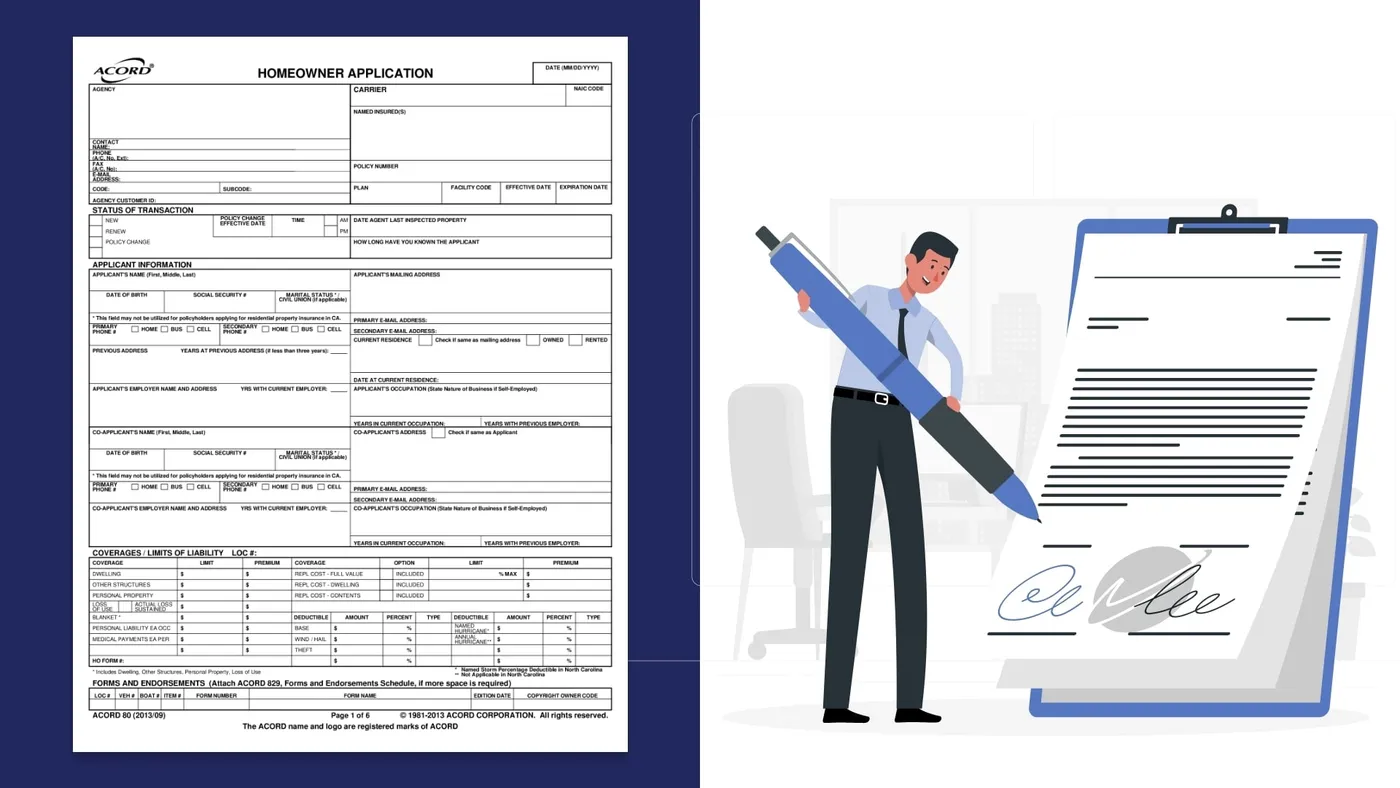
Key takeaways
- The ACORD 80 is the Homeowner Application: the standard form an agent completes to apply to a carrier for a homeowners policy. The current edition is ACORD 80 (2026/03).
- Its core sections cover the applicant, coverages and deductibles, how the home is built and protected, prior coverage and loss history, underwriting questions, additional interests such as the mortgagee, and signatures.
- It's an application, not a policy. It binds coverage only when its binder section is completed, and that binder ends when a policy replaces it.
- ACORD's forms index lists state versions for 18 states, such as ACORD 80 FL and ACORD 80 NY, so identify the version before reading the form.
- Automating it means classifying the state version, extracting every section and running checks, such as the dwelling limit against replacement cost and listed losses against claims history, so underwriters see only the exceptions.
On this page
The ACORD 80 is the Homeowner Application: the standard form an insurance agent completes to apply to a carrier for a homeowners policy. It records the applicant, the coverages and deductibles requested, how the home is built and protected, prior insurance and losses, and any mortgagee. Carriers and MGAs automate ACORD 80 processing so that data reaches their rating systems without being retyped.
What is an ACORD 80 form?
ACORD forms are the standard forms insurance agents, brokers and carriers use for applications, certificates and claims. They're published by ACORD (Association for Cooperative Operations Research and Development), a nonprofit, industry-owned standards body.
The ACORD 80 is an application, not a policy: the agent fills it in with the applicant and sends it to a carrier or MGA for a quote. It binds coverage only when its binder section is completed, and that binder ends when a policy replaces it. The data falls into five groups:
Applicant
Name, date of birth, contact details, addresses, employer and occupation, for the applicant and any co-applicant.Dwelling and location
Each location's address, and how the home is built and protected: construction, roof, heating, wiring, plumbing, fire protection, pools and fuel tanks.Coverages and deductibles
Limits for dwelling, other structures, personal property, loss of use, liability and medical payments, plus base, wind or hail, theft and hurricane deductibles.Prior coverage and losses
The prior carrier and policy, and every loss in the look-back period, paid or not.Additional interest
The mortgagee, lienholder or loss payee, with the loan number.
ACORD's forms index lists state versions for 18 states, from ACORD 80 AL to ACORD 80 WA, each adapted to that state's rules. The Mississippi and Arkansas versions capture IBHS FORTIFIED certification and wind mitigation features for the premium discounts those states require. The Kansas version exists because Kansas regulators found look-back periods over three years potentially unfairly discriminatory.
How an ACORD 80 moves from agent to carrier
An ACORD 80 often travels with other documents, and the form names them: the ACORD 45 for more additional interests, 101 for remarks, 610 for payment details and 829 for forms and endorsements, plus replacement cost estimates, photos and state supplements.
- Agent email
- Carrier or MGA portal
- Scans of paper applications
- 01Classify the form and state version
- 02Extract every section
- 03Check against underwriting rules
- 04Review the exceptions
The sections of an ACORD 80, and what to extract
The current 2026/03 edition changes little from 2016/11: "Agency" is now "Producer", there's a co-applicant signature line, the state fraud statements are reorganized, and a new seventh page carries a notice used only in Massachusetts.
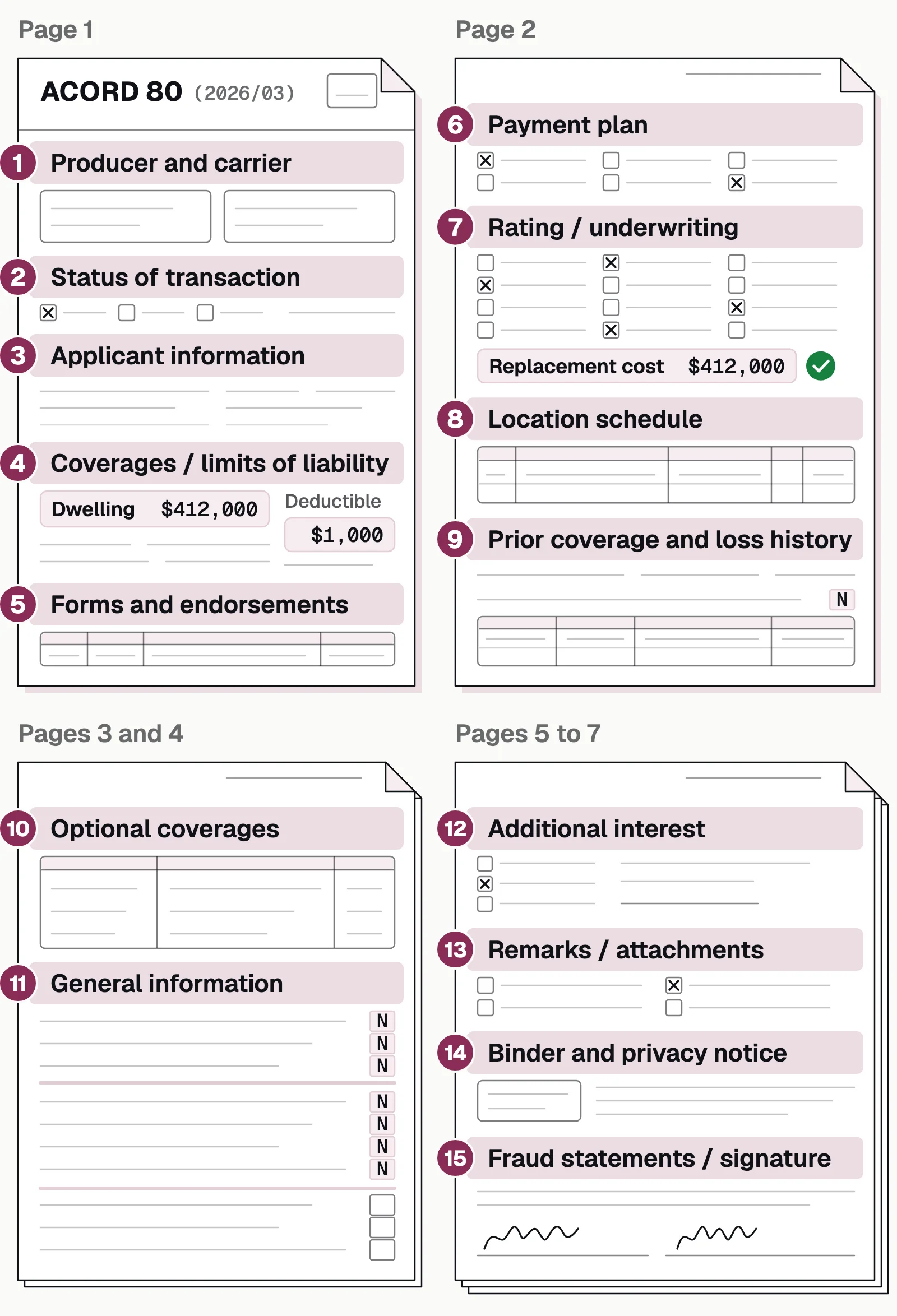
For each section, the fields worth extracting and what they're used for:
| Section | Fields to extract | Used for |
|---|---|---|
| Producer and carrier | Producer and code; carrier and NAIC code; named insureds; policy number; effective and expiration dates | Routing and quote setup |
| Status of transaction | New, renew or policy change; date the agent last inspected the property | What's being asked for |
| Applicant information | Name, date of birth, Social Security number, contact details, addresses, owned or rented, employer and occupation; the same for a co-applicant | Identity and eligibility |
| Coverages / limits of liability | Limit and premium for each coverage; replacement cost options; base, wind or hail, theft and hurricane deductibles; HO form number | Coverage and rating |
| Forms and endorsements | Form number, name and edition date | Building the policy |
| Payment plan | Billing type, plan and method; payor (insured or mortgagee); premium finance company | Billing setup |
| Rating / underwriting | Construction, year built, residence type, occupancy, living area, replacement cost, roof, heating, wiring and plumbing updates, protection devices, distance to hydrant and fire station, protection class, pool, fuel tank, wind features | Rating the home |
| Location schedule | Street, city, county, state and ZIP+4 | Territory |
| Prior coverage and loss history | Prior carrier, policy number and expiration date; each loss's date, type, description, amount paid and dispute status | Eligibility and pricing |
| Optional coverages | Limit and premium for each option, such as earthquake, flood, water backup or inflation guard | Coverage requested |
| General information | Coverage declined, canceled or non-renewed in 3 years; foreclosure, bankruptcy, judgment or lien in 5 years; fraud or arson convictions; for each location, business on premises, hazards, animals, trampoline, lead paint and code violations; three questions for renters and condos | Referral triggers and underwriting |
| Additional interest | Type (mortgagee, lienholder, loss payee and others), name and address, loan number, certificate and billing flags | Mortgage clause and billing |
| Remarks / attachments | Attachments checked, such as a replacement cost estimate, photos or state supplements | Completeness |
| Binder and privacy notice | Binder dates and time, or "coverage is not bound"; notice of information practices given; applicant's initials | Whether coverage is bound |
| Fraud statements / signature | Applicant's and co-applicant's signatures and dates; producer's signature and national producer number | Validity |
The checks to run on every ACORD 80
Run these on every application. Each check ends with what to do when it fails.
- State versionWhere a state version exists, the form matches the state the home is in, such as ACORD 80 FL for a Florida home. If not, ask for the state form.
- Dwelling limitAt or near the replacement cost on the form or the attached estimate. Most insurers require at least 80% of replacement cost, and some 100%. If it falls short, refer it.
- MortgageeIf the mortgagee pays the premium, it's listed under additional interest with a loan number. If not, ask the agent before binding.
- Loss historyListed losses match a claims history report such as CLUE, which covers seven years of claims on the person and the house. Unlisted losses go to an underwriter.
- Roof and fire protectionRoof material, roof condition, the last roofing update, protection class and distances to the hydrant and fire station are filled in. If not, return the application.
- ExplanationsEvery answer the form asks you to explain has an explanation: "yes" answers in general information, "no" answers for renters and condos. If not, request it.
- Signatures and initialsThe applicant's signature and date, a co-applicant's on the 2026/03 edition, the producer's signature, and the applicant's initials on the loss history and privacy notice. If any are missing, return it for signature.
How to automate ACORD 80 processing
Keying is where homeowners intake slows down: up to seven pages, handwritten answers, and attachments that change with every application. Automating the workflow for ACORD applications turns the pile into a queue of exceptions.
- Collect applications in one queueAgent email, portal uploads and scans land in one place, so applications are processed in bulk.
- Classify and splitSeparate the ACORD 80 from its schedules, estimates and supplements, and identify the edition and state version.
- Extract every sectionRead typed and handwritten entries, keeping each location, loss and additional interest row intact.
- Run the checksSet up the checks above, and any from your own guidelines, as workflow steps: an AI step or your own Python code. Each failure is flagged with the field and the rule it broke.
- Send exceptions to a personLow-confidence fields and failed checks go to a reviewer, and clicking a field highlights its source line on the page.
- Push the dataSend it to rating and policy systems through an API or webhook, or download it to Excel.
Docsumo is an intelligent document processing (IDP) platform that runs steps 2 to 6. It reads ACORD forms and the rest of the packet, printed or handwritten, with classification and splitting on the Business plan. It can find and redact sensitive data such as the applicants' Social Security numbers, and it's SOC 2 Type 2 compliant (see security). It doesn't rate, underwrite or bind the policy: data goes to your systems through the API and webhooks. Vertikal RMS already uses Docsumo to verify certificates of insurance through ACORD capture.
- 99%field-level accuracy across 250+ document types
- 95%+of documents processed straight through, without manual review
- <5 minper document, down from 2+ hours
Other ACORD forms
The same approach covers ACORD's other forms. See insurance automation for the full intake flow.
ACORD 25
The certificate of liability insurance, checked against contract requirements. See ACORD 25 data extraction.ACORD 90
The personal auto application, with vehicle and driver tables and its own state versions. See the ACORD 90 guide.ACORD 125
The commercial insurance application at the center of a commercial submission. See the ACORD 125 guide.All ACORD forms
Applications, certificates and loss notices, read field by field. See ACORD form processing.
The bottom line
The ACORD 80 puts a homeowners submission on one standard form: who's applying, the coverage they want, how the home is built and protected, and what has gone wrong before. Check the state version, extract every section, compare the dwelling limit with replacement cost and the losses with claims history, and send underwriters only the applications that need a closer look.
Book a demo with a few of your own homeowner applications, or start a free trial.
Frequently asked questions
What is an ACORD 80 form?
It's the Homeowner Application published by ACORD, the insurance industry's standards body. An agent completes it with the applicant to request a homeowners quote or policy from a carrier. It lists the applicant, the home, the coverages wanted, prior insurance and past losses.
What ACORD form is used for homeowners insurance?
The ACORD 80, or its state version where one exists, such as ACORD 80 FL in Florida. ACORD also publishes the ACORD 84 for dwelling fire policies, the ACORD 85 for mobile homes, and the ACORD 88 personal insurance application with its ACORD 89 residential section.
What is an ACORD form?
A standard insurance form from ACORD (Association for Cooperative Operations Research and Development), a nonprofit, industry-owned standards body. ACORD forms include applications such as the ACORD 80, 90 and 125, certificates such as the ACORD 25 and loss notices such as the ACORD 1, so agents, brokers and carriers exchange the same fields in the same layout.
Where can I get a fillable ACORD 80?
From ACORD's forms library, which offers its forms as printable PDFs, electronic fillable forms and eForms. Downloading requires a subscription to an eligible ACORD forms program. Use the current 2026/03 edition, or the state version for the state where the home is.
What is the 80% rule in homeowners insurance?
Most insurers require a home to be insured for at least 80% of its replacement cost, and some require 100%, according to the Texas Department of Insurance. North Carolina's Department of Insurance adds that if a home is insured for less than 80% of its replacement cost, the insurer may not cover the entire cost to rebuild. On the ACORD 80, compare the dwelling limit with the replacement cost field.
What are coverages E and F on a homeowners policy?
Coverage E is personal liability and Coverage F is medical payments to others. Coverages A to D are the dwelling, other structures, personal property and loss of use. On the ACORD 80, E and F appear as personal liability each occurrence and medical payments each person.
Sources
- ACORD Forms Index (rev. 9/8/2026)
- ACORD Forms Notification Service, May 2026 bulletin: ACORD 80 (2026/03) changes
- ACORD Forms Notification Service, January 2026 bulletin: ACORD 80 MS and ACORD 80 AR
- ACORD Forms Notification Service, March 2026 bulletin: ACORD 80 KS
- ACORD: Forms library
- ACORD: About ACORD
- Texas Department of Insurance: Home insurance guide
- North Carolina Department of Insurance: Basic homeowners insurance
First published . Last updated .