ACORD 25 data extraction: fields, checks and automation
A guide for risk, compliance and operations teams that collect certificates of insurance from vendors, tenants and borrowers: what to pull off an ACORD 25, what to check it against, and how to stop keying it by hand.

Key takeaways
- The ACORD 25 is the certificate of liability insurance, one page that summarizes a business's general liability, auto, umbrella and workers' compensation policies.
- The fields that matter are the insured, the insurers and their NAIC numbers, policy numbers, effective and expiration dates, limits per coverage line, the additional insured and subrogation boxes, and the certificate holder.
- Extraction is only half the job. Every COI should be checked against the contract, for limits at or above the minimums, dates that cover the work, the right certificate holder, and additional insured status backed by an endorsement.
- A certificate confers no rights on its own. It's evidence of coverage, so an automated check should flag gaps for a person, not approve them silently.
- Automating the read and the checks turns COI tracking from data entry into exception handling. People only see the certificates that fail a rule.
On this page
- What is an ACORD 25 form?
- How a certificate moves through COI tracking
- The sections of an ACORD 25, and what to extract
- The checks to run on every certificate
- Why ACORD 25 extraction is harder than it looks
- How to automate ACORD 25 extraction and COI checks
- What the certificate can't tell you
- Frequently asked questions
ACORD 25 data extraction means reading the ACORD 25, the standard certificate of liability insurance, and turning it into structured data. That's who is insured, by which insurers, under which policies, for how much and until when. Teams that collect certificates from vendors, contractors, tenants or borrowers do it so they can check each one against the insurance requirements in their contracts and chase the ones that fall short.
What is an ACORD 25 form?#
ACORD 25 is the standard Certificate of Liability Insurance published by ACORD (the Association for Cooperative Operations Research and Development), the nonprofit that maintains standard forms for the US insurance industry. An agent or broker issues it to show that a business holds liability coverage. The current edition is ACORD 25 (2025/12), which replaced the 2016/03 edition.
The person asking for the certificate is usually the one who carries the risk if the business isn't insured: a property manager leasing space, a general contractor hiring subcontractors, a lender financing a property, a franchisor, or an event venue. They are named on the form as the certificate holder. (The application forms an agent sends to an underwriter are different documents: see our guides to ACORD 125 and ACORD 126.)
| Field | Extracted value | Confidence |
|---|---|---|
| Issue date | 2026-09-18 | |
| ACORD version | 2016/03 | |
| Producer | Allegheny Risk Partners LLC | |
| Insured | Keystone HVAC LLC | |
| Insurer A · NAIC | Brightwater Casualty Company · 21873 | |
| Insurer B · NAIC | Brightwater Specialty Insurance Co. · 34418 | |
| Insurer C · NAIC | Laurel Highlands Mutual Insurance Co. · 13052 |
| Field | Extracted value | Confidence |
|---|---|---|
| General liability | GL 7204418 · A · occurrence | |
| Auto liability | CA 7204419 · A · any auto | |
| Umbrella | UMB 3310582 · B · occurrence | |
| Workers comp | WC 5519027 · C · per statute | |
| GL, auto, umbrella term | 2026-07-01 → 2027-07-01 | |
| Workers comp term | 2026-03-15 → 2027-03-15 | |
| Additional insured | General liability, auto | |
| Waiver of subrogation | General liability, auto, WC |
| Field | Extracted value | Confidence |
|---|---|---|
| Each occurrence | 1,000,000 | |
| General aggregate | 2,000,000 | |
| Products-comp/op aggregate | 2,000,000 | |
| Auto combined single limit | 1,000,000 | |
| Umbrella each occurrence | 2,000,000 | |
| E.L. each accident | 1,000,000 |
| Field | Extracted value | Confidence |
|---|---|---|
| Certificate holder | Riverside Plaza LLC | |
| Holder address | c/o Harbor Point Properties, 500 Penn Ave, Suite 1200, Pittsburgh, PA 15222 | |
| Certificate number | CL2609180417 | |
| Description of operations | HVAC maintenance and repair at 1 Riverside Plaza … | |
| Authorized representative | Signed |
How a certificate moves through COI tracking#
A certificate starts with a request and ends as a record in the system that tracks the vendor, tenant or loan. In between, someone has to read it, compare it with the contract and chase whatever is missing.
- Contract insurance requirements
- Agent or broker
- COI inbox and vendor portal
- 01Classify the packet
- 02Extract every field
- 03Check against the contract
- 04Review exceptions
Manual COI tracking
- Someone keys insurers, policies, dates and limits into a spreadsheet
- Limits are compared with the contract by eye, certificate by certificate
- Expiration dates live in a spreadsheet column nobody watches
- Every certificate gets the same attention, compliant or not
Automated COI tracking
- Fields are read off the certificate, scans included, and linked to their insurer
- Every limit, date and box is checked against the rules for that contract
- Expirations trigger a renewal request before coverage lapses
- People only see the certificates that fail a rule
The sections of an ACORD 25, and what to extract#
The layout is standard, so every certificate has the same nine sections. The numbers on the form below match the rows of the table.
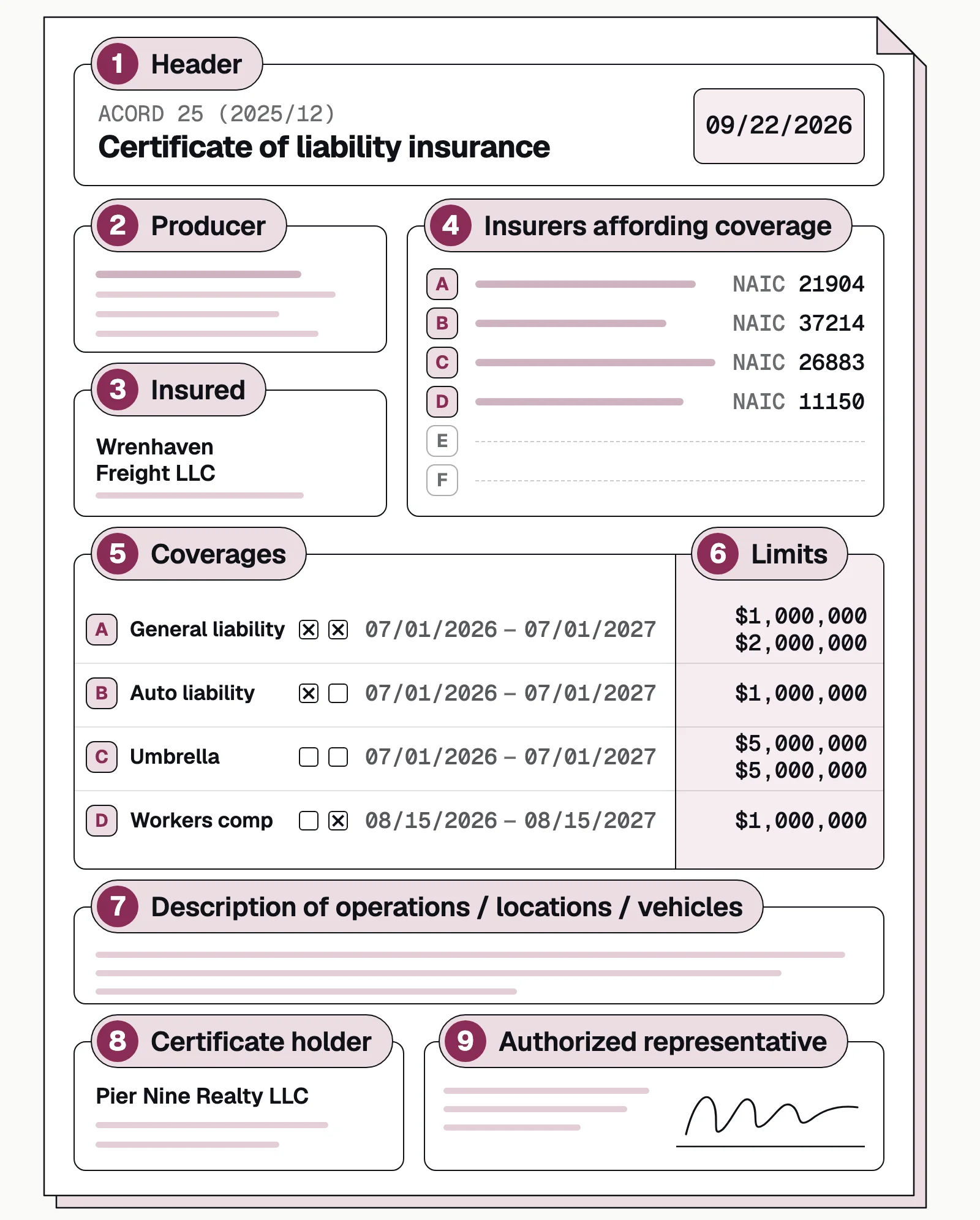
| Section | Fields to extract | Used for |
|---|---|---|
| Header | Certificate date | How current it is |
| Producer | Agency name, contact, phone, email | Requesting corrections and endorsements |
| Insured | Named insured and address | Matching the vendor, tenant or borrower |
| Insurers affording coverage (A–F) | Insurer name and NAIC number per letter | Checking ratings; linking policies to insurers |
| Coverages | Insurer letter, type, ADDL INSD, SUBR WVD, policy number, dates | The core compliance check |
| Limits | Each limit per coverage line (below) | Comparing with contract minimums |
| Description of operations / locations / vehicles | Project, location, additional insured wording, endorsement numbers | Confirming the right work and parties |
| Certificate holder | Name and address | Confirming it was issued to you |
| Authorized representative | Signature present | Validity |
Limits by coverage line
Each line in the coverages grid has its own limits:
Commercial general liability
Each occurrence, damage to rented premises, medical expense, personal and advertising injury, general aggregate, products and completed operations aggregate, and whether the aggregate applies per policy, project or location.Automobile liability
Combined single limit, or bodily injury per person and per accident plus property damage, and which autos are covered (any auto, owned, hired, non-owned).Umbrella or excess liability
Each occurrence and aggregate, and whether it is occurrence or claims-made.Workers' compensation and employers' liability
Statutory limits, plus employers' liability for each accident, disease per employee and disease policy limit, and whether any owner or officer is excluded.Other lines
Professional liability, cyber, property or other lines the agent lists on the spare row.
The checks to run on every certificate#
Extracted data is only useful once it's compared with what the contract requires. These are the checks most COI tracking programs run, whether by hand or by software, and the fix when one fails:
- LimitsEach limit is at or above the contract minimum for that line. If not, ask for higher limits or an umbrella policy.
- DatesEvery required policy is in force for the full contract period. Track each expiration date and request a renewal certificate about 30 days before the policy lapses.
- Certificate holderYour legal entity name and address, exactly. If not, request a corrected certificate.
- Additional insuredADDL INSD is marked on the lines the contract requires, and the endorsement is stored with the certificate. If not, request the additional insured endorsement.
- Waiver of subrogationSUBR WVD is marked where the contract requires it, with the waiver endorsement stored alongside. If not, request it.
- InsurerEach insurer has an NAIC number and meets your minimum financial rating. If not, escalate to risk management.
- Named insuredMatches the vendor, tenant or borrower you contracted with. If not, confirm the legal entity, since a parent or affiliate may not be covered.
- Description of operationsMentions the project, location or wording the contract requires. If not, request a corrected certificate.
Most failures are fixable with a corrected certificate or an endorsement from the agent, which is why the producer's contact details are worth extracting too. The follow-up email goes to them.
We'd judge a COI program less by how cleanly one certificate reads and more by whether it agrees with everything else in the file, from the contract's requirements to the endorsement that grants additional insured status. A certificate can pass every check on its own and still be missing an endorsement it was supposed to come with, and that gap only shows up once the pieces are checked against each other. Cross-document checks like that, from the certificate to the contract, are on Docsumo's Enterprise plan.
Why ACORD 25 extraction is harder than it looks#
The form is standard; the certificates aren't. Six things break simple OCR and templates.
Same form, different content
The layout is standard, but insurers, rows and limits change from certificate to certificate, and blank rows are common.Scans and faxes
Many certificates arrive as skewed scans or photos, where template-based OCR loses fields.Free text that matters
The description of operations often holds the additional insured wording and endorsement numbers the check depends on.Several insurers per certificate
Each policy row points to an insurer letter, so the extraction has to keep the links between rows and insurers intact.Endorsements and attachments
Certificates often arrive with endorsement pages or ACORD 101 additional remarks, which need to be classified and read too.Volume and renewals
Every vendor renews every year, so a program with a few thousand vendors sees thousands of certificates a year, with spikes at common renewal dates.
How to automate ACORD 25 extraction and COI checks#
The work splits into seven steps, and software can now do most of them end to end.
- Write your requirements down as rulesFor each contract type, list the required lines, minimum limits, additional insured and waiver requirements, and the certificate holder name.
- Collect certificates in one placeRoute the COI inbox, vendor portal uploads and scans into one queue.
- Classify the packetSeparate the ACORD 25 from endorsements, ACORD 101 remarks pages and other attachments.
- Extract every fieldUse a model that reads scans as well as digital PDFs and keeps each policy row linked to its insurer. Docsumo reads ACORD forms and reaches 99% field-level accuracy across 250+ document types.
- Run the checksCompare the extracted values with the rules for that vendor's contract and flag every failure with the field and the rule it broke.
- Send only exceptions to a personA reviewer sees the failing certificates, with each flagged field linked to its spot on the page, and requests the fix from the agent.
- Push the data where it's usedSend the results to your vendor management, property management or loan servicing system through an API or webhook, and track expiration dates there.
Teams already do this at scale. Vertikal RMS uses Docsumo to verify certificates of insurance through ACORD capture, and Arbor uses it on insurance compliance documents.
- 99%accuracy on insurance compliance documents at Arbor
- 3,000+hours a month saved at Arbor
- 95%+of documents processed straight through, without manual review
What the certificate can't tell you#
An ACORD 25 is a one-page summary of a business's liability coverage, and its value comes from checking it against what your contract requires. Extract every field, keep the links between policies and insurers, run the same checks on every certificate, and let people handle only the ones that fail.
Book a demo with a few of your own certificates, or start a free trial.
Frequently asked questions#
What is the difference between ACORD 25 and ACORD 24?
ACORD 25 is the certificate of liability insurance. ACORD 24 is the certificate of property insurance, used when a lender or landlord needs evidence that a building or its contents are insured. Property evidence can also come on ACORD 27 or ACORD 28.
Does a certificate of insurance make me an additional insured?
No. The ACORD 25 only reports coverage. You become an additional insured through an endorsement to the policy, so ask for the endorsement as well as the certificate.
What does SUBR WVD mean on an ACORD 25?
It stands for subrogation waived. A mark in that column means the policy includes a waiver of subrogation, so the insurer can't pursue the certificate holder to recover a claim it paid. Like additional insured status, it depends on an endorsement.
How often should certificates of insurance be collected?
At the start of every contract and at every policy renewal, which is usually once a year per vendor. Tracking expiration dates and requesting renewals ahead of time avoids gaps in coverage.
How do I get an ACORD 25 form?
Ask the business's insurance agent or broker. They issue the certificate and name you as the certificate holder. Blank forms come from ACORD, which requires a subscription to an eligible forms program to download them.
Can OCR alone extract data from ACORD 25 forms?
Basic OCR turns the page into text but doesn't know which number is which limit, or which policy belongs to which insurer. Intelligent document processing adds that understanding, validates the values and flags anything uncertain for review.