Invoice data extraction: fields, methods and how to automate it
For AP managers, finance ops and developers: which invoice fields to capture, how the main extraction methods compare, what the output should look like, and the checks that make the data safe to post.

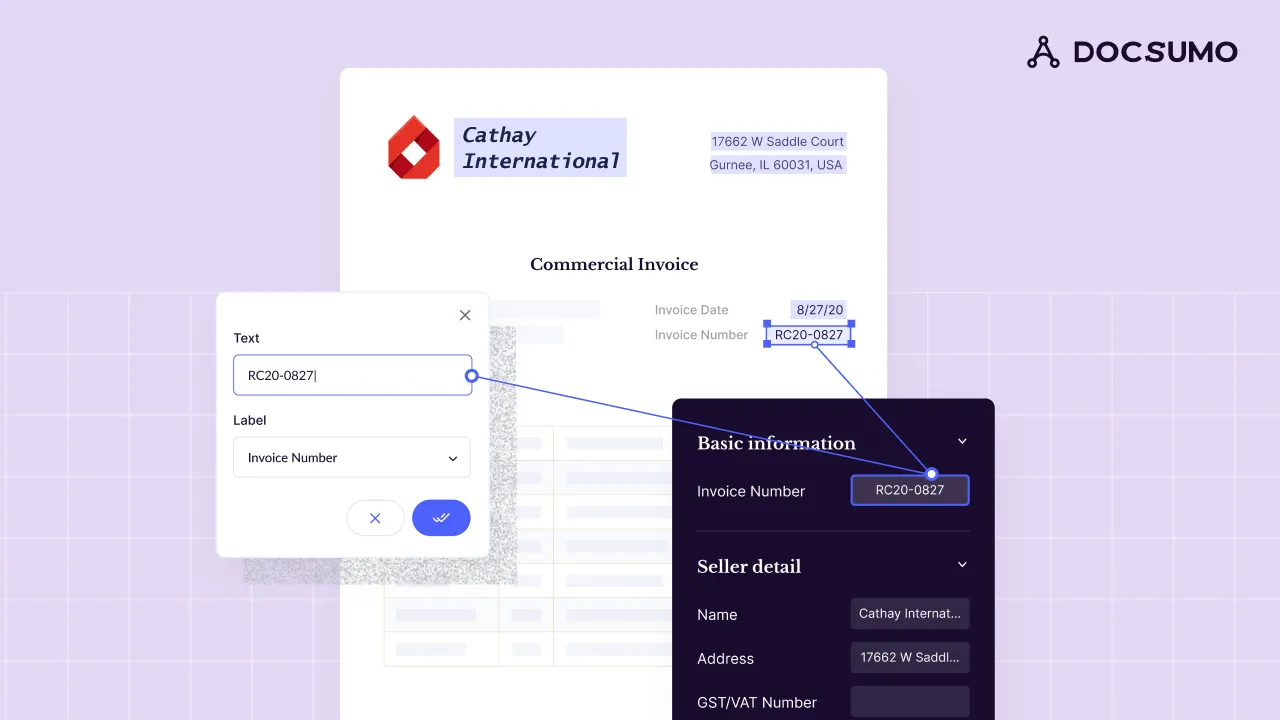
Key takeaways
- Invoice data extraction is reading an invoice and turning its contents into structured data: vendor, invoice number, dates, PO number, line items, tax, and totals.
- The five methods are manual entry, template OCR, rule-based parsing, machine learning, and hybrid systems. Only ML and hybrid approaches handle new vendor layouts without setup.
- Line items are the hardest part: tables that span pages, wrap across lines, and use different column names for every vendor.
- Extraction isn't finished until the data is validated: line items sum to the subtotal, totals reconcile, the vendor exists, and the invoice isn't a duplicate.
- Measure extraction by field-level accuracy on your own invoices, not by a vendor's headline number.
On this page
- Fields to extract from an invoice
- Invoice data extraction methods compared
- What good extraction output looks like
- Why line items are the hard part
- Checks to run on extracted invoice data
- How to automate invoice data extraction
- Best practices for managing extracted invoice data
- The bottom line
- Frequently asked questions
Invoice data extraction is the process of reading an invoice and turning its contents into structured data: vendor details, invoice number, dates, PO number, line items, tax and totals. Accounts payable teams use it to stop typing invoices into their ERP, and developers use it to feed invoice data into other systems. Modern tools combine OCR with machine learning, so they work across vendor layouts without a template for each one.
This guide covers the fields to capture, how the main extraction methods compare, what good output looks like, the checks to run, and a step-by-step way to automate it.
Fields to extract from an invoice#
| Group | Fields | Used for |
|---|---|---|
| Vendor | Name, address, tax ID, remit-to address and bank details | Matching to the vendor master; catching changed bank details |
| Buyer | Bill-to entity and address, ship-to address | Routing to the right entity and cost center |
| Invoice header | Invoice number, invoice date, due date, payment terms, PO number, currency | Duplicate checks, PO matching, payment scheduling |
| Line items | Description, SKU or item code, quantity, unit of measure, unit price, line amount, line tax | 2-way and 3-way matching, GL coding, spend analysis |
| Totals | Subtotal, discounts, freight, tax by rate, total due | Posting and reconciliation |
Credit memos, pro forma invoices, and statements look like invoices but need different handling. A good extraction tool classifies them first.
Invoice data extraction methods compared#
| Method | How it works | Strengths | Limits |
|---|---|---|---|
| Manual entry | A person types each field into the ERP or a spreadsheet | No setup; handles anything | Slow, costly, error-prone at volume |
| Template OCR | OCR plus fixed zones defined for each vendor layout | Accurate for a few stable layouts | Breaks when a vendor changes format; a template for every vendor |
| Rule-based parsing | Keywords and regular expressions find values in the OCR text | Good for digital PDFs with predictable wording | Brittle across vendors; weak on tables |
| Machine learning | Models trained on many invoices find fields by context and layout | Handles new layouts; extracts line items; improves with corrections | Needs a good review step for low-confidence fields |
| Hybrid | ML extraction plus rules and validation against your data | Best accuracy and control in production | More to configure up front |
For an AP team with dozens or thousands of vendors, ML or hybrid is the practical choice. Template OCR only makes sense for a handful of layouts that never change.
What good extraction output looks like#
Whatever the method, you want structured output with a confidence score for each value and a link to where it sits on the page. A trimmed, illustrative example:
{
  "document_type": "invoice",
  "vendor_name": "Cathay International",
  "invoice_number": "RC20-0827",
  "invoice_date": "2026-08-27",
  "po_number": "PO-10452",
  "currency": "USD",
  "subtotal": 4200.00,
  "tax": 346.50,
  "total": 4546.50,
  "line_items": [
    { "description": "Steel brackets", "quantity": 300, "unit_price": 12.00, "amount": 3600.00 },
    { "description": "Freight", "quantity": 1, "unit_price": 600.00, "amount": 600.00 }
  ]
}
Why line items are the hard part#
Header fields such as the invoice number and total appear once. Line items are tables, and every vendor builds them differently:
- Column names vary: "Qty", "Quantity", "Units", "Hrs".
- Descriptions wrap across two or three lines.
- Tables continue across pages, sometimes with repeated headers and subtotals.
- Discounts, freight, and fees appear as extra rows or in a footer.
- Scanned invoices add skew, stamps, and handwriting.
If you do 2-way or 3-way matching or code invoices by line, test line-item extraction specifically. See multi-page table parsing for how it's handled.
Checks to run on extracted invoice data#
- Math: line amounts equal quantity × unit price; lines sum to the subtotal; subtotal + tax + freight − discounts equals the total.
- Vendor: the vendor exists in the vendor master, and the remit-to bank details match what's on file.
- Duplicates: the same vendor and invoice number, or the same vendor, amount, and date, hasn't been processed before. See duplicate invoice detection.
- PO match: quantities and prices match the purchase order and, for goods, the receipt. See 2-way vs 3-way matching.
- Dates: the invoice date isn't in the future; the due date matches the terms.
- Tax: tax rates are valid for the ship-to location.
Docsumo runs checks like these after extraction and sends only failures to a reviewer. Docsumo reports 95%+ straight-through processing.
How to automate invoice data extraction#
- Collect invoices in one place. Route the AP inbox, supplier portal uploads, and scans into one queue.
- Classify and split. Separate invoices from credit memos, statements, and attachments, and split multi-invoice PDFs.
- Extract header fields and line items with a model trained on invoices. Docsumo extracts invoice data with 99% field-level accuracy.
- Validate with the checks above, using your vendor master and PO data.
- Review exceptions. A person sees only the invoices that fail a check, with each flagged value shown on the page.
- Export or post. Download JSON, CSV, or Excel, or push data to your ERP or accounting system through APIs and webhooks.
- Measure. Track field-level accuracy, straight-through rate, and exception reasons each month.
Manual processing is expensive. Ardent Partners' 2025 benchmarks put the average cost to process an invoice at $9.40, against $2.78 for best-in-class teams. Docsumo customers report under 5 minutes per document, down from more than 2 hours, and Valtatech cut costs by more than 65% with 99%+ touchless invoices.
Best practices for managing extracted invoice data#
- Keep the source linked. Store each invoice image with its extracted data so auditors can trace every value.
- Standardize vendor names against your vendor master so spend reports aren't split across spellings.
- Control access. Invoices hold bank details and pricing. Use role-based access and a vendor with SOC 2 Type 2 compliance.
- Watch exception trends. A vendor that always fails a check usually needs a fix upstream, such as a PO process or corrected master data.
For the full accounts payable workflow, see accounts payable automation and AI invoice processing.
The bottom line#
Invoice data extraction turns invoices into data your ERP can use. Capture header fields and line items, use a method that handles new layouts without templates, and validate everything before it posts. Test on your own invoices and measure field-level accuracy. That's the number that decides how much manual work is left.
Frequently asked questions#
How do I extract data from an invoice?
Upload the invoice to an extraction tool, which reads the text with OCR, identifies each field and the line-item table, and returns the data as JSON, CSV, or Excel, or sends it to your ERP. Review any low-confidence fields before posting.
What fields should I extract from an invoice?
At minimum, the vendor name and address, remit-to details, invoice number, invoice date, due date, PO number, currency, subtotal, tax, total, and the line items with description, quantity, unit price, and amount.
Can I extract invoice data into Excel?
Yes. Most extraction tools export to Excel or CSV, with header fields in one sheet and line items in another. For ongoing volume, sending data straight to the accounting system or ERP through an API saves another manual step.
What's the difference between invoice OCR and invoice data extraction?
OCR converts the invoice image to text. Data extraction goes further. It identifies which text is which field, structures the line items, and validates the values.
How accurate is automated invoice extraction?
It depends on the tool and your invoices. Test on a few hundred of your own invoices and measure errors per field. Docsumo reports 99% field-level accuracy across 250+ document types.
Sources
First published . Last updated .