Driver qualification file: required documents, retention and checklist
For safety and compliance teams at motor carriers: what FMCSA requires in each driver's file, when records come due and when they can come out, and how to check files without paging through them by hand.

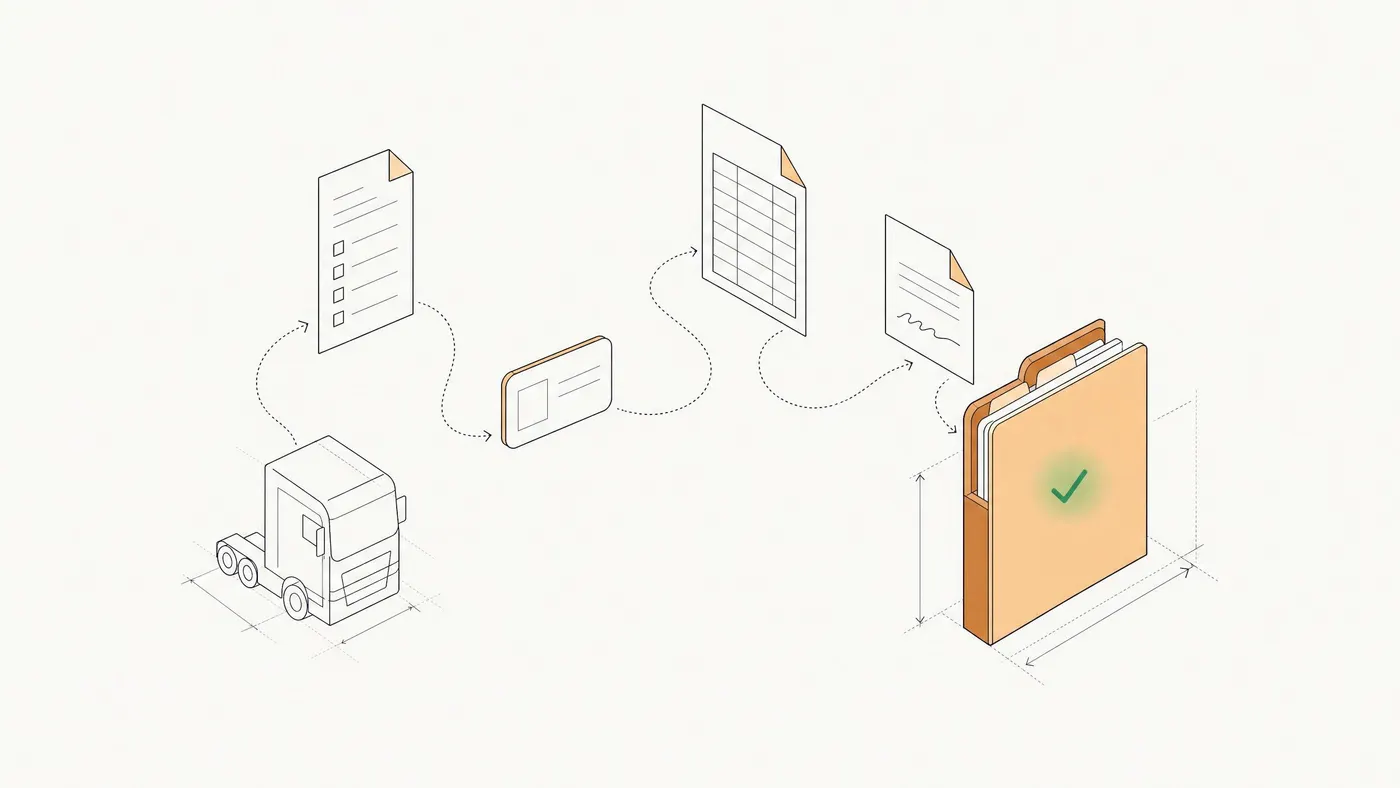
Key takeaways
- A driver qualification file (DQF) is the record a motor carrier must keep for every driver of a commercial motor vehicle to show the driver is qualified to drive. The rule is 49 CFR 391.51.
- The file holds the employment application, the motor vehicle records (MVRs), the road test certificate or an accepted equivalent, the annual review note and proof of medical certification, plus any medical variance.
- Keep the file while the driver works for you and for three years after. Annual MVRs, review notes and medical records may be removed three years after the date of execution.
- Since June 23, 2025, medical examiners no longer give CDL and CLP holders a paper certificate, so for those drivers the medical record in the file is the CDLIS motor vehicle record from their licensing state.
- Software can read each document and check names, license numbers and dates against rules you set, so only the files that fail a rule reach your safety team.
On this page
- What is a driver qualification file?
- What goes in a driver qualification file
- When each record comes due
- How long to keep DQF records
- Medical certification after June 2025
- Driver qualification file checklist
- Why DQFs are hard to keep complete
- How to check driver qualification files with Docsumo
- The bottom line
- Frequently asked questions
A driver qualification file (DQF) is the set of records a motor carrier must keep for every driver of a commercial motor vehicle, to show that the driver is qualified to drive. 49 CFR 391.51 lists what goes in it: the driver's employment application, motor vehicle records (MVRs), road test certificate, annual review note and proof of medical certification. You keep the file for as long as the driver works for you, plus three years.
This guide covers what goes in a DQF, when each record comes due, how long to keep it, a checklist to audit files against, and how carriers check files with software. The rules are as published in the eCFR in September 2026; this is a summary, not legal advice.
What is a driver qualification file?#
Every motor carrier must keep a qualification file for each driver it employs, and the file may be combined with the driver's personnel file (§ 391.51(a)). It applies to drivers of commercial motor vehicles in interstate commerce: vehicles with a weight rating or actual weight of 10,001 pounds or more, vehicles designed or used to carry more than 8 passengers (including the driver) for compensation or more than 15 without, and vehicles carrying placarded hazardous materials (§ 390.5). The test is the vehicle, not the license, so many drivers who don't need a CDL need a file too.
The file is the carrier's evidence that it checked the driver before the first trip and keeps checking every year after.
What goes in a driver qualification file#
Employment application
Completed and signed by the driver on your form: 3 years of addresses, every current license, accidents and violations in the last 3 years, and employers for the last 3 years. CDL drivers also list driving jobs in the 7 years before that (§ 391.21).Pre-employment MVR
A motor vehicle record from every state that licensed the driver in the last 3 years, covering those 3 years, in the file within 30 days of hire (§ 391.23).Road test or equivalent
The certificate of road test and the signed test form, or a copy of the CDL or of a road test certificate from the last 3 years that you accepted instead (§ 391.31, § 391.33).Medical certification
For CDL holders, the CDLIS MVR from the current licensing state. For other drivers, the medical examiner's certificate and a note that you verified the examiner on the National Registry (§ 391.51(b)(6)).Annual MVR and review
A new MVR at least every 12 months from each licensing state, and a note with the reviewer's name and the date of the review (§ 391.25).Medical variance, if any
A Skill Performance Evaluation certificate or a federal medical exemption, when the driver's certification depends on one (§ 391.51(b)(7)).
When each record comes due#
A DQF isn't finished at hiring. Some records are due before the first trip, some within 30 days, and some every year.
- Before the first tripThe signed application, the road test certificate or the equivalent you accepted, and the medical certification in the file (§ 391.23(m)). Run a pre-employment full query of the Drug and Alcohol Clearinghouse as well (§ 382.701).
- Within 30 days of hireAn MVR from each state that licensed the driver in the last 3 years, and the safety performance history from DOT-regulated employers of the last 3 years, which goes in the separate driver investigation history file (§ 391.23).
- At least every 12 monthsA new MVR from each licensing state, reviewed to confirm the driver still meets the safe-driving requirements and isn't disqualified, with a note of who reviewed it and when (§ 391.25). The Clearinghouse needs a query at least once a year too (§ 382.701).
- When medical certification renewsAt least every 24 months, or sooner if the examiner certifies for a shorter period (§ 391.45). File the new certificate, or the updated CDLIS MVR for CDL holders.
- After the driver leavesKeep the file for three more years (§ 391.51(c)).
How long to keep DQF records#
The file stays for the length of employment plus three years, but some records inside it can come out sooner (§ 391.51(c) and (d)).
| Record | Retention |
|---|---|
| Application, pre-employment MVRs, road test certificate or equivalent | While the driver works for you, plus 3 years |
| Annual MVRs and annual review notes | May be removed 3 years after the date of execution |
| Medical certificates or CDLIS MVRs, medical variances, National Registry notes | May be removed 3 years after the date of execution |
| Previous employers' safety performance history (driver investigation history file) | While the driver works for you, plus 3 years (§ 391.53) |
Medical certification after June 2025#
What proves medical certification now depends on the driver's license.
Which driver is it?
Driver qualification file checklist#
Use it for every new hire, then again at each annual review.
- Signed applicationEvery § 391.21 item is filled in, including 3 years of employers and the signed certification at the end.
- An MVR from every stateOne from each state that licensed the driver in the last 3 years, in the file within 30 days of hire.
- Road test or accepted equivalentThe certificate and signed test form, or a copy of the CDL or road test certificate you accepted, for the type of vehicle you'll assign.
- One current licenseThe driver holds a valid license from only one state (§ 391.11).
- Current medical certificationThe CDLIS MVR shows the driver as certified, or the certificate hasn't expired and the National Registry note is on file.
- Variance documentsAny SPE certificate or medical exemption the certification depends on.
- Annual MVR and review noteNo more than 12 months since the last one, with the reviewer's name and the date.
- Names and numbers agreeThe same name, date of birth and license number on the application, license, MVRs and medical record.
Why DQFs are hard to keep complete#
Many sources
Each file draws on the driver, state licensing agencies, medical examiners, the Clearinghouse and previous employers.Dates that roll
Annual MVRs, reviews and medical certification each run on their own clock for every driver, and each departure starts a three-year retention clock.Paper and photos
Applications, certificates and cards often arrive as scans or phone photos, in layouts that differ by state and examiner.
How to check driver qualification files with Docsumo#
Docsumo is an intelligent document processing platform. It reads each document in a driver qualification file, such as the CDL, the DOT medical card, the MVR, the employment application and the road test certificate, and checks names, license numbers and dates against the rules you set. Trucking carrier Lee Trans uses Docsumo to read driver licenses and medical cards.
- Applications
- CDLs and medical cards
- MVRs
- Road test certificates
- 01Classify each document
- 02Extract the fields
- 03Check against your rules
- 04Review exceptions
The rules are yours to configure. For example:
- the same name on every document
- the license number and state match the CDL
- the road test equipment is covered by the CDL class
- an MVR dated within the last 12 months
- every document your checklist requires is present
Files that pass move on; the rest reach your safety team with the document and the rule that failed. Cross-document checks are on the Enterprise plan. Expiration dates come out as structured data, so they can feed the renewal reminders in the system you already use, through the API or webhooks. For how license reading works, see driver's license OCR.
The same platform reads the freight paperwork too, from bills of lading to rate confirmations and delivery receipts: see intelligent document processing for logistics. Applications carry Social Security numbers, so access matters: Docsumo holds SOC 2 Type 2 and ISO/IEC 27001:2022. It doesn't order MVRs or run Clearinghouse queries, and it doesn't replace the system that keeps your files: it reads and checks the documents and hands the data to that system.
The bottom line#
A driver qualification file proves each driver was qualified before the first trip and stayed qualified: the application, MVRs, road test, medical certification and annual review, kept for the length of employment plus three years. Build your checklist from 49 CFR 391.51, file medical records the way the June 2025 changes require, and keep investigation history and drug and alcohol records apart. Then let software read the documents and check them against your rules, so your safety team only opens the files that need attention.
Book a demo with a few of your own driver files, or start a free trial.
Frequently asked questions#
What is a driver qualification file?
A driver qualification file (DQF) is the set of records a motor carrier keeps for each driver of a commercial motor vehicle to prove the driver is qualified to drive. Under 49 CFR 391.51 it holds the employment application, motor vehicle records, the road test certificate or an accepted equivalent, the annual review note and proof of medical certification.
Do non-CDL drivers need a driver qualification file?
Yes, if they drive a commercial motor vehicle in interstate commerce. The test is the vehicle, not the license: a weight rating or actual weight of 10,001 pounds or more, more than 8 passengers (including the driver) for compensation or more than 15 without, or placarded hazardous materials. Part 391 lists a few exceptions, such as certain farm operations.
How long do you keep a driver qualification file?
For as long as the driver works for you and for three years after (§ 391.51(c)). Annual MVRs, annual review notes, medical certificates or CDLIS MVRs, medical variances and National Registry notes may be removed three years after the date of execution (§ 391.51(d)).
Is there an FMCSA driver qualification file form?
No single form. Section 391.51 lists what the file must hold. The carrier supplies its own employment application that meets § 391.21, the road test certificate follows the format in § 391.31, and the medical examiner's certificate is Form MCSA-5876.
Do previous employer checks and drug test records go in the DQF?
No. Safety performance history from previous employers goes in the driver investigation history file, kept in a secure location with controlled access (§ 391.53). Drug and alcohol testing records follow Part 382, which has its own confidentiality and retention rules.
Can Docsumo check driver qualification files?
Yes. Docsumo reads the documents in a driver qualification file, such as the commercial driver's license, the DOT medical card, the MVR, the employment application and the road test certificate, and checks them against each other with rules you configure. Files that pass move on; the rest reach your safety team with the document and the rule that failed. Cross-document checks are on the Enterprise plan.
Sources
- eCFR: 49 CFR 391.51, General requirements for driver qualification files
- eCFR: 49 CFR 391.21, Application for employment
- eCFR: 49 CFR 391.23, Investigation and inquiries
- eCFR: 49 CFR 391.25, Annual inquiry and review of driving record
- eCFR: 49 CFR 391.31, Road test, and 391.33, Equivalent of road test
- eCFR: 49 CFR 391.43, Medical examination, and 391.45, Persons who must be medically examined and certified
- eCFR: 49 CFR 391.53, Driver investigation history file
- eCFR: 49 CFR 382.701, Drug and Alcohol Clearinghouse
- eCFR: 49 CFR 390.5, Definitions (commercial motor vehicle)
First published .