Debt settlement letter data extraction: fields, checks and automation
For debt relief and settlement operations teams: the fields to pull from every creditor's letter, the checks to run before a client accepts and a fee is earned, and how to automate the work.

Key takeaways
- Debt settlement letter data extraction turns creditors' letters into data: the creditor or collector, the account, the balance, the settlement amount, the payment schedule and the deadline.
- Every creditor and collection agency formats its letters differently, so extraction has to read whatever layout arrives, not fill a fixed template.
- Under the FTC's Telemarketing Sales Rule, a for-profit debt relief company that sells by phone can't collect a fee until it has settled a debt, the client has agreed to the creditor's written terms, and the client has made at least one payment under them.
- Check every letter against the enrolled debt before a client accepts: the account matches, the amounts add up and the deadline leaves time to fund the payment.
- Automation reads and matches letters as they arrive, so negotiators see only the ones that fail a check. National Debt Relief reached 95% straight-through processing on debt settlement letters with Docsumo.
On this page
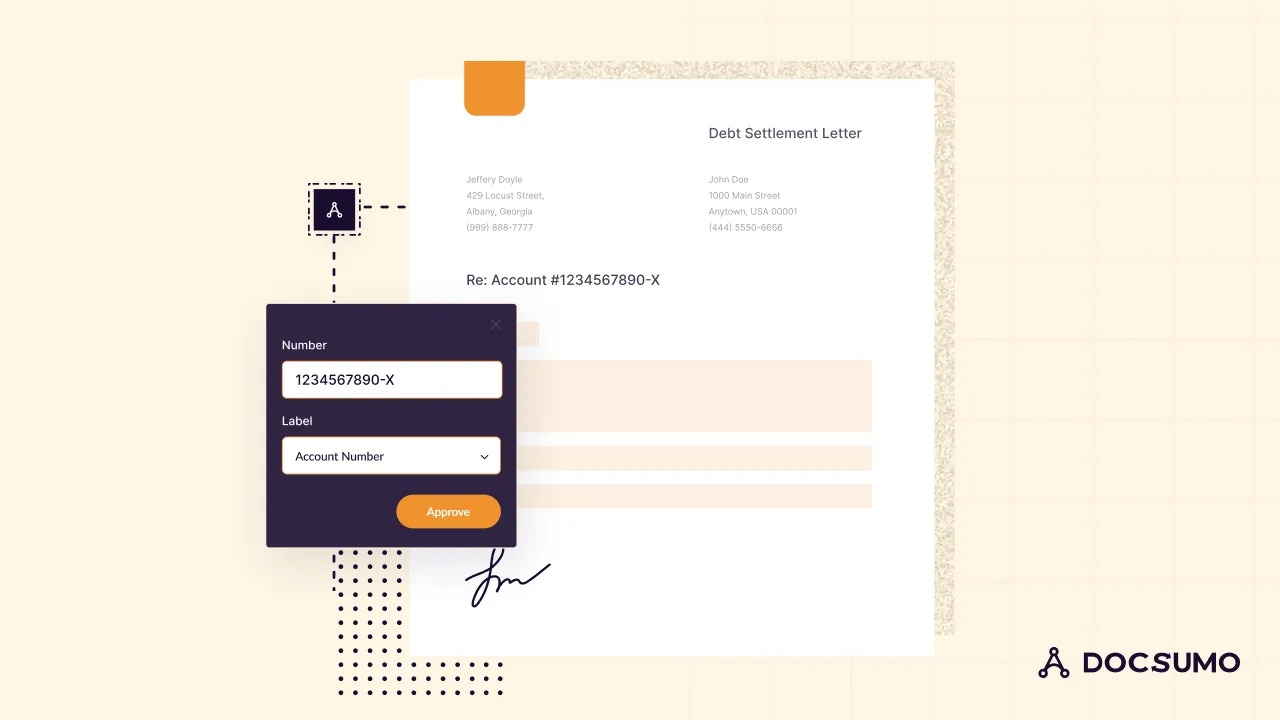
Debt settlement letter data extraction is how debt relief companies turn creditors' settlement letters into data: who the creditor or collector is, which account the letter covers, the balance, the settlement amount, the payment schedule and the deadline to accept. Every creditor and collection agency formats its letters differently, so AI extraction reads each layout as it comes, matches the letter to the client's enrolled debt and sends only uncertain values to a person.
This guide covers the fields to capture, how settlement amounts and fees work out, the checks to run on every letter, and how to automate the workflow.
What's in a debt settlement letter#
Eight fields decide what a negotiator does next:
Creditor or collector
Who holds the debt now, and who you're negotiating with. Debts get sold and placed with agencies, so a letter may name both the original and the current creditor.Account number
Ties the letter to the right enrolled debt, even when only the last four digits are printed.Client name and address
Confirms the letter is about your client, not someone with a similar name.Balance
What the creditor says is owed now. It may have grown since enrollment with interest and fees.Settlement amount
What the creditor will accept, and its share of the balance.Payment terms
A lump sum or installments: each amount, due date, payee and payment method.Deadline
When the offer expires or the first payment must arrive. Miss it and the offer can lapse.Settlement terms
Whether payment resolves the debt in full, and any conditions the creditor attaches.
The letters debt relief teams process#
Settlement letters aren't the only creditor mail a debt relief team reads. Each type answers a different question:
| Letter | What to extract | Checked against |
|---|---|---|
| Settlement offer | Creditor, account, balance, offer amount, payment options, expiry date | The enrolled debt and the funds in the client's dedicated account |
| Settlement agreement | Agreed amount, installment schedule, settled-in-full wording, signatures | The offer and the client's approval |
| Payment confirmation | Amount received, date, whether the debt is satisfied | The payment schedule |
| Validation notice | Debt collector, creditor, account number, amount owed, dispute deadline | The enrolled debt, and whether it was sold or placed |
How settlement amounts and fees work out#
The settlement amount is what the creditor or collector agrees to accept, and the letter states it. The FTC's Telemarketing Sales Rule, which covers for-profit debt relief companies that sign up clients by phone, shapes what happens next: a company can't collect a fee until it has settled the debt, the client has agreed to the creditor's written terms, and the client has made at least one payment under them. The fee is either a proportional share of the total fee, matching the share of the enrolled debt that's been settled, or a fixed percentage of savings, measured from the balance when the client enrolled.
| Item | Amount |
|---|---|
| Balance when the client enrolled | $3,566.00 |
| Settlement amount in the creditor's letter | $2,140.00 (60% of the enrolled balance) |
| Savings | $1,426.00 |
| Fee at 25% of savings, the rate in the FTC's own example | $356.50 |
How to verify a debt settlement letter#
Run these checks before a client accepts an offer or a fee is taken.
- The account matchesCreditor, account number and client name match an enrolled debt.
- The sender can settle itThe letter comes from the current creditor or a collector acting for it, not an earlier owner of the debt.
- The amounts add upThe settlement is less than the balance, and the installments add up to the settlement amount.
- The dates workThe first payment date and the offer deadline leave time for the client's approval and for the funds to be in the dedicated account.
- The terms are in writingThe creditor's agreement is in writing and the client has agreed to it. The FTC's rule needs both, and a first payment, before a fee.
- The records are keptThe creditor's written agreement and proof of the client's payment are on file. The FTC accepts a creditor's settlement offer with evidence of a matching payment as proof that a debt was settled.
How to automate debt settlement letter processing#
Debt settlement workflow automation takes the reading and matching off negotiators' desks. AI models read layouts they haven't seen before, so a letter from a new creditor or collection agency goes through the same flow as the rest.
- Creditor mail and email
- Client uploads
- Collection notices
- 01Classify the letter
- 02Extract the terms
- 03Match to the enrolled debt
- 04Review exceptions
Letters are sorted by type as they arrive, their fields are extracted, and each one is matched to the client and debt it belongs to. Letters that fail a check, and fields the model is unsure about, go to a person; the rest update the client's record. When letters arrive bundled with statements and other mail, see multi-document handling.
Debt settlement automation with Docsumo#
Docsumo is an intelligent document processing (IDP) platform. Letters come in by email to a Docsumo inbox, by upload or through the API, and it reads them in any creditor's layout, scans and handwritten notes included. On the Business plan it classifies and splits mixed uploads. On the Enterprise plan, master data lookup checks the extracted creditor and account number against your client records. Fields it's unsure about go to your team with the source line highlighted. Calculations such as the settlement percentage or your fee can run as a workflow step you set up (an AI step or your own Python code). Data goes to your CRM or settlement system through API and webhooks, or downloads to Excel. It doesn't negotiate with creditors, move client funds or decide whether a client should accept an offer.
- 95%straight-through processing on debt settlement letters at National Debt Relief
- 170,000documents processed in 9 months at ClearOne Advantage
- 96.67%less processing time at ClearOne Advantage
Read the National Debt Relief and ClearOne Advantage stories.
The bottom line#
Debt settlement letters are short, but every creditor writes them differently, and their terms decide when your client pays and when you can charge. Extract the same fields from every letter, check them against the enrolled debt before anyone accepts, and keep the written agreement and proof of payment. Automating the reading and matching leaves negotiators with the letters that need judgment.
Book a demo with a few of your own settlement letters, or start a free trial.
Frequently asked questions#
What is a debt settlement letter?
A letter from a creditor or debt collector that offers, or confirms, an agreement to accept less than the full balance to resolve a debt. It states the account, the balance, the settlement amount, how and when to pay, and what happens once the payments are made.
How is a debt settlement amount calculated?
The creditor or collector decides what it will accept, and the letter states the amount and the payment schedule; dividing it by the balance gives the settlement percentage. For fees, the FTC measures savings from the amount enrolled: in its own example, a $1,000 debt settled for $600 saves $400, and a fee disclosed as 25% of savings comes to $100.
How do you verify a debt settlement letter?
Match the creditor, account number and client name to the enrolled debt, confirm the letter comes from the current creditor or a collector acting for it, check that the installments add up to the settlement amount and the dates are workable, and keep the written agreement with proof of the first payment.
What's the difference between a debt validation notice and a settlement letter?
A validation notice is the information a debt collector must give under the CFPB's Regulation F: who is collecting, the creditor, the account number, the amount owed and the date by which to dispute it. A settlement letter offers or confirms an agreement to accept less than the amount owed.
Can AI extract data from debt settlement letters?
Yes. Intelligent document processing reads each creditor's layout without templates, extracts the fields, checks them against your client records and sends uncertain values to a person. National Debt Relief reached 95% straight-through processing on debt settlement letters with Docsumo.
Sources
- FTC: Debt relief services and the Telemarketing Sales Rule, a guide for business
- CFPB: Regulation F §1006.34, notice for validation of debts
First published . Last updated .