W-9 form data extraction: how to collect, read and check W-9s at onboarding
For AP, vendor management and onboarding teams that collect W-9s before paying a vendor or opening an account: what's on the current form, what to extract, which checks to run, and what the IRS requires of an electronic W-9.

Key takeaways
- Form W-9 is how a US person gives a payer their correct taxpayer identification number (TIN), so the payer can report payments on information returns such as Form 1099-NEC.
- The current revision is Rev. March 2024. It added line 3b for partnerships, trusts and estates with foreign partners, owners or beneficiaries.
- Extract the name on line 1, tax classification, exemption codes, address, TIN and the signed certification. Line 7 account numbers are optional, and the form has no field for bank details.
- Check every W-9 before the first payment: current revision, TIN format, name and TIN matched against IRS records, and a signature and date. A missing or wrong TIN can mean 24% backup withholding.
- Electronic W-9s are allowed when the system meets the IRS requirements, including the payee's electronic signature under penalties of perjury as the final entry when the form must be signed.
On this page
W-9 collection automation gets a completed Form W-9 from each new vendor or customer during onboarding, extracts its fields into your vendor master or account record, and checks the name, TIN and tax classification before the first payment or account opening. If payees fill in the form online, the system has to meet five IRS requirements, from confirming who is submitting to ending with the payee's e-signature when the form must be signed. This guide covers what's on the current W-9, what to extract, which checks to run, and each IRS requirement for an electronic W-9.
What is Form W-9?
Form W-9, Request for Taxpayer Identification Number and Certification, is how a US person, including a resident alien, gives a requester their correct taxpayer identification number (TIN). The requester needs the TIN to report payments and other amounts to the IRS on information returns, so W-9 requests come from anyone who files them.
AP and vendor onboarding
Businesses paying contractors and vendors, for Forms 1099-NEC and 1099-MISC.Banks and brokers
Accounts that earn interest or dividends or sell securities, for Forms 1099-INT, 1099-DIV and 1099-B.Payment platforms
Card and third-party network payments to sellers, for Form 1099-K.Lenders and real estate
Mortgage interest, canceled debt and real estate sales, for Forms 1098, 1099-C and 1099-S.
The payee gives the form to you, not the IRS. Collect it before the first payment: whether a contractor crosses the 1099-NEC threshold ($2,000 for payments made in 2026, up from $600) is often only clear at year end, and payments to a payee who hasn't given you a TIN can be subject to backup withholding.
What's on a W-9, and what to extract
The current form is Rev. March 2024. It added line 3b and clarified how a disregarded entity fills in line 3a. The IRS posted a draft June 2026 revision in May 2026 that adds a certification checkbox for US digital asset brokers; until the IRS finalizes it, the March 2024 revision is current.
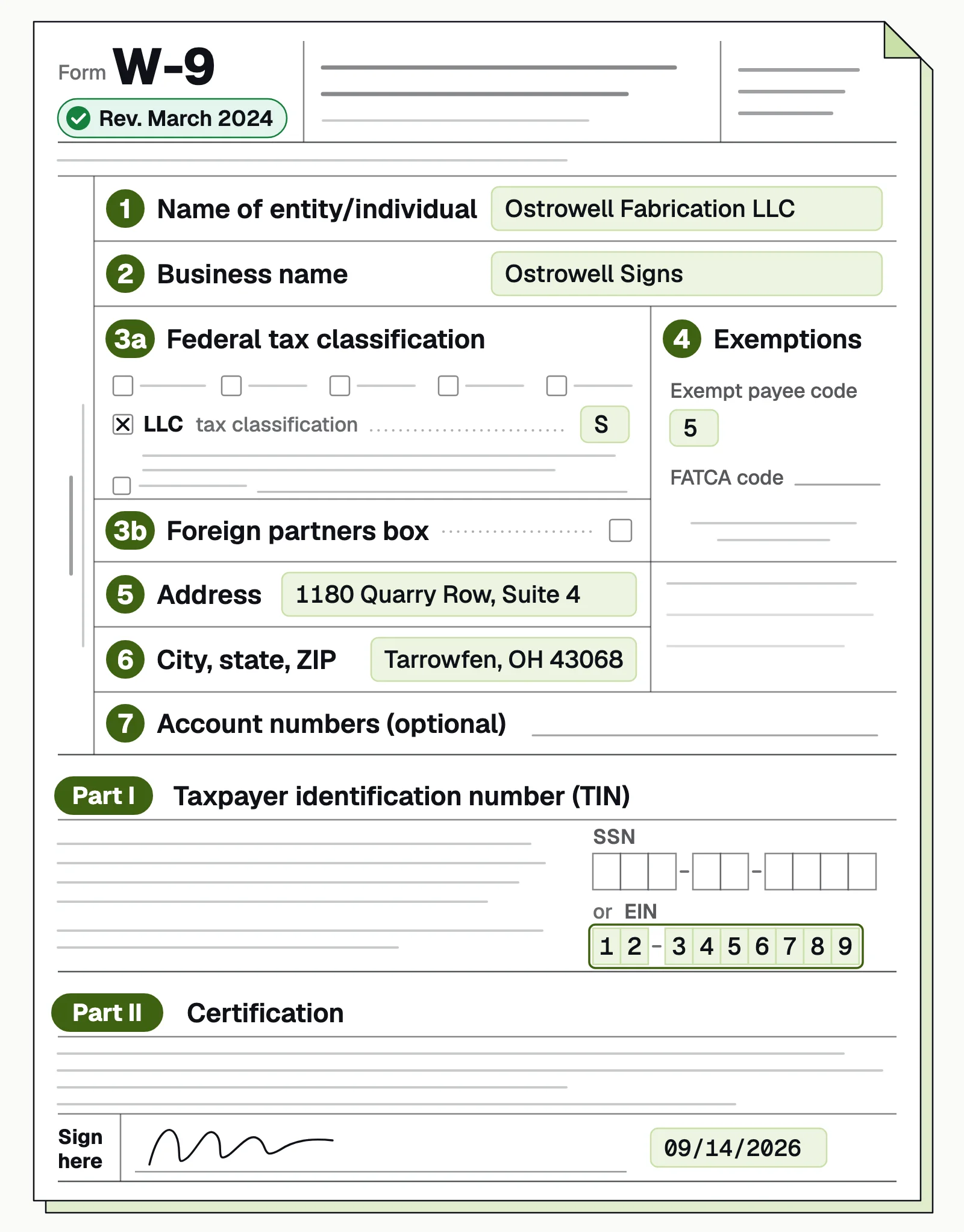
Lines 1 and 2: Names
Line 1 is required: the name on the payee's tax return. Sole proprietors and disregarded entities put the owner's name here and the business name on line 2.Line 3a: Tax classification
Exactly one of seven boxes. An LLC that checks the LLC box also enters its tax classification: C, S or P. A disregarded LLC checks its owner's box instead.Line 3b: Foreign partners
Checked by a partnership, trust or estate with foreign partners, owners or beneficiaries when it gives the form to a partnership, trust or estate it owns part of.Line 4: Exemptions
The exempt payee code and FATCA exemption code, if any. The codes apply to certain entities, not individuals.Lines 5 and 6: Address
Where you'll mail the payee's information returns. "NEW" written at the top means it differs from the address you have on file.Line 7: Account numbers
Optional: the payee's accounts with you that the form covers. The W-9 has no field for bank details, so payment details come separately.Part I: TIN
An SSN or an EIN (an ITIN goes in the SSN boxes). It must match the name on line 1.Part II: Certification
The US person's signature and the date, certifying the TIN and US status. Item 2 is crossed out if the IRS has told the payee they're subject to backup withholding.
W-9 or W-8: which form to collect
Only US persons use Form W-9. A foreign payee gives you a Form W-8 instead, and which one depends on who they are.
| Payee | Form to collect |
|---|---|
| US individual, resident alien or sole proprietor | W-9, with an SSN (or an ITIN); a sole proprietor may give an EIN |
| US corporation, partnership or LLC | W-9, with an EIN; a disregarded single-member LLC gives its owner's name and TIN |
| Foreign individual | W-8BEN |
| Foreign entity | W-8BEN-E |
| Foreign person with income effectively connected with a US business | W-8ECI |
| Foreign government or other foreign organization | W-8EXP |
| Foreign intermediary or flow-through entity | W-8IMY |
A US disregarded entity with a foreign owner uses the owner's W-8, not a W-9. A W-8 is generally valid until the last day of the third calendar year after the year it's signed, unless circumstances change, so give each W-8 a renewal date in your records. The W-9 sets no such date, but the payee must send a new one when their name or TIN changes.
How to automate W-9 collection
Ask for the W-9 in the same onboarding request as everything else you need from the vendor, such as a certificate of insurance, and route every copy, whatever the channel, into one queue. From there the form is classified, read, checked and filed without anyone retyping it.
- Vendor portal
- Onboarding email
- Account opening form
- Scanned paper
- 01Classify the form
- 02Extract every line
- 03Check the fields
- 04Review exceptions
Manual W-9 collection
- Vendors email PDFs, and someone retypes the name and TIN into the ERP
- Missing signatures and old revisions are chased one email at a time
- Name and TIN errors surface at year end, or when the IRS sends a notice
- The form sits in a shared folder, apart from the vendor record
Automated W-9 collection
- Every W-9 lands in one queue, whatever the channel
- Fields are extracted and checked the day the form arrives
- Only forms that fail a check go to a person
- The checked fields and the form itself sit with the vendor or account record
What the IRS requires of an electronic W-9
You can collect W-9s through a portal or an online form instead of on paper. The IRS instructions for requesters set five requirements for the electronic system. It must:
Receive what was sent
Ensure the information received is the information sent, and document every access that results in a submission.Confirm who submitted it
Make reasonably certain that the person submitting the form is the person named on it.Match the paper form
Provide the same information as the paper Form W-9.Produce a hard copy
Be able to supply a hard copy of the electronic form if the IRS asks for it.End with an e-signature
Require as the final entry the payee's electronic signature, made under penalties of perjury, with the perjury statement from the paper form.
A W-9 that doesn't have to be signed doesn't need the e-signature or perjury statement either, and the IRS counts fax as electronic submission. Your own substitute form is also allowed if its content is substantially similar to the IRS form, it's signed and dated under penalties of perjury, and signing it doesn't commit the payee to terms unrelated to the certifications.
Checks to run on every W-9
Run these when the form arrives, before the vendor or account is set up. Most can run automatically, so a person sees only the forms that fail.
- Current revisionRev. March 2024. The October 2018 form has no line 3b.
- Name on line 1The name on the payee's tax return: the owner's name for a sole proprietor or disregarded entity, with the business on line 2.
- One classification boxExactly one box checked on line 3a, with C, S or P entered if it's the LLC box.
- TIN formatNine digits: an SSN or ITIN as NNN-NN-NNNN (ITINs start with 9), an EIN as NN-NNNNNNN. "Applied For" means the number is on its way, and until it arrives, reportable payments other than interest and dividends are subject to backup withholding.
- Name and TIN match IRS recordsPayers that filed 1099s in the last two years can check name and TIN pairs through IRS TIN Matching, interactively or in bulk.
- Signed and datedPart II is signed and dated. For contractor pay, the form requires a signature only from payees who've been notified that they gave a wrong TIN before, but the signature certifies US status and you can ask for it. If item 2 is crossed out, flag it for your tax team.
- Exemptions that fitIndividuals and sole proprietors generally aren't exempt from backup withholding, so an exempt payee code next to one needs a look.
- Not already on fileThe TIN isn't already on another vendor record, which would point to a duplicate vendor.
Getting it wrong has a cost. Payers must withhold 24% of certain payments (backup withholding) when a payee doesn't give a TIN or the IRS says the TIN is wrong, and the IRS sends a notice when the name and TIN on an information return you filed don't match its records.
How Docsumo reads W-9s
Docsumo reads W-9s along with the other IRS forms on its tax forms page, whether they're typed, handwritten or scanned. It extracts each line, and low-confidence fields go to a person for review, with the source line highlighted when the reviewer clicks the field.
On the Business plan, auto-classification and splitting pull the W-9 out of an onboarding packet. On the Enterprise plan, master data lookup checks values against your own records, such as the vendor master. Cross-document validation, also on that plan, checks documents in the same case against each other. For example, it checks the name and TIN on a 1099 against the W-9 on file. A check such as TIN format can run as a code step you set up in the workflow. The checked data goes to your ERP or vendor system through the API and webhooks, or downloads to Excel.
Pick W-9 in the explorer below to see its fields and checks:
Individual and wage forms
Business returns
Form W-2: Wage and Tax Statement
Employers send one to each employee every January.✓ 3 passedWages one employer paid one employee in the tax year, and the taxes withheld from them.
What Docsumo reads
- Employee, box e
- Elena M. Ruiz
- Employee's SSN, box a
- XXX-XX-4127
- Employer, box c
- Front Range Dental Group PC
- Employer EIN, box b
- 84-3150792
- Wages, box 1
- 136,500.00
- Federal tax withheld, box 2
- 24,180.00
- Social security wages, box 3
- 160,000.00
- 401(k) deferrals, box 12a code D
- 23,500.00
Checked against
- Form 1040Box 1 against wages on line 1a✓ 136,500 on both
- Form 1040Box 2 against withholding on line 25a✓ 24,180 on both
- ItselfBox 3 against box 1 plus the 401(k) deferrals✓ Adds up
SSNs shown truncated. Field names and the output schema are configurable.
Docsumo doesn't pay vendors or file 1099s, and TIN Matching runs in your own IRS account. For the 1099s themselves, see our guide to tax form OCR; for the rest of the payables process, see accounts payable automation.
The bottom line
A W-9 is one page, but it decides whether your 1099s match IRS records. Ask for the current revision at onboarding, extract every line, check the name and TIN before the first payment, and keep a person on the forms that fail.
Book a demo with a few of your own W-9s, or start a free trial.
Frequently asked questions
What is a W-9 form used for?
A payer uses Form W-9 to get a US person's correct name and taxpayer identification number (TIN), which it needs to report payments to the IRS on information returns such as Forms 1099-NEC, 1099-MISC, 1099-INT and 1099-K. The payee gives the completed form to the requester, not to the IRS.
Can a W-9 be completed and signed electronically?
Yes, if the requester's system meets the IRS's five requirements. Among them, it must make reasonably certain the person submitting is the person named on the form, provide the same information as the paper form, be able to produce a hard copy for the IRS, and, when the form must be signed, end with an electronic signature under penalties of perjury.
What are common W-9 mistakes?
An outdated revision, a business name on line 1 where the owner's name belongs, an LLC box checked without its C, S or P classification, a TIN that doesn't match the name, and a missing signature or date.
Do I need a W-9 or a W-8?
Ask US persons, including resident aliens, for a W-9. Foreign payees give a Form W-8 instead: W-8BEN for individuals, W-8BEN-E for entities, and W-8ECI, W-8EXP or W-8IMY in other cases. A US disregarded entity with a foreign owner uses the owner's W-8.
What is the difference between a W-9 and a COI?
A W-9 gives you a vendor's taxpayer ID for 1099 reporting. A certificate of insurance (COI), usually an ACORD 25, shows the vendor's liability coverage. You'll often ask the same vendor for both at onboarding; see ACORD 25 data extraction.
Can OCR extract data from a W-9?
Yes. A W-9 parser combines OCR, which reads the typed or handwritten text, with extraction that maps each value to its line: the name on line 1, the box checked on line 3a, the TIN in Part I. Add checks for TIN format and a signature, and send low-confidence fields to a person. See tax form extraction.
Sources
- IRS: Form W-9, Request for Taxpayer Identification Number and Certification (Rev. March 2024)
- IRS: About Form W-9 (current revision)
- IRS: Instructions for the Requester of Form W-9 (electronic submission, substitute forms, backup withholding, IRS notices)
- IRS: Draft tax forms (Form W-9, Rev. June 2026 draft, posted May 2026)
- IRS: Taxpayer Identification Number (TIN) Matching
- IRS: Taxpayer identification numbers (TIN)
- IRS: Instructions for the Requester of Forms W-8BEN, W-8BEN-E, W-8ECI, W-8EXP and W-8IMY
- IRS: Instructions for Forms 1099-MISC and 1099-NEC ($2,000 threshold for 2026 payments)
First published . Last updated .