Unstructured data statistics: how much data is unstructured, and how much of it gets used
For writers, analysts and data leaders who need a number they can cite. Every figure is numbered, dated and linked to its publisher, and we traced the famous 80% back to 1998.

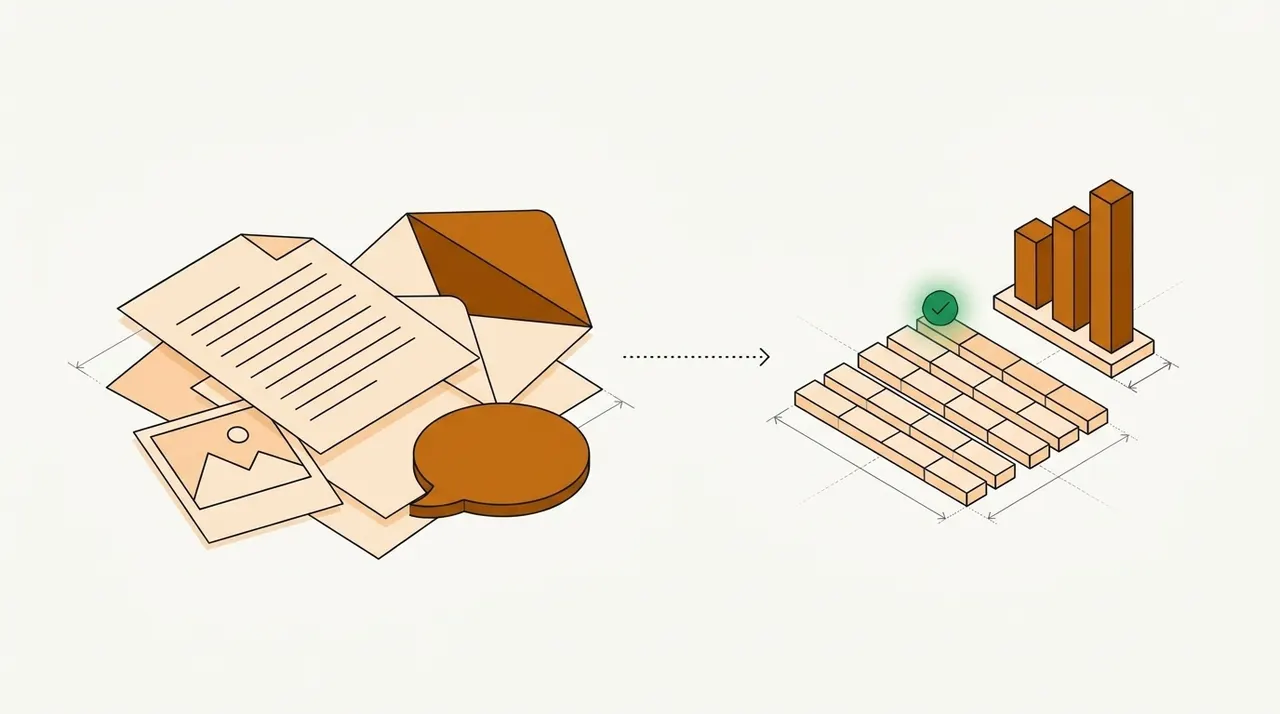
Key takeaways
- IDC estimates 92.9% of the data generated in 2023 was unstructured, and Gartner puts unstructured data at 70% to 90% of organizational data (2026).
- The popular "80% of data is unstructured" goes back to a 1998 Merrill Lynch report, which said only that some estimates ran as high as 80%.
- Structured data now grows faster. IDC forecasts 49.3% a year for structured data against 21.4% for unstructured through 2028, so the unstructured share falls below 83%.
- Only 39% of organizations say their unstructured data is ready for AI, against 65% for structured data, and IBM estimates less than 1% of enterprise data has reached AI models.
- 74% of large US companies store more than 5 PB of unstructured data, up from nearly 50% in 2024 (Komprise survey of 300 storage leaders).
On this page
- How much data is unstructured?
- How fast unstructured data is growing
- Documents, email and files
- Time spent looking for information
- How much data goes unused
- Unstructured data and AI
- Security risks in unstructured files
- Popular unstructured data statistics, checked
- How we picked and checked these figures
- If your unstructured data is mostly documents
- Frequently asked questions
Most unstructured data statistics start with the share of all data that's unstructured, and current estimates run from 70% to 93%. IDC estimates that 92.9% of the data generated worldwide in 2023 was unstructured, and Gartner puts unstructured data at 70% to 90% of what organizations hold. The "80%" quoted in most articles is older than both. It comes from a 1998 Merrill Lynch report that gave no source for it.
The figures below run from how much unstructured data there is to how ready it is for AI. Each is numbered so you can link to a single statistic, and we checked every one on the publisher's own page on September 27, 2026.
How much data is unstructured?#
Nobody counts the world's data file by file, so every share is an estimate. The two current estimates measure different things. IDC models all data generated worldwide, video and sensor data included, while Gartner describes the data organizations hold.
1. 92.9% of the data generated worldwide in 2023 was unstructured, IDC estimates, and it expects that share to fall below 83% by 2028 (IDC, 2024).
2. Unstructured data, such as documents and multimedia files, makes up 70% to 90% of organizational data, according to Gartner analyst Mark Beyer (Gartner, 2026).
3. Structured data made up less than 12% of the data enterprises generated in 2023, and IDC expects it to reach about 22% by 2028 (IDC, 2024).
4. In a survey of 500 US enterprises, respondents put unstructured data at 57% of their total storage volume (the median answer) and said 67% of it sits in cloud storage (AIIM and Deep Analysis, 2024).
The share has been quoted for almost 30 years, and it changes with each retelling. This is where each version comes from.
| Figure | Source | What it rests on |
|---|---|---|
| "As high as 80%" | Merrill Lynch equity research, 1998 (archived report) | "Some estimates run as high as 80%," with no estimate named |
| "More than 90%" | EMC announcing the IDC Digital Universe study it sponsored, 2011 (EMC, 2011) | IDC's model of all the world's digital data |
| "80% of worldwide data will be unstructured by 2025" | Credited to IDC in articles since 2019 | No IDC source. IDC's Data Age 2025 papers, where it's usually pinned, don't say it (IDC for Seagate) |
| "80% to 90%" | MIT Sloan, 2021 (MIT Sloan) | "Multiple analyst estimates," none of them named |
| "90%" | IDC white paper sponsored by Box, 2023 (Box summary) | IDC's model of data generated in 2022, not a measure of what one company stores |
| "92.9%" | IDC, 2024 (IDC) | The same model for 2023, with the share forecast to fall below 83% by 2028 |
| "70% to 90%" | Gartner, 2026 (Gartner) | An analyst estimate of the data organizations hold |
How fast unstructured data is growing#
Unstructured data is still piling up fast. It just isn't the fastest-growing kind any more, because business systems and sensors now produce structured data even faster. Companies feel the growth in storage bills more than in any global forecast.
5. IDC forecasts structured data to grow 49.3% a year from 2023 to 2028, against 21.4% for unstructured data. All data generated grows 24.4% a year, from about 132 zettabytes in 2023 to 202 zettabytes in 2025 and 394 zettabytes in 2028 (IDC, 2024).
6. IDC's August 2025 update says the same thing. Unstructured data "continues to flood the digital world," but structured data is rising faster (IDC, 2025).
7. Video and images, from films and TV to surveillance and medical imaging, made up about 69% of the unstructured data generated in 2023. IDC expects that share to fall below 43% by 2028 as IoT, social media and productivity data grow faster (IDC, 2024).
8. 74% of large US companies store more than 5 petabytes of unstructured data, up from nearly 50% in 2024, and 40% store at least 10 petabytes (Komprise, 2026; Komprise, 2024).
9. 85% of IT and storage leaders at those companies expect their storage spending to rise in 2026, up from 59% in the 2024 survey, and 55% already spend more than 30% of their IT budget on data storage (Komprise, 2026).
10. 55% of US enterprises say the cost of managing their unstructured data is rising, 42% say it's flat and only 4% say it's falling (AIIM and Deep Analysis survey of 500 US enterprises, 2024).
11. Where those costs are rising, 50% say the extra spending goes mainly to software and 31% to storage (AIIM and Deep Analysis, 2024).
12. Demand for data center storage capacity will grow 19.5% a year from 2024 to 2029, reaching 3.19 zettabytes, Gartner forecasts (Gartner, 2025).
13. By 2027, 40% of IT spending on data management will focus on managing multistructured data, Gartner predicts (Gartner, 2026).
Documents, email and files#
By volume, most unstructured data is video and images. The part that runs a business is documents and messages, and those arrive in enormous numbers.
14. Video made up about 75% of all mobile data traffic at the end of 2025 (Ericsson Mobility Report, 2026).
15. There are more than 3 trillion PDFs in circulation, by Adobe's count (Adobe, 2025).
16. Over 2 billion files are uploaded to SharePoint every day, and SharePoint serves more than 1 billion users a year (Microsoft, 2026).
17. 75% of US enterprises use SharePoint, and 36% of those run more than 100 SharePoint sites or instances (AIIM and Deep Analysis, 2024).
18. More than 361 billion emails were sent and received each day in 2024, and the Radicati Group expects over 424 billion a day by the end of 2028 (Radicati Group, 2024).
19. The average worker receives 117 emails a day and 153 Teams messages every weekday, according to Microsoft 365 data (Microsoft Work Trend Index, 2025).
20. About 300 billion B2B invoices will be issued worldwide in 2026, and only 29% of them are e-invoices issued and received digitally (billentis, 2026).
21. In North America, 36% of 28.6 billion B2B invoices are electronic, and over half of the invoices larger companies receive still arrive as paper or PDF (billentis, 2026).
22. 61% of intelligent document processing (IDP) processes still include paper documents, and 48% expect paper volumes to rise next year (AIIM and Deep Analysis survey of 600 enterprises, 2025).
23. In the primary care records of 1.8 million patients, only 13% of the clinical concepts in free-text notes had a similar structured entry in the record (Seinen et al., Journal of Medical Internet Research, 2025). Most of what doctors write never reaches a coded field, which is why healthcare document automation starts with the notes and forms.
An invoice shows the problem in miniature. Everything a finance system needs is printed on the page, but none of it is in a form a database can use until someone keys it in or software reads it out. Invoice processing does the reading, and our accounts payable statistics show what the keying costs.
| Field | Extracted value | Read |
|---|---|---|
| Vendor name | Northeast Kitchen Equipment | |
| Invoice number | NKE-9921 | |
| Invoice date | 2026-08-12 | |
| Due date | 2026-09-11 | |
| Payment terms | Net 30 | |
| PO number | 5498 (handwritten) |
| Field | Extracted value | Read |
|---|---|---|
| Vendor address | 37 Bridge St, Westbrook, ME | |
| Bill to | Harbor Street Bakery LLC | |
| Ship to | 22 Thames St, Portland, ME | |
| Remit to | PO Box 3170, Portland, ME |
| Field | Extracted value | Read |
|---|---|---|
| Item code | WT-3072 | |
| Description | Stainless work table, 30 x 72 in | |
| Quantity | 2 | |
| Unit of measure | EA | |
| Unit price | 385.00 | |
| Amount | 770.00 |
| Field | Extracted value | Read |
|---|---|---|
| Subtotal | 23,250.00 | |
| Sales tax rate | 5.5% | |
| Sales tax | 1,278.75 | |
| Freight | 121.25 | |
| Total due | 24,650.00 |
Time spent looking for information#
24. Knowledge workers and executives spend a quarter of the workweek searching for information, in Atlassian's survey of 12,000 knowledge workers and 200 Fortune 1000 executives (Atlassian, 2025).
25. Employees at US and UK companies with 5,000 or more staff say they lose about three hours a day looking for information, and that 42% of what they sift through is irrelevant to their role (Coveo survey of 4,000 employees, 2025).
Both surveys come from companies that sell search software, and people are poor judges of their own time. Read the two as a range. Even the lower figure is more than a day of every working week.
How much data goes unused#
Dark data is data a company keeps but never uses, and most of it is unstructured. The dark data shares most articles quote come from surveys and analyst notes published between 2016 and 2020. The newest estimate we found asks a narrower question.
26. Data and analytics leaders estimate that 19% of their company's data is siloed, inaccessible or otherwise unusable (Salesforce State of Data and Analytics, 2025).
That's well below the 52% to 73% in older estimates, but it isn't the same measure. The older figures counted data that was never analyzed or whose value nobody knew, and they're in the table of checked statistics below.
Unstructured data and AI#
Generative AI changed what unstructured data is for. Language models read documents directly, so files a company kept only for the record are now possible inputs. The surveys show how few of them are ready.
27. 39% of organizations say their unstructured data is somewhat or fully ready for AI, against 65% for their structured data (Harvard Business Review Analytic Services survey sponsored by Hyland, 2026).
Only 10% name a lack of data (Hyland, 2026). The data exists. It sits in the wrong format or the wrong place.
28. IBM estimates that less than 1% of enterprise data has made it into AI models (IBM Research, 2024; IBM, 2025).
29. 96% of organizations say AI agents need access to company-specific content, but only 36% of those using agents have connected them to trusted internal content across many use cases (Box survey of 1,640 IT leaders, 2026).
30. 49% of IT leaders call automated extraction of structured data from unstructured files "very important" to their downstream workflows, rising to 70% at companies on the leading edge of AI adoption (Box, 2026).
31. Classifying and tagging is the top challenge in preparing unstructured data for AI, named by 56% of storage leaders at large US companies, up from 41% in 2024 (Komprise, 2026).
32. For 54% of IT leaders at large US companies, the hardest part is finding the right unstructured data and moving it to where AI can ingest it (Komprise survey of 200 IT leaders, 2025).
33. Data problems have led 55% of organizations to avoid some generative AI use cases, and 75% are investing more in data management because of generative AI (Deloitte survey of 2,770 leaders, 2024).
34. Retrieval-augmented generation, which answers questions from a company's own documents, reached 51% adoption in Menlo Ventures' 2024 survey of 600 US IT decision-makers, up from 31% a year earlier (Menlo Ventures, 2024).
35. Through 2028, teams that build their own unstructured metadata tools will spend more than 300% more than they would with existing document and records tools, Gartner predicts (Gartner, 2026).
36. 63% of organizations don't have, or aren't sure they have, the right data management practices for AI, and Gartner predicts organizations will abandon 60% of AI projects that lack AI-ready data through 2026 (Gartner, 2025).
Our take. Those classification numbers are why we wouldn't start with the whole archive. We'd start with the one document type that drives a decision and arrives in volume, such as invoices or bank statements, get its fields out reliably, and widen from there.
That first step is what document AI is for. For market figures on the software itself, see our intelligent document processing statistics.
Security risks in unstructured files#
AI tools read whatever they can reach. That turns years of loosely shared files into an exposure problem.
37. 99% of organizations have sensitive data exposed to AI tools, and 90% have sensitive files open to every employee through Microsoft 365 Copilot, in Varonis's risk assessments of 1,000 organizations (Varonis, 2025).
38. Only 1 in 10 companies in the same assessments had labeled their files (Varonis, 2025).
39. 49% of organizations have had an incident in which an AI tool surfaced content a user shouldn't have been able to see, and 34% have formal standards for how agents access company data (Box, 2026).
40. 79% of IT leaders at large US companies say sending corporate data to AI has led to negative outcomes, and 44% cite sensitive data leaking into AI (Komprise, 2025).
41. Reducing data risk from AI is the top business challenge in managing unstructured data, for 62% of storage leaders (Komprise, 2026).
Popular unstructured data statistics, checked#
These figures still turn up in articles about unstructured data. We traced each one to its origin, and the current figure sits beside it where one exists.
| As often quoted | What the original says | Cite instead |
|---|---|---|
| "Unstructured data grows 55% to 65% a year" | Usually credited to Gartner, with no link. We found no Gartner or IDC source for it. | 21.4% a year for unstructured data and 49.3% for structured data, 2023 to 2028 (IDC, 2024) |
| "The world will hold 175 zettabytes of data by 2025" | IDC's 2018 forecast in a white paper sponsored by Seagate, covering all data created or copied in a year, not only unstructured data (IDC for Seagate, 2018) | About 202 zettabytes generated in 2025 and 394 zettabytes by 2028 (IDC, 2024) |
| "90% of the world's data was created in the last two years" | SINTEF, a Norwegian research institute, said it in 2013 about data at that time (ScienceDaily, 2013). It's still quoted as current. | Data generated grows 24.4% a year (IDC, 2024) |
| "55% of an organization's data is dark," often dated 2025, or "52%" or "68%" | Splunk's 2019 survey (Splunk, 2019), Veritas's 2016 Databerg survey (Veritas, 2016) and a 2020 survey Seagate commissioned from IDC (Seagate, 2020), all based on respondents' estimates | 19% of company data is siloed, inaccessible or unusable, a narrower measure (Salesforce, 2025) |
| "60% to 73% of enterprise data goes unused for analytics" | A 2016 Forrester blog post that gives no method (Forrester, 2016) | No current figure on the same measure |
| "Only 0.5% of data is ever analyzed" | IDC's 2012 estimate for the whole digital universe, most of it consumer video and images, not company data (IDC for EMC, 2012) | No current figure on the same measure |
| "Knowledge workers spend 2.5 hours a day searching for information" | IDC's 2001 white paper, which called it "a general estimate" (IDC, 2001) | A quarter of the workweek (Atlassian survey, 2025) |
| "Employees spend 1.8 hours a day, or 19% of the week, searching for information" | McKinsey's 2012 report on social technologies, built on IDC's time estimates (McKinsey, 2012) | A quarter of the workweek (Atlassian survey, 2025) |
| "Only 18% of organizations use their unstructured data" | Deloitte's 2019 survey of 1,048 US executives found 18% "have taken advantage of unstructured data" (Deloitte, 2019) | 39% say their unstructured data is AI-ready, a different measure (survey sponsored by Hyland, 2026) |
How we picked and checked these figures#
Every numbered figure was published in 2024, 2025 or 2026, and we checked each one on the publisher's own page or report on September 27, 2026. The figures in the two tables are older on purpose, because they trace numbers that are still being quoted.
Many sources here sell products in this area. Box, Komprise, Hyland, Salesforce, Varonis, Atlassian and Coveo ran or sponsored their own surveys, and Menlo Ventures invests in AI companies. M-Files underwrote AIIM's 2024 research on unstructured data, four document software vendors underwrote its 2025 IDP survey, and e-invoicing vendors sponsor the billentis report. IDC's structured and unstructured figures come from an excerpt of its September 2024 forecast that IDC licensed to Box. Adobe's PDF count and Microsoft's SharePoint figures are the companies' own. We kept these sources because they're the newest numbers on their questions, and each figure names its source.
IDC counts data generated, including video and sensor data, and folds semi-structured data into its unstructured total. Gartner's range describes the data organizations hold. The two answer different questions, so quote the source and year with the number.
If your unstructured data is mostly documents#
For most finance and operations teams, the unstructured data that matters arrives as documents, such as invoices, bank statements, claim forms and contracts. That's also the part software can now turn into fields reliably, with a person checking only the values it isn't sure of.
Before sizing a project from any percentage on this page, count the documents your team reads and retypes in a week. That number tells you where to start, and it's easy to check against a pilot, ours included.
To see it on your own files, book a demo or start a free trial.
Frequently asked questions#
What percentage of data is unstructured?
Current estimates run from 70% to over 90%. IDC estimates 92.9% of the data generated worldwide in 2023 was unstructured, and Gartner puts unstructured data at 70% to 90% of organizational data. Both are estimates rather than counts, and IDC expects the share to fall below 83% by 2028.
Is it true that 80% of data is unstructured?
It's an old estimate, never a measurement. The figure goes back to a 1998 Merrill Lynch report that said "some estimates run as high as 80%" without naming any of them. Today's estimates from IDC and Gartner put the share between 70% and 93%, depending on what's counted.
How fast is unstructured data growing?
IDC forecasts unstructured data generated worldwide to grow 21.4% a year from 2023 to 2028, while structured data grows 49.3% a year. The often-quoted 55% to 65% annual growth rate has no source we could trace.
How much unstructured data is used for AI?
Very little so far. IBM estimates less than 1% of enterprise data has made it into AI models, and only 39% of organizations say their unstructured data is AI-ready. In Box's 2026 survey, 36% of organizations using AI agents had connected them to trusted internal content across many use cases.
What is dark data?
Data a company collects and keeps but never uses, most of it unstructured, such as old files and emails. The shares most articles quote, from 52% to 73%, come from vendor surveys and analyst notes published between 2016 and 2020. A 2025 Salesforce survey asked a narrower question and found leaders consider 19% of their company's data siloed, inaccessible or unusable.
What are examples of unstructured data?
Documents such as PDFs, invoices and contracts, plus emails, chat messages, images, audio and video. Our guide to structured vs unstructured vs semi-structured data explains the differences with examples.
Sources
- IDC, Worldwide Global DataSphere Structured and Unstructured Data Forecast, 2024–2028 (excerpt licensed to Box) (Sep 2024)
- Gartner, Data & Analytics Summit 2026 London, Day 2 highlights (May 12, 2026)
- AIIM, New AIIM report by Deep Analysis on AI adoption and unstructured data management (Sep 10, 2024)
- Merrill Lynch (Shilakes and Tylman), Enterprise Information Portals, archived copy (Nov 16, 1998)
- EMC, World's data more than doubling every two years (IDC Digital Universe study) (Jun 28, 2011)
- IDC for Seagate, Data Age 2025: The Evolution of Data to Life-Critical (Apr 1, 2017)
- MIT Sloan, Tapping the power of unstructured data (Feb 1, 2021)
- Box, 90% of your data is unstructured, and it's full of untapped value (summary of an IDC white paper) (Aug 24, 2023)
- IDC, Worldwide Global DataSphere Structured and Unstructured Data Forecast, 2025–2029 (abstract) (Aug 1, 2025)
- Komprise, Companies are collecting more unstructured data and spending more to manage it (2026 survey) (Dec 9, 2025)
- Komprise, Enterprise IT builds AI infrastructure on a budget (2024 survey) (Aug 6, 2024)
- Komprise, 2026 State of Unstructured Data Management report (Dec 9, 2025)
- Deep Analysis and AIIM, Market Momentum Index: AI and Unstructured Data Management (report hosted by M-Files) (Sep 7, 2024)
- Gartner, Forecast analysis: data center storage capacity by delivery type, worldwide, 2024–2029 (summary) (Oct 27, 2025)
- Gartner, Data & Analytics Summit 2026 Orlando, Day 2 highlights (Mar 10, 2026)
- Ericsson Mobility Report, June 2026 (Jun 16, 2026)
- Adobe, Acrobat Studio delivers new AI-powered home for productivity and creativity (Aug 19, 2025)
- Microsoft, SharePoint at 25: how Microsoft is putting knowledge to work in the AI era (Mar 2, 2026)
- The Radicati Group, Email Statistics Report 2024–2028, executive summary (archived copy) (Dec 2, 2024)
- Microsoft WorkLab, Breaking down the infinite workday (Work Trend Index special report) (Jun 17, 2025)
- billentis, E-invoicing report 2026: Riding the Tornado (Jun 8, 2026)
- AIIM, AIIM study reveals AI-driven transformation in document processing (IDP survey 2025) (Aug 13, 2025)
- Seinen et al., Using structured codes and free-text notes to measure information complementarity in electronic health records, Journal of Medical Internet Research (Feb 13, 2025)
- Atlassian, The State of Teams 2025 (Mar 7, 2025)
- Coveo, EX Relevance Report 2025 (Apr 29, 2025)
- Salesforce, Study: 84% of technical leaders need data overhaul for AI strategies to succeed (State of Data and Analytics) (Nov 4, 2025)
- Hyland, Harvard Business Review Analytic Services research on the AI readiness gap (Apr 29, 2026)
- IBM Research, The future of AI is open (Think 2024) (May 23, 2024)
- IBM, Agentic AI has an unstructured data problem (May 6, 2025)
- Box, State of AI in the Enterprise 2026: enterprise content becomes the AI bottleneck (Jun 11, 2026)
- Komprise, Survey finds shadow AI is a major concern across enterprise IT (Jun 3, 2025)
- Deloitte, State of Generative AI in the Enterprise, Q3 2024 (Aug 20, 2024)
- Menlo Ventures, 2024: The State of Generative AI in the Enterprise (Nov 20, 2024)
- Gartner, Lack of AI-ready data puts AI projects at risk (Feb 26, 2025)
- Varonis, 2025 State of Data Security Report (May 20, 2025)
- Varonis, State of Data Security Report (blog summary) (May 20, 2025)
- Box, State of AI in the Enterprise 2026: governance makes scale possible (Jun 11, 2026)
- IDC for Seagate, Data Age 2025: The Digitization of the World From Edge to Core (Nov 1, 2018)
- ScienceDaily (source: SINTEF), Big Data, for better or worse: 90% of world's data generated over last two years (May 22, 2013)
- Splunk, Dark data research reveals widespread complacency (State of Dark Data), archived copy (Apr 30, 2019)
- Veritas, Global Databerg Report finds 85% of stored data is either dark or ROT, archived copy (Mar 15, 2016)
- Seagate, Rethink Data report reveals that 68% of data available to businesses goes unleveraged (Jul 15, 2020)
- Forrester, Hadoop is data's darling for a reason, archived copy (Jan 21, 2016)
- IDC for EMC, The Digital Universe in 2020 (copy hosted by Princeton University) (Dec 1, 2012)
- IDC (Feldman and Sherman), The High Cost of Not Finding Information, archived copy (Jul 1, 2001)
- McKinsey Global Institute, The social economy (Jul 1, 2012)
- Deloitte Insights, Analytics and AI-driven enterprises thrive in the Age of With (Jul 25, 2019)
First published .