Data extraction techniques: 10 methods and when to use each
For analysts, engineers and operations leads choosing how to get data out of documents, databases and websites: 10 techniques compared, with where each one works and where it breaks.

Key takeaways
- Data extraction techniques are the methods used to pull specific data out of a source, such as a document, database, app or website, into a structured format.
- The right technique depends on the source: SQL and APIs for databases and apps, web scraping for websites, and OCR plus machine learning for documents.
- For documents, techniques build on each other: OCR reads the text, rules or models find the fields, and validation checks them.
- Templates and regular expressions are cheap and precise on fixed layouts but break when layouts change; machine learning and LLMs handle variety but need confidence checks.
- Most production pipelines combine techniques and send low-confidence results to a person.
On this page
Data extraction techniques are the methods used to pull specific data out of a source, such as a database, an app, a website or a document, into a structured format you can analyze or load into another system. The main ones are manual entry, database queries, APIs, web scraping, OCR, templates, regular expressions, machine learning, NLP and large language models. Which one fits depends mostly on where the data lives.
Where does your data live?
Data extraction techniques compared#
| Technique | Best source | Strengths | Limits |
|---|---|---|---|
| Manual data entry | Anything a person can read | Flexible, no setup | Slow, costly, error-prone at volume |
| Database querying (SQL) | Relational databases | Precise, fast, repeatable | Only works on data already in a database |
| API integration | SaaS apps and platforms | Structured, reliable, often real time | Limited to what the API exposes; rate limits |
| Web scraping | Public websites | Reaches data with no API | Breaks when pages change; check terms of use and law |
| OCR | Scanned documents and images | Turns images into text | Text only; doesn't know which value is which |
| Template or zonal extraction | Fixed-layout forms | Precise on a known layout | Needs a template per layout |
| Pattern matching (regex) | Text with predictable formats | Cheap, transparent, exact | Brittle when wording varies |
| Machine learning models | Semi-structured documents | Handle many layouts; give confidence scores | Need labeled examples |
| NLP (entity recognition) | Free text such as contracts and emails | Finds names, dates, amounts by meaning | Needs tuning for domain language |
| Large language models | Varied documents and free text | No training; flexible schemas | Can return confident wrong values; cost per page |
Techniques for data that's already digital#
When the data already sits in a system, extraction is mostly a question of access.
Manual data entry
A person reads the source and types the values: the fallback for rare documents, slow at volume.Database querying
SQL selects the rows and columns you need, with filters and joins.API integration
Call an endpoint and parse the JSON: the most reliable route into CRMs, ERPs and payment platforms.Web scraping
Parse a page's HTML for prices or listings. See data extraction vs data scraping.
Techniques for documents#
Documents are where most manual extraction still happens: invoices, bank statements, pay stubs, tax forms and insurance forms, arriving as PDFs, scans and photos. The techniques build on each other: OCR reads the text, then rules or models find the fields.
OCR
Turns an image of text into characters, but doesn't know that "4,120.50" is the invoice total. See OCR accuracy.Templates
Say where each field sits on a known layout, so every new layout needs a new template. See zonal OCR.Regular expressions
Find values by format, such as dates and amounts. Cheap, transparent and good for validation.Machine learning and NLP
Learn where fields sit from labeled examples, or find names, dates and amounts in free text, with a confidence score per value.Large language models
Extract fields from layouts they've never seen, given a schema. Validate every value and send uncertain ones to a person. See LLMs in document processing.
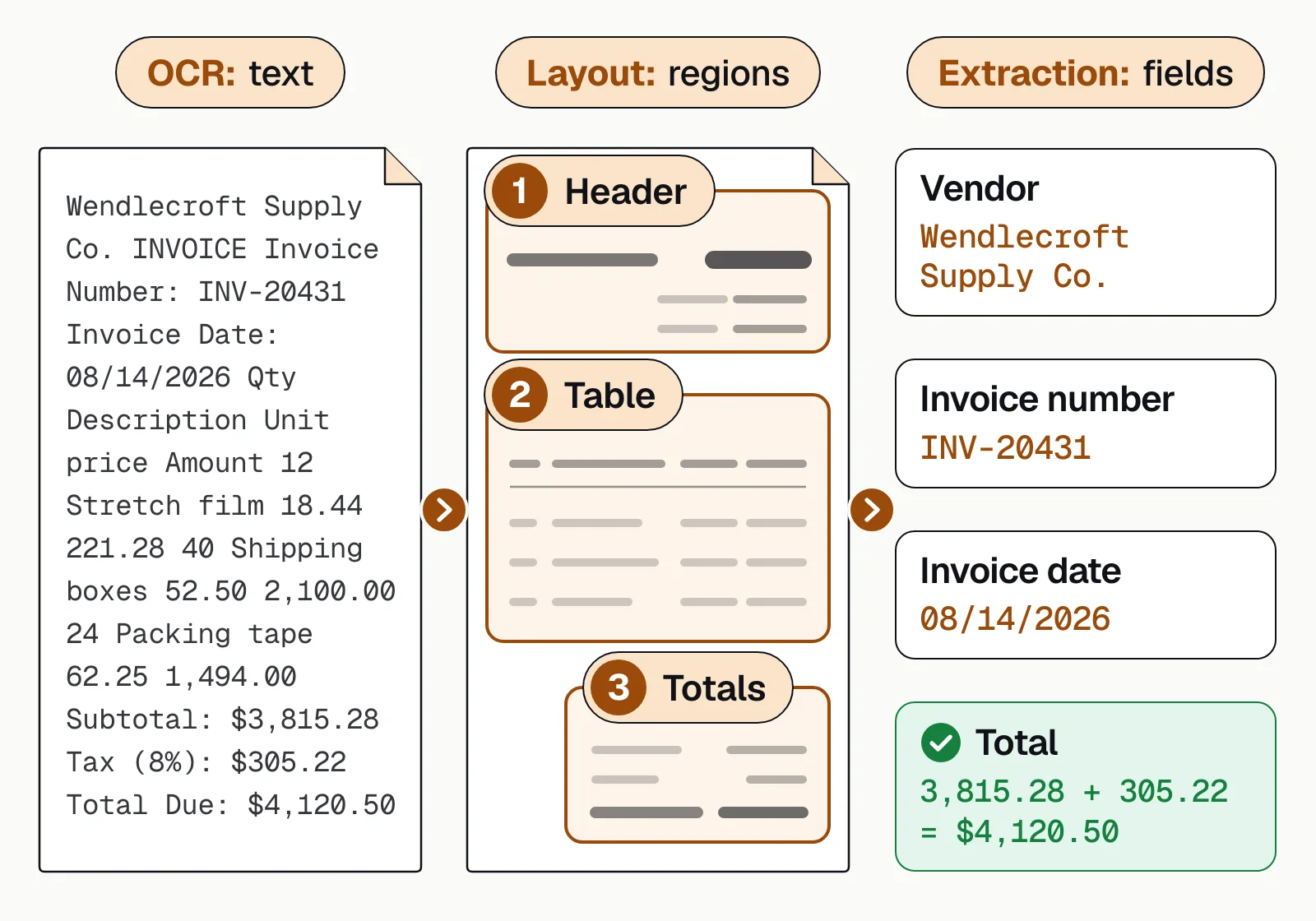
Regular expressions work on OCR text like the first panel above. This Python example (3.8+) pulls three fields from it:
import re

text = """INVOICE
Invoice Number: INV-20431
Invoice Date: 08/14/2026
Total Due: $4,120.50"""

patterns = {
    "invoice_number": r"Invoice Number:\s*([A-Z]+-\d+)",
    "invoice_date": r"Invoice Date:\s*(\d{2}/\d{2}/\d{4})",
    "total_due": r"Total Due:\s*\$([\d,]+\.\d{2})",
}
fields = {name: (m.group(1) if (m := re.search(p, text)) else None) for name, p in patterns.items()}
print(fields)
# {'invoice_number': 'INV-20431', 'invoice_date': '08/14/2026', 'total_due': '4,120.50'}
The weakness shows as soon as another vendor writes "Amount due" instead of "Total Due": every variation needs another pattern.
How techniques combine in a document pipeline#
No single technique handles real document volume. An intelligent document processing pipeline chains them, and uses regex, math checks, master data lookups and cross-document comparisons to validate the results.
- PDFs
- Scans
- Photos
- Emails
- 01Classify
- 02Read
- 03Extract
- 04Validate
- 05Review
Arbor Realty Trust runs its insurance compliance documents through this kind of pipeline with Docsumo.
- 99%accuracy on insurance compliance documents at Arbor
- 3,000+hours a month saved at Arbor
How to choose a data extraction technique#
Five checks settle most choices.
- Text layer or scanA PDF with a text layer can be parsed directly; scans and photos need OCR first.
- Layout varietyOne fixed form: a template may do. Hundreds of layouts: machine learning or an LLM.
- How you'll catch errorsConfidence scores, validation rules and a review step matter more than raw accuracy.
- MaintenanceTemplates and regex are cheap to write and expensive to keep up as layouts drift.
- Build or buyA document pipeline means owning OCR, models, validation and a review screen. Platforms such as Docsumo cover 250+ document types with 99% field-level accuracy; compare options in the best data extraction software.
The bottom line#
Pick the technique that matches where your data lives. Query databases and apps directly; for documents, combine OCR, models and validation, with a person reviewing the values the software isn't sure about. New to the topic? Start with what data extraction is.
Book a demo with a few of your own documents, or start a free trial.
Frequently asked questions#
What are the main data extraction techniques?
Manual entry, database querying, API integration, web scraping, OCR, template or zonal extraction, pattern matching with regular expressions, machine learning models, natural language processing, and large language models. Most real pipelines combine several.
What is the best technique for extracting data from PDFs?
If the PDF has a text layer and a fixed layout, a parser plus rules may be enough. For scans and varied layouts such as invoices or bank statements, use OCR with machine learning models and validation, which is what intelligent document processing platforms do.
What is the difference between data extraction and data mining?
Extraction retrieves specific data from a source into a structured form. Data mining analyzes large datasets, often after extraction, to find patterns and trends.
Are LLMs good at data extraction?
They are good at reading unfamiliar layouts and free text with no training. They can also return confident but wrong values, so production use needs schema constraints, validation rules and human review for low-confidence fields.
What is ETL?
Extract, transform, load. Data is extracted from source systems, cleaned and reshaped, and loaded into a destination such as a data warehouse. Document extraction often feeds the "extract" step of an ETL pipeline.
Sources
- Python documentation: re (regular expressions)
- Tesseract OCR on GitHub
- spaCy: Named entity recognition
- Docsumo: Arbor case study
First published . Last updated .