Healthcare accounts payable automation: what to check on each supplier invoice
For AP and finance teams at hospitals, provider groups, clinic networks and device makers. See what each supplier invoice should match, which checks software can do, and when you need a business associate agreement (BAA).

Key takeaways
- Healthcare accounts payable automation reads the invoices suppliers send, checks each one, and sends a person only the invoices that fail a check.
- Check invoices for medical and surgical supplies against the contract price and the unit of measure, not only the PO. Over 95% of US hospitals buy through group purchasing organizations (GPOs), which negotiate those contract prices.
- Bill-only implant invoices arrive after surgery. The hospital creates the PO after the surgery too. Check these invoices against the record of which implants were used.
- Match staffing agency invoices to the approved timesheets and the rate in the agency contract.
- If any invoice or supporting document can include patient details, get a business associate agreement (BAA) from the software vendor. Sign it before those documents reach the software.
On this page
- What reaches a healthcare AP team
- What makes healthcare invoices harder to check
- What to automate, and what stays with your team
- What each invoice costs to process
- When AP software needs a BAA
- If you make medical devices
- How Docsumo handles healthcare supplier invoices
- Test it on your implant and agency invoices
- Frequently asked questions
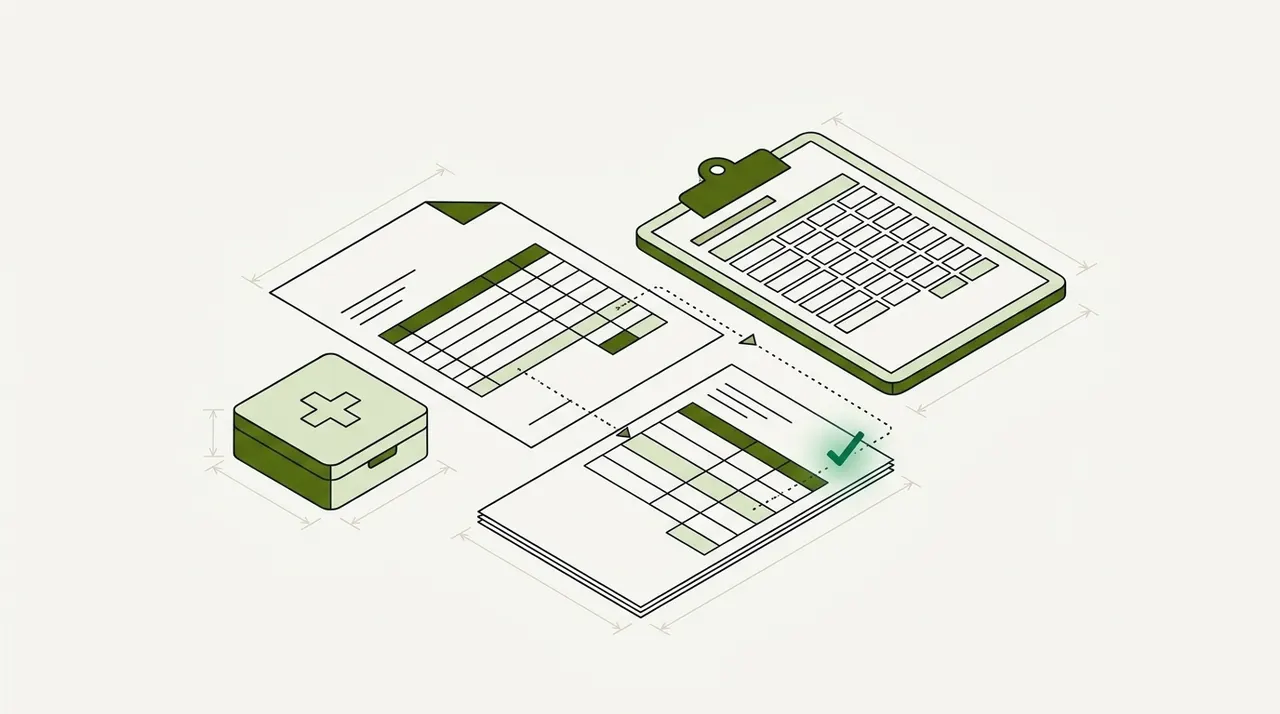
Healthcare accounts payable automation is software that reads the invoices a hospital or clinic gets from its suppliers. It checks each one against the purchase order, the contract and what was received. Invoices that pass go to approval and then into the ERP. The rest wait for a person, with the reason shown. Provider groups and device makers use it too.
What reaches a healthcare AP team#
Each kind of supplier invoice needs its own check before it's paid. The table lists the usual ones and what to check each one against.
| Invoice | Who sends it | Check it against |
|---|---|---|
| Medical and surgical supplies | Distributors and manufacturers | The PO, the contract price and the unit of measure |
| Implants billed after surgery | The implant maker's billing team, from its rep's record of what was used | The record of which implants were used in the surgery, and the PO the hospital creates after surgery |
| Pharmacy | Drug wholesalers | The PO and what the pharmacy received |
| Staffing | Nurse and physician staffing agencies | Approved timesheets and the contract rate |
| Leases and service contracts | Equipment lessors and service vendors | The lease or contract schedule |
| Facilities and utilities | Utilities, cleaning, food and waste services | The contract and last month's bill |
| Components and contract manufacturing | Suppliers to device makers | The PO and the goods receipt |
GHX sells ordering and invoice software to hospitals and suppliers. It says hospitals order most medical and surgical supplies through their ERP by electronic data interchange (EDI). Invoices are electronic less often than orders. GHX estimated in 2023 that about half of invoices still arrive on paper or by email. Without automation, AP staff type those invoices in by hand. Document software can read those paper and email invoices instead.
What makes healthcare invoices harder to check#
Supply prices come from contracts, not only from the PO. Over 95% of US hospitals buy through group purchasing organizations (GPOs), which negotiate prices for their members. So the real question on a supply invoice is whether the price matches the contract. Units cause a second kind of mismatch. A PO may order gloves by the case while the invoice bills by the box, and the quantities look wrong until someone converts them.
Implants break the usual order of PO, delivery and invoice. For many implants, the maker's sales rep brings a selection to the hospital the day before or the day of surgery. The surgeon picks what fits the patient, so the hospital can't create a PO ahead of time. This process is called bill only. After the surgery, the rep and a nurse each record what was used. The hospital creates the PO from the nurse's record, and the supplier's billing team creates the invoice from the rep's record. The records travel as sticker sheets, PDFs, emails and sometimes faxes. GHX says the invoice and the PO often don't match when AP compares them.
Staffing agencies bill for hours worked at a set rate. Check each invoice against the timesheets a manager approved and the rate in the agency contract. Provider groups and clinic networks have one more task. One supplier may bill many sites, so AP must code each invoice to the right entity and cost center.
What to automate, and what stays with your team#
Healthcare AP automation can take over the reading and most of the checking. Here is how the daily work changes.
By hand
- A clerk keys each invoice line into the ERP from a PDF or a scan.
- Prices get checked against the contract when someone has time.
- A second copy of an invoice is caught only if someone remembers the first.
- Invoices wait in approvers' email until someone asks about them.
With AP automation
- Every line is read, including lines that run onto a second page.
- Each line is matched to the price and quantity on the PO.
- An invoice that duplicates one already received is flagged.
- Invoices go to approvers by the rules you set.
People still make the decisions. Your team handles the invoices that fail a check. Your ERP or bank still makes the payments. A price that doesn't match the contract still needs a call to the distributor, and usually a credit memo. An implant invoice with no usage record still needs someone in the operating room or supply chain to confirm what was used.
Our take. Keep the work on failed invoices with your own AP team. In healthcare, fixing a failed invoice usually takes facts that only your team has. Your staff know which contract price applies and which agency shifts a manager approved, and they know who to call. Buy software that your own team runs, not a service whose staff review your invoices for you. That way you keep control of the process and what it costs.
What each invoice costs to process#
Ardent Partners' State of ePayables 2025, a sponsored analyst report, puts the average cost of processing one invoice at $9.84. On average, 18.4% of invoices become exceptions that a person has to sort out. Health systems handle invoices in large numbers. Temple University Health System processes about 290,000 invoices a year with the equivalent of 13 full-time AP staff, according to Grant Thornton. Put in your own numbers below.
What invoice processing costs you
Put in your own numbers. The cost and exception-rate defaults are the 2025 averages across AP teams.
- Cost today, per month
- Cost with automation, per month
- Difference per month
- Difference per year
How it's worked out
- Cost today is invoices per month times the cost of one invoice.
- With automation, an invoice that still needs a person costs what it costs today, and the rest cost only the software.
- It leaves out late-payment fees and missed early-payment discounts, which usually make the gap bigger.
Source: Ardent Partners, State of ePayables 2025: AP benchmarks (sponsored analyst report, Jan 2026)
At the starting values, 2,000 invoices a month at $9.84 each cost $19,680 a month. The saving depends on how many invoices still need a person. Implant and agency invoices need checks against extra records, such as usage records and timesheets. Count them separately when you test a tool.
When AP software needs a BAA#
Some supplier invoices are tied to one patient's surgery. A bill-only implant invoice is one example. HIPAA has a rule for vendors that handle protected health information (PHI) for a hospital or provider group. Before the hospital shares PHI with such a vendor, it must get the vendor's written promise to protect the data. That written promise is usually a business associate agreement (BAA). If any document your AP team handles can include patient details, sign the BAA before those documents reach the software.
Docsumo is HIPAA compliant, SOC 2 Type 2 audited and ISO/IEC 27001:2022 certified. A BAA and a data processing agreement (DPA) are available. Data is encrypted in transit (TLS) and at rest (AES-256), so it is protected while it moves and while it is stored. Docsumo has role-based access, single sign-on (SSO) and multi-factor authentication (MFA). Your documents are not used to train shared or third-party models. The security page has the details.
If you make medical devices#
At a device maker, AP looks like AP at any manufacturer. Many of its invoices come from component suppliers and contract manufacturers. Each one should match its PO and goods receipt, which is what 3-way matching checks. 2-way vs 3-way matching explains which purchases need which.
Payments to doctors need extra care. Drug and device companies make payments to physicians, such as consulting and speaker fees. They report these payments to the Centers for Medicare & Medicaid Services (CMS). CMS publishes them in its Open Payments database. So when AP pays a physician's invoice, the payee and the amount have to be right, because they end up in a public report.
How Docsumo handles healthcare supplier invoices#
Invoices reach Docsumo by email, upload or the API, and Docsumo has an inbox for emails. On the Business plan, auto-classification and splitting sort invoices from credit memos and statements, and cut a combined PDF into separate documents. Docsumo reads the header fields and every line item, and joins line-item tables that run across pages. It reads handwritten text too, such as a PO number written on a scan. Invoice line-item extraction lists the fields.
Docsumo gives each field a confidence score, which shows how sure it is of the value. A field that scores below the level you set for it goes to a reviewer. The reviewer clicks the field to see the line it came from. Docsumo flags an invoice that duplicates one already received, and duplicate invoice detection covers how duplicates get in. Docsumo also matches vendor statements to your ledger. A workflow step can suggest GL codes.
On the Business plan, Docsumo routes invoices for approval by the rules you set. On the Enterprise plan, it matches each invoice line to the PO and the receipt on quantity, unit price and amount. That covers 2-way and 3-way matching. The Enterprise plan also adds master data lookup, which checks invoice fields against your own records, such as the vendor master. On the Enterprise plan, cross-document validation can check one document against another, such as an agency invoice against its approved timesheet.
Checked data goes to your ERP or accounting system through Docsumo's API and webhooks, which connect it to other software. Docsumo doesn't pay vendors, so payments stay in your ERP or bank. It runs only in the cloud, with nothing to install on your servers. Docsumo supplies the software, not a review team, so your own staff handle the exceptions. The full workflow is on the accounts payable automation page. For claims, explanations of benefits (EOBs) and medical records on the revenue side, see intelligent document processing for healthcare.
- 99%field-level accuracy on 250+ document types
- 95%+of documents processed straight through, without manual review
- 99%+of supplier invoices processed touchless at Valtatech
- 65%+lower data processing costs at Valtatech
Valtatech is not a healthcare organization. It is an accounts payable automation provider in Melbourne that runs invoice capture for finance teams across Asia Pacific. It uses Docsumo on the supplier invoices it handles for those clients. Its results are in the Valtatech story.
Test it on your implant and agency invoices#
Pick one month of invoices and keep the awkward ones in. Include implant invoices with their usage records, agency invoices with their timesheets, and a distributor invoice where the price changed. Run them through the tool you're considering. Count how many invoices a person had to open, and note why each one needed a person. That count shows how much of the manual work the tool takes over.
Book a demo with a month of your supplier invoices, or start a free trial.
Frequently asked questions#
What is healthcare accounts payable automation?
Healthcare accounts payable automation is software that reads the invoices suppliers send to a hospital, provider group or device maker. It checks each invoice against the purchase order, the contract and what was received. Invoices that pass go to approval and into the ERP, and the rest go to a person with the reason.
What is accounts payable in healthcare?
Accounts payable in healthcare is the team and the process that pay a healthcare organization's suppliers. The bills are for medical supplies, drugs, implants, agency staff, equipment and building services. It's separate from the revenue cycle, which bills patients and insurers.
How do you automate the accounts payable process?
Send every invoice to one place, by email, upload or API. Software reads the header and the line items, checks for duplicates and matches each invoice to its PO and receipt. Invoices that pass go to approvers and then to the ERP, and your team handles only the exceptions. The accounts payable automation page shows each step.
What is the best accounts payable automation software for healthcare?
It depends on what your ERP already does. If you want one product that both checks invoices and pays suppliers, look at AP suites. If your ERP already pays suppliers and the work is reading and checking invoices, a document platform such as Docsumo fits. Either way, ask for a BAA and test the tool on your own invoices. AP automation software compared covers both kinds.
Does AP automation software need a BAA?
It does if the software will receive protected health information. Under HIPAA, the hospital must get a written promise from the vendor to protect that information. That written promise is usually a business associate agreement (BAA). Ask for a BAA if any invoice or supporting document can include patient details. Docsumo has a BAA available.
Sources
- Dean, Pierre, Carter and Bond, Role of supply chain intermediaries in steering hospital product choice: Group Purchasing Organizations and biosimilars, Health Affairs Scholar (2024)
- GHX (vendor blog), What is Bill Only? Exploring the Delivery of Healthcare Products (Jan 9, 2023)
- GHX (vendor blog), Automate Bill-Only Implant Orders: Real-World Success Stories (Sep 1, 2023)
- GHX (vendor blog), Automated Invoicing and Payments Solutions in Healthcare Supply Chains (Jul 31, 2023)
- Grant Thornton, Automating accounts payable in healthcare (Nov 10, 2025)
- Ardent Partners, State of ePayables 2025: AP benchmarks and Best-in-Class performance (sponsored analyst report, Jan 2026)
- eCFR, 45 CFR 164.502(e): disclosures to business associates
- CMS, What is Open Payments?
- CMS, Open Payments: natures of payment
First published .