Accounts payable outsourcing vs shared services vs automation: pros, cons and how to choose
For controllers and AP managers deciding who should process invoices: an outside provider, a shared services center or your own team with software. What each option costs in money and control, and how to decide.

Key takeaways
- Accounts payable outsourcing hands AP work, from invoice entry and matching to payment runs, to an outside provider, usually for a per-invoice, per-person or monthly fee.
- Shared services keeps AP in-house but centralizes it: one internal team does the work for every business unit.
- AP automation keeps the work and the decisions with your own team. Software reads, checks and routes invoices, so people handle only the exceptions.
- Exceptions come back to you in every model: approvals, disputes and invoices without a PO still need someone who knows the business.
- Compare the options on cost per invoice. A sponsored analyst report from Ardent Partners puts the 2025 average at $9.84, and best-in-class AP teams spend 79% less.
On this page
- What is accounts payable outsourcing?
- Benefits of outsourcing accounts payable
- Disadvantages of outsourcing accounts payable
- Shared services vs outsourcing
- Benefits of automating accounts payable in-house
- What does it cost to outsource accounts payable?
- How to decide: five questions
- The bottom line
- Frequently asked questions
Accounts payable outsourcing means hiring an outside provider to run some or all of your AP work: receiving and keying invoices, matching them to purchase orders, answering vendor questions and preparing payment runs. The alternatives keep the work in-house: shared services centralizes AP for every business unit in one internal team, and AP automation keeps it with your own team, with software reading and checking invoices so people handle only the exceptions.
This guide compares the three: the pros and cons of outsourcing, how shared services differs, what automation changes and what each costs.
Outsource, centralize or automate?
What is accounts payable outsourcing?#
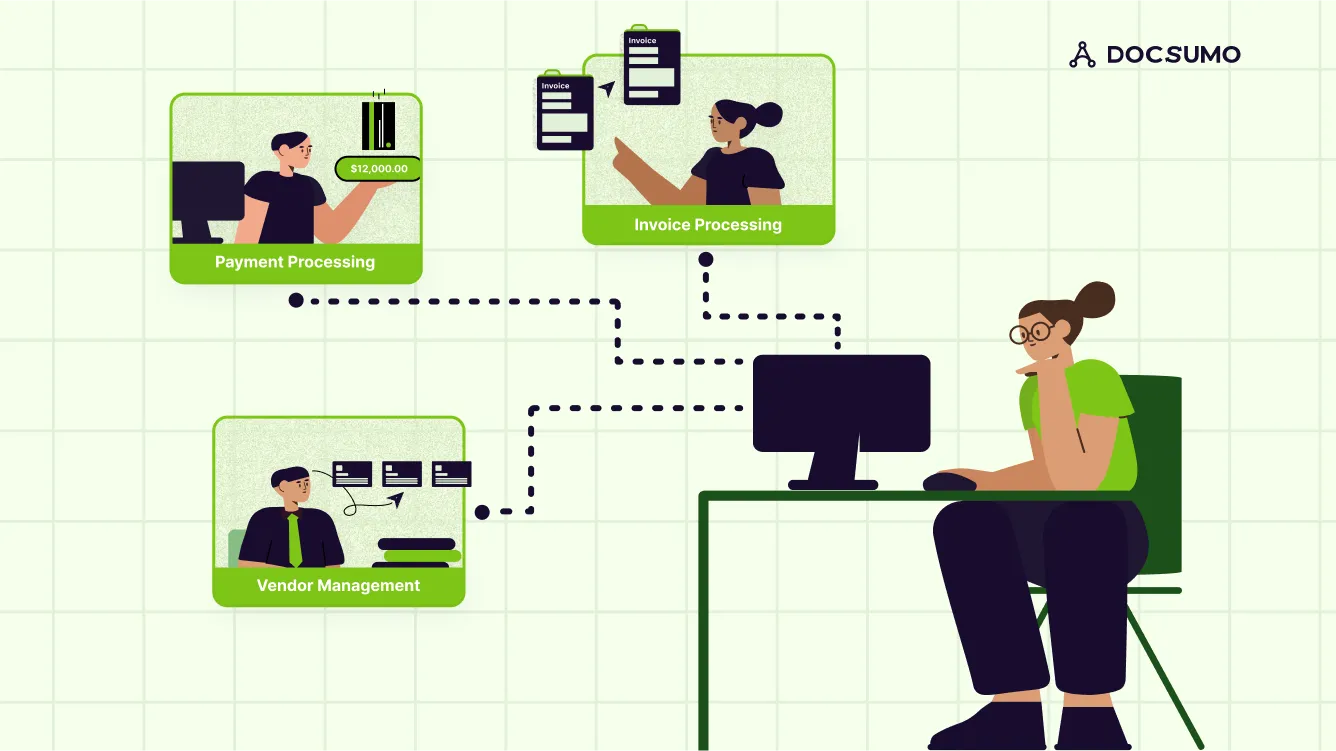
A provider takes over the repetitive part of accounts payable: invoice receipt and data entry, matching to purchase orders and receipts, vendor inquiries, payment runs and statement reconciliation. You still own the decisions: what gets approved, when it's paid and which vendors you use.
Benefits of outsourcing accounts payable#
Fewer fixed costs
No salaries, benefits or desks for an in-house AP team; you pay the provider's fee instead.Specialist staff
The provider's team does AP all day, with its own training and quality checks.Cover for peaks and absences
Month-end spikes, vacations and turnover become the provider's problem.Technology you don't buy
Many providers run their own capture and workflow software.Faster start
No hiring or training before the work gets done.
Disadvantages of outsourcing accounts payable#
Less control
Process changes go through the contract and the provider's service levels.Less visibility
You see reports, not invoices in progress, so problems surface late.Data and security risk
Vendor bank details and invoices are handled by another company's people, often in its systems.Uneven quality
Errors show up as late payments, duplicate payments or unhappy vendors.Exceptions still come back
Missing POs, price differences and disputes need someone who knows the business.
Shared services vs outsourcing#
Shared services accounting combines finance work from several business units, such as accounts payable, accounts receivable and the general ledger, into one internal center run by your own employees. Outsourcing hands the same work to an outside provider. Automation is a third option, and it can also run inside either model.
| Shared services | Outsourcing | In-house automation | |
|---|---|---|---|
| Who does the work | Your employees, in one central team | The provider's staff | Your team, with software doing the reading and checking |
| Control | Full: your process and your systems | Set by the contract and service levels | Full: your process and your rules |
| How cost grows | Headcount grows with volume, offset by scale | Fees grow with invoices or people assigned | Mostly software; people only for exceptions |
| Best for | Large companies with several business units | Small teams, or peaks without AP staff | Growing volume where control matters |
Benefits of automating accounts payable in-house#
Much of what an AP provider sells is labor for repetitive work: opening invoices, keying fields, matching and chasing approvals. Automation removes most of that work and keeps the process and the vendor relationships with you.
Manual in-house AP
- Invoices keyed by hand from email, portals and paper
- Matching to POs and receipts by eye
- Approvals chased by email
- More invoices means more people
Automated in-house AP
- Fields and line items read from PDFs, scans and photos
- Invoices matched to POs and receipts; duplicates flagged before payment
- Invoices routed for approval, with an audit trail
- Volume can grow without adding headcount
Docsumo is software, not a managed service: your own team reviews the fields it isn't sure about, so the work stays in-house. It reads invoices and the rest of the AP document set and flags duplicate invoices. It routes invoices for approval on the Business plan and matches them to POs and receipts on the Enterprise plan. It doesn't pay vendors: approved invoices go to your ERP through the API and webhooks. Valtatech, for example, cut costs by 65%+ and processes 99%+ of its invoices touchless.
What does it cost to outsource accounts payable?#
Providers quote per invoice, per full-time person or as a monthly fee, so start from what an invoice costs you today. A sponsored analyst report from Ardent Partners puts the 2025 average at $9.84 per invoice. Best-in-class AP teams spend 79% less. Compare that with a provider's price per invoice at your volume, exceptions and setup fees included, and with automation, where the invoices that still need a person cost what they cost now and the rest cost only the software. More benchmarks are in AP metrics.
What invoice processing costs you
Put in your own numbers. The cost and exception-rate defaults are the 2025 averages across AP teams.
- Cost today, per month
- Cost with automation, per month
- Difference per month
- Difference per year
How it's worked out
- Cost today is invoices per month times the cost of one invoice.
- With automation, an invoice that still needs a person costs what it costs today, and the rest cost only the software.
- It leaves out late-payment fees and missed early-payment discounts, which usually make the gap bigger.
Source: Ardent Partners, State of ePayables 2025: AP benchmarks (sponsored analyst report, Jan 2026)
How to decide: five questions#
- VolumeHow many invoices a month, and how fast is that growing? Provider fees and headcount grow with volume; with automation, your team's time grows only with the exceptions.
- ExceptionsWhat share of invoices needs a person today? Exceptions come back to you whoever keys the invoice.
- ControlWho needs to change approval rules, vendor records and payment timing, and how quickly?
- SecurityWho can see vendor bank details? Ask any provider or software vendor for its SOC 2 Type 2 report. Docsumo is SOC 2 Type 2 compliant and ISO/IEC 27001:2022 certified (security).
- CostWhat does an invoice cost you today, against the provider's price and against software plus the exceptions your team still handles?
The bottom line#
Outsource accounts payable when volume is low and nobody can take it on; move to shared services when several business units each run their own AP. When volume is growing and you want to keep the process in-house, automate: software does the reading, matching and routing, and your team handles the exceptions. See accounts payable automation and how to automate accounts payable.
Book a demo with a month of your own invoices, or start a free trial.
Frequently asked questions#
What is accounts payable outsourcing?
Accounts payable outsourcing means paying an outside provider to run some or all of your AP work: receiving and keying invoices, matching them to purchase orders, answering vendor questions and preparing payment runs. You keep the decisions on what gets approved and paid.
How much does it cost to outsource accounts payable?
It depends on volume and scope. Providers usually price per invoice, per full-time person assigned to you, or as a fixed monthly fee. Compare the quote with your own cost per invoice today and with the cost of automating in-house. A sponsored analyst report from Ardent Partners put the 2025 average at $9.84.
What is the difference between shared services and outsourcing?
Shared services keeps the work in-house: your own employees, in one central team, handle AP and often other finance work for every business unit. Outsourcing moves the work to an outside provider's staff under a contract.
What does shared services mean in accounting?
Shared services accounting, or finance shared services, combines transactional finance work such as accounts payable, accounts receivable, general ledger and fixed assets from several business units into one internal center with one process.
What are the benefits of accounts payable automation?
Less keying, fewer errors, faster approvals and a lower cost per invoice, with the work kept in-house. Software reads and checks invoices, and your team handles only the ones that fail a check. See how to automate accounts payable.
Can you outsource only part of accounts payable?
Yes. Some companies outsource invoice entry or vendor inquiries and keep approvals and payments in-house; others automate invoice capture and outsource payment runs. Split it by where the manual work and the risk sit.