Statement of account: what it shows, an example, and how to reconcile it
For accounts payable and finance teams: what a statement of account shows, how it differs from an invoice or a bank statement, and how to reconcile vendor statements against your ledger.

Key takeaways
- A statement of account is a summary a supplier sends a customer, listing the invoices, payments and credits on the account over a period and the balance still owed.
- The math is simple: closing balance = opening balance + invoices − payments − credits, and the aging buckets must add up to the closing balance.
- AP teams reconcile vendor statements against their own ledger to find missing invoices, unapplied credits, duplicates and payments the vendor hasn't recorded yet.
- Account statement also means a bank or credit card statement: the record of your own account, not a supplier's bill.
- Automation reads every statement line and compares it with your AP ledger, so staff chase only the differences.
On this page
A statement of account, often shortened to account statement, is a summary a supplier sends a customer, listing the invoices, payments and credits on the account over a period, usually a month, and the balance still owed. It shows what the supplier believes you owe, so accounts payable (AP) teams check it against their own records.
What is a statement of account?#
Suppliers send statements to remind customers of what's due and overdue, and so both sides agree on the balance. Accounting software can produce different kinds; QuickBooks Online, for example, has three:
Balance forward
The invoices, payments and current balance for a date range.Open item
Every unpaid invoice from a start date to today.Transaction statement
Every transaction recorded in a date range.
What's on a statement of account#
A typical statement has seven parts, numbered on the example below.
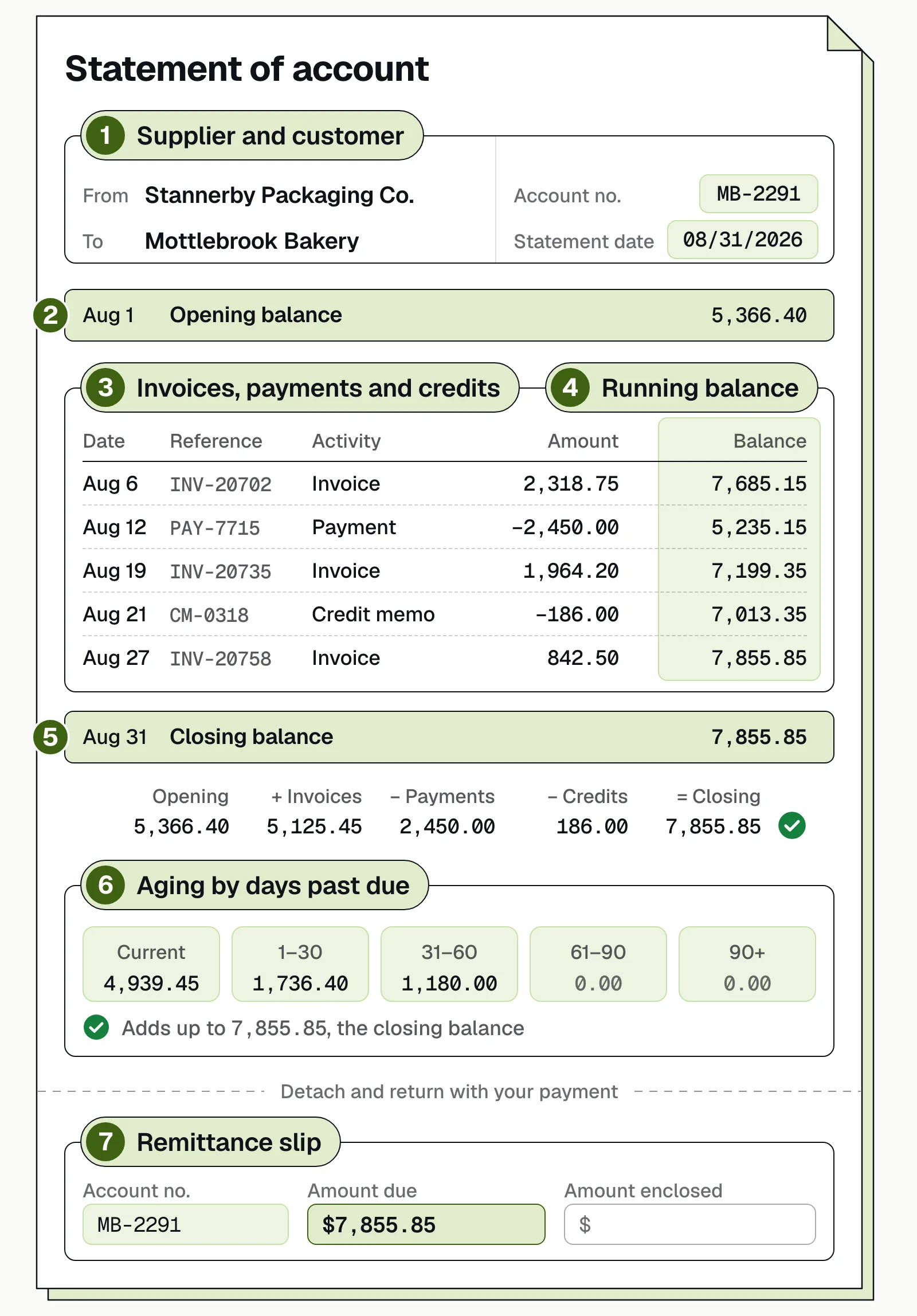
| Part | What it tells you |
|---|---|
| Who is billing whom, the account number and the statement date |
| What was owed when the period began; it should match last month's closing balance |
| Each item with its date and reference: invoices add to the balance, payments and credit memos reduce it |
| The balance after each line, so you can see where a difference starts |
| Opening balance plus invoices, minus payments and credits |
| The balance split by days past due: current, 1–30, 31–60, 61–90 and 90+; the buckets add up to the closing balance |
| The account number and amount due, to send back with a payment |
Statement of account vs invoice vs bank statement#
| Document | Sent by | What it shows |
|---|---|---|
| Statement of account | A supplier to a customer, usually monthly | Every invoice, payment and credit on the account for a period, and the balance owed |
| Invoice | A supplier, for each sale | One sale: the items, the amount and the due date |
| Bank statement | A bank to its account holder | Deposits, withdrawals, fees and opening and closing balances for the period |
Financial statements are different again: the income statement, balance sheet and cash flow statement report a whole company's results. For how lenders read them, see financial statement data extraction and financial statement spreading.
How AP teams reconcile a vendor statement#
A statement is the vendor's view of your account. Reconciling it against your accounts payable ledger each month finds problems while they're still small.
- Request statements monthlyAsk your main vendors for a statement as of month-end.
- Match every line to your ledgerInvoices, payments and credit memos, by reference number and amount.
- Chase what's missingInvoices that never reached AP, and credits you're owed but haven't applied.
- Resolve the differencesPayments the vendor hasn't posted yet, disputed charges and duplicates; agree the corrected balance with the vendor.
- Record what you fixedSo next month's opening balances agree on both sides.
- Opening balanceMatches last month's closing balance.
- Every invoice is in your ledgerA missing one may be sitting unapproved, or lost on the way in.
- Every payment you made appearsA payment sent near month-end may not be on the statement yet.
- Credits were appliedCredit memos and returns reduce what you owe.
- No invoice appears twiceOn the statement or in your ledger, so nothing is paid twice.
- Aging matches your recordsOld items often point to a dispute or a missing credit.
Automating statement reconciliation#
Done by hand, reconciliation means keying each statement line and searching the ledger for it. Automation does the reading and matching, and your team works only the differences.
- Vendor statements (PDF)
- Scans
- Email attachments
- 01Extract every line
- 02Match to the AP ledger
- 03Flag differences
- 04Review
Docsumo reads vendor statements, including tables that run across pages, and sends fields it's unsure about to a reviewer. The lines download to Excel or go to your ERP through API and webhooks; matching them against your AP ledger is a workflow step you set up, as an AI step or your own Python code. For the invoices themselves, Docsumo flags duplicate invoices and, on the Business plan, routes invoices for approval. It doesn't pay vendors.
The bottom line#
A statement of account is the supplier's record of what you owe. Reconciling it each month against your ledger catches missing invoices, unapplied credits and duplicates before they become late fees or overpayments. Automating the reading and matching leaves your team only the differences to chase; see accounts payable automation.
Book a demo with a few of your own vendor statements, or start a free trial.
Frequently asked questions#
What is a statement of account?
A statement of account is a document a supplier sends a customer that lists the invoices, payments and credits on the customer's account over a period, usually a month, and the balance still owed. Many also show how much of the balance is past due.
What is the difference between a statement of account and an invoice?
An invoice bills one sale and asks for that amount by a due date. A statement of account summarizes every invoice, payment and credit on the account over a period and shows the total balance.
What is an account statement?
In banking, it's the periodic record of the deposits, withdrawals, fees and balances on your account. For consumer accounts, Regulation E requires a statement for each month with an electronic fund transfer, and at least one a quarter otherwise. In business, the term also means a supplier's statement of account.
How do I get a statement of account?
Ask the supplier's accounts receivable team for one as of a date you choose. Accounting software such as QuickBooks Online can produce one for any customer and date range.
How do you make a statement of account?
Start with the customer's opening balance, then list each invoice, payment and credit in the period with its date and reference, and a running balance. End with the closing balance, an aging summary and the amount due. In QuickBooks Online, select customers in the customer list and choose Batch action, then Statement.
What is the difference between a balance forward and an open item statement?
In QuickBooks Online's terms, a balance forward statement lists the invoices, payments and current balance for a date range, and an open item statement lists every unpaid invoice from a start date to the present.
Sources
- QuickBooks: Create and send customer statements in QuickBooks Online
- CFPB: Regulation E, 12 CFR 1005.9(b) periodic statements
First published . Last updated .