Shipping document automation, starting with the commercial invoice
For customs brokers, forwarders and importers who receive a shipper's paperwork. See which document to automate first, what US Customs requires on it, and how to check the rest against it.

Key takeaways
- Shipping document automation reads the trade documents that come with each shipment and checks them against each other.
- Start with the commercial invoice. US Customs and Border Protection (CBP) needs it to release goods. The rule at 19 CFR 141.86 sets out what it must show.
- Add the other documents as checks on the invoice. The packing list shows what each package holds, and the waybill or bill of lading gives the count and the weight.
- Under the United States-Mexico-Canada Agreement (USMCA), a claim for a lower duty rate is based on a certification of origin. The certification must describe the goods in enough detail to match them to the invoice.
- Software reads and compares. Decisions on tariff classification and customs value stay with your customs broker or compliance team.
On this page
- Which shipping documents come with an import
- Why the commercial invoice comes first
- Then check the other documents against the invoice
- How one shipment's paperwork moves through the checks
- What stays with your broker and compliance team
- How Docsumo reads and checks import documents
- Start with a week of commercial invoices
- Frequently asked questions
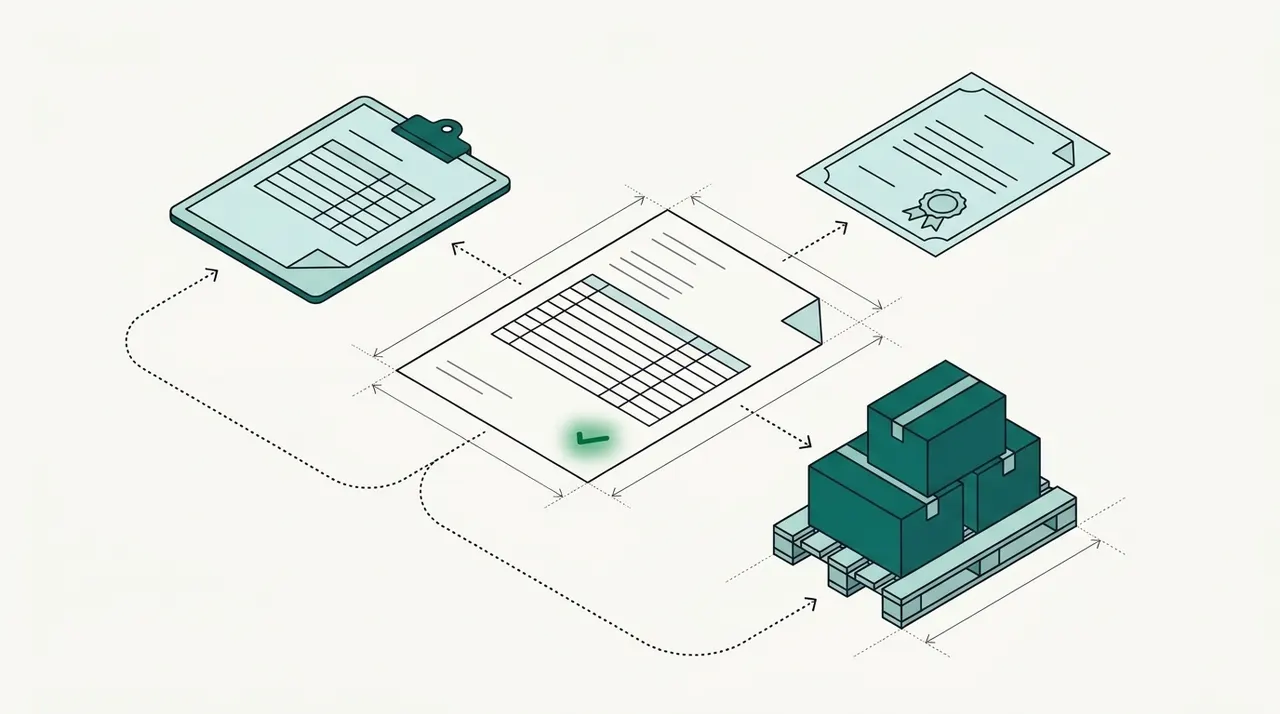
Shipping document automation uses software to read the trade documents that come with each shipment and check them against each other. On an import, the main ones are the commercial invoice, packing list, waybill or bill of lading, and certificate of origin. Start with the commercial invoice. US Customs and Border Protection (CBP) needs it to release the goods, and the duty depends on what it says. Then add the documents that check it.
Which shipping documents come with an import#
The shipper's paperwork for an import commonly includes the four documents below. Each one tells your team something different about the same goods.
Commercial invoice
The seller's bill to the buyer. It states the goods being sold and the amount the buyer is to pay. CBP lists it among the entry documents it needs to release goods.Packing list
It lists each package in the shipment and what it holds. It also names the parties, the invoice number, the ship date and the carrier.Air waybill or bill of lading
The carrier's document for the move. An air waybill travels with goods flown by an international air carrier and lets the shipment be tracked. A bill of lading is the contract between the owner of the goods and the carrier.Certificate of origin
A signed statement of where the goods come from. Under the United States-Mexico-Canada Agreement (USMCA), an importer can claim a lower duty rate based on one. USMCA calls it a certification of origin. The importer, the exporter or the producer can complete it.
For the paperwork behind a domestic truckload, such as proofs of delivery and carrier invoices, see logistics document automation.
Why the commercial invoice comes first#
The commercial invoice is the document your entry writers can't work without. They take the description, the quantities, the prices and the country of origin from it. Your compliance team reviews the same lines for origin and value.
CBP's rules point the same way. A commercial invoice is on CBP's list of entry documents for releasing goods (19 CFR 142.3). The rules name some cases where a pro forma invoice or other papers can be used instead. A separate rule, 19 CFR 141.86, says what each invoice must show. That rule also works as the list of fields to extract. The table shows its main items.
| The rule requires | Extract | Check against |
|---|---|---|
| The seller and buyer, the port of entry, and when and where the goods were sold | Seller, buyer, port of entry, invoice number and date | The packing list |
| A detailed description of each item, with its marks and numbers | Line description, part or style number, package marks | The packing list and the certificate of origin |
| Quantities, in weights and measures | Quantity and unit on each line, weights | The packing list and the waybill or bill of lading |
| The purchase price of each item, in the currency of the purchase, and every discount from the list price | Unit price, discounts, line amount, currency | Your purchase order |
| Every charge, listed by name and amount, such as freight, insurance, commission and packing | Each charge and the invoice total | The sum of the lines and charges |
| The country of origin | Origin, on each line where it differs | The certificate of origin |
| Assists the price leaves out, such as dies, molds or tools the buyer supplied for production (not those furnished in the US) | Each assist on the invoice | Your compliance team's records |
Timing matters too. The entry gets the goods released from CBP custody. The entry summary gives CBP what it needs to assess duties (19 CFR 141.0a). If the entry summary isn't filed at the time of entry, it's due with estimated duties within 10 working days after entry (19 CFR 142.12). Every day an invoice waits to be typed in leaves one day less to check it.
Our take. Get the commercial invoice right before you add any other document. It's the one your entry writers can't work without, and there's at least one for nearly every shipment. Once its fields are read and checked, the packing list and the waybill only have to agree with it. Checking that they agree is a much smaller job than typing them in.
Then check the other documents against the invoice#
Once your team has the invoice data, each of the other documents checks part of that data. The packing list confirms what each package holds. CBP requires the invoice to state what each package contains (19 CFR 141.86). That detail can be on an attachment, such as a packing list.
The waybill or bill of lading confirms the count and the weight. The bill of lading below is from a domestic truck shipment, shown here for its totals. It lists 12 pallets holding 288 cartons, with a total weight of 6,420 lb. A packing list for the same load should add up to the same totals. Our bill of lading guide explains each section of the form.
| Field | Extracted value | Confidence |
|---|---|---|
| Shipper | Ridgeline Home Goods Inc. | |
| Ship-from address | 3150 Valley View Rd, Columbus, OH 43219 | |
| Consignee | Brightwater Supply Co. | |
| Ship-to address | 1800 Airpark Dr, Nashville, TN 37217 | |
| Bill to (third party) | Summit Lane Logistics LLC | |
| Freight terms | Third party |
| Field | Extracted value | Confidence |
|---|---|---|
| BOL number | RHG-260914-018 | |
| Ship date | 2026-09-14 | |
| Carrier · SCAC | Blue Ridge Freight Lines · BRFL | |
| PRO number | 731455208 | |
| Customer PO | 88412 | |
| Total pieces · weight | 12 PLT · 288 CTN · 6,420 lb |
| Field | Extracted value | Confidence |
|---|---|---|
| Handling units | 8 PLT | |
| Packages | 192 CTN | |
| Description | Plastic bins, nested | |
| Weight | 3,520 lb | |
| NMFC item | 156600 | |
| Freight class | 85 |
For air freight, CBP requires the carrier to send the air waybill number, the number of packages and the total weight (19 CFR 122.48a). Packages are counted by the smallest outer unit, so 12 pallets holding 288 cartons would count as 288. The carrier must also send a precise cargo description and the names and addresses of the shipper and consignee. Those are the same fields your team checks against the packing list.
- Packing list against the invoiceThe parties and the invoice number match. The contents of the packages add up to the quantities on the invoice lines.
- Waybill or bill of lading against the packing listThe number of packages and the total weight agree. The consignee is the party you expect.
- Certificate of origin against the invoiceUnder USMCA, the certification describes the goods in enough detail to match them to the invoice lines. The certification also gives their tariff classification under the Harmonized Tariff Schedule (HTS), to six or more digits. Check each line you claim the lower rate for against the certification.
- Blanket certificatesA blanket certificate covers identical goods for a period it states, of no more than 12 months. Check that the shipment falls inside that period.
- Origin on each lineWhere a certificate of origin names a country, it agrees with the country of origin on each invoice line.
- Totals and chargesThe line amounts and the itemized charges add up to the invoice total.
- EnglishAn invoice in another language comes with an accurate English translation. The rule covers the invoice and all its attachments.
How one shipment's paperwork moves through the checks#
A shipment's documents often arrive in pieces, from more than one sender. Some come as one scanned file with every document inside.
- Shipper emails
- Forwarder pre-alerts
- Scanned packets
- 01Split the packet
- 02Read each document
- 03Match by shared numbers
- 04Run the checks
- 05Send exceptions to review
Matching comes before checking. Software ties each document to its shipment by a number they share, such as the invoice number, the purchase order number or the waybill number. The checks run once the set is complete. If a document is missing, the shipment waits, and the sender can be asked for it by email.
What stays with your broker and compliance team#
Software can read the tariff code a supplier printed on the invoice. It can compare that code with the HTS number your team used for the same part last time. It can't tell you whether either number is right. Tariff classification is a judgment about the goods, and it stays with your customs broker or your trade compliance team.
Customs value works the same way. Software can add up the line amounts and list every charge on the invoice. Deciding which of those charges belong in the declared value is a valuation question, and it needs a person who knows the rules.
The entry itself still goes out through your customs software. What changes is the work before it. Your entry writers start from data that's already read and checked, so they spend their time on the shipments that failed a check.
How Docsumo reads and checks import documents#
Docsumo, our product, is an intelligent document processing (IDP) platform. It reads commercial invoices, packing lists, air waybills, bills of lading and certificates of origin, printed or handwritten. Optical character recognition (OCR) reads the characters, and large language models (LLMs) put them into fields. So Docsumo isn't limited to pre-built models. It can read a document type that has no ready-made model.
Suppliers write in many languages. Docsumo reads most printed languages, including Chinese, Japanese, Korean and Arabic scripts, so an invoice is read in the language it arrives in. Handwriting support varies by language, so test samples first. Our guide to multilingual OCR goes further.
Documents arrive by email to Docsumo's own inbox, by upload or through the API. On the Business plan, Docsumo sorts a mixed file by document type. It splits the file into separate documents, such as the invoice and the packing list. You name the document types you want, and you don't need a training set of sample files. To split a file, AI Split takes a plain-English definition of each one. Line-item tables that run across pages are joined into one table, with the headers mapped. Our guide to table extraction from PDFs covers tables that span pages.
Fields the model isn't sure of go to a person. You set the confidence threshold for each field, and clicking a field shows the line it came from on the page.
Checks between documents, like the ones above, are cross-document validation, on the Enterprise plan. Master data lookup, also on the Enterprise plan, can compare extracted values with your own reference data, such as a parts list. A check your team runs by hand today can be set up as a step in the workflow. If a document is missing from a shipment's file, Docsumo can email the sender to ask for it.
Checked data goes to your customs software, ERP or accounts payable system through the API and webhooks, or downloads to Excel. The logistics page covers the rest of the freight paperwork Docsumo reads, from bills of lading to proofs of delivery.
- 99%field-level accuracy across 250+ document types
- 95%+of documents processed straight through, without manual review
- <5 minper document, down from 2+ hours
Start with a week of commercial invoices#
Pull the commercial invoices from one recent week of entries, with the packing lists and waybills that came with them. That set shows the layouts and the mismatches your team really sees. Try it in any tool you're considering before you widen to other documents.
Book a demo with that week of invoices, or start a free trial.
Frequently asked questions#
What are examples of shipping documents?
Common ones are the commercial invoice, the packing list, the bill of lading or air waybill, the certificate of origin and the pro forma invoice. On an import, the invoice and the packing list describe the goods. The waybill or bill of lading covers the move, and the certificate of origin supports a claim for a lower duty rate.
What should a packing list include?
A packing list names the seller, buyer and shipper, the invoice number, the ship date, the mode of transport and the carrier. It then lists the quantity, description and type of package for each item. It also gives the number of packages and the total net and gross weight. The team that receives it checks those totals against the commercial invoice and the waybill.
What does CBP require on a commercial invoice?
19 CFR 141.86 sets it out. Each invoice must show the port of entry, the seller and the buyer, and a detailed description of the goods. It must give the quantities and each item's purchase price, in the currency of the purchase. It must also itemize all charges and name the country of origin. It must list assists that the price leaves out. Assists are goods or services the buyer supplied for production, such as dies, molds or tools. Assists furnished in the US don't need to be listed. The invoice and its attachments must be in English or come with an accurate English translation.
What software do shipping companies use?
It depends on which side of the shipment they're on. Shippers use shipping software to print labels and create documents such as packing slips, bills of lading and commercial invoices. Customs brokers and importers receive those documents. They can use document automation to read them and send the data to their own systems.
When does a certificate of origin matter on an import?
It matters when the importer claims a lower duty rate under a trade agreement. One such agreement is the United States-Mexico-Canada Agreement (USMCA). USMCA calls the document a certification of origin. It needs no set format, but the importer must have it when the claim is made. Among other details, the certification must give the tariff classification (19 CFR 182.12). It must also describe the goods in enough detail to match them to the invoice.
Sources
- 19 CFR 141.86: Contents of invoices and general requirements (Cornell LII)
- 19 CFR 141.0a: Definitions of entry and entry summary (Cornell LII)
- 19 U.S.C. 1401a(h): Definition of an assist (Cornell LII)
- 19 CFR 142.3: Entry documentation required (Cornell LII)
- 19 CFR 142.12: Time for filing or submission for preliminary review (Cornell LII)
- 19 CFR 182.11: Filing of claim for preferential tariff treatment upon importation (Cornell LII)
- 19 CFR 182.12: Certification of origin (Cornell LII)
- 19 CFR 122.48a: Electronic information for air cargo required in advance of arrival (Cornell LII)
- International Trade Administration: Common export documents
- ShipHawk: Automated shipping documentation software (an example of software that creates shipping documents)
First published .