AI in lending: use cases, risks and how lenders put it to work
For heads of lending operations, credit and risk at banks, credit unions, mortgage and fintech lenders. You'll see where AI gives a return across the loan lifecycle, what regulators, Fannie Mae and Freddie Mac now expect, and how to start.

Key takeaways
- Lenders use AI across the loan lifecycle. It reads documents, analyzes income and cash flow, supports credit decisions, helps with servicing and collections, and checks for fraud.
- The fastest payback is usually in document processing. Every loan starts with bank statements, pay stubs, tax returns and financial statements that someone would otherwise key in.
- Cost is a real pressure. The MBA reports that independent mortgage banks spent $11,898 to produce each loan in Q1 2026.
- Rules are getting stricter. Freddie Mac (since March 2026) and Fannie Mae (since August 2026) require sellers and servicers to have a written AI governance framework. Regulation B still requires specific reasons for any credit denial.
- A person should make the decision and handle exceptions. AI should prepare, check and explain, with an audit trail for every value it extracts.
On this page
AI in lending means using machine learning and language models to help make and manage loans. It reads borrower documents and calculates income and cash flow. It also spots fraud, supports credit decisions and runs servicing and collections. Most lenders see the fastest return in document processing. Every application brings bank statements, pay stubs, tax returns and financials, and someone would otherwise key them all in. The lender still makes the credit decision. Regulators now expect formal rules for any AI the lender uses. Fannie Mae and Freddie Mac, known as the GSEs, expect the same.
Where AI fits in the loan lifecycle#
Lenders automate for cost as much as for speed. The MBA reports that independent mortgage banks spent $11,898 to produce each loan in Q1 2026. Much of that cost comes from moving documents and data through the stages below.
- Bank statements
- Pay stubs and W-2s
- Tax returns
- Financial statements
- 01Intake
- 02Data extraction
- 03Verification
- 04Underwriting support
- 05Decisioning
Follow one small business loan through those stages. It arrives as a single scanned PDF with the business and personal tax returns, the bank statements and a profit and loss statement. At intake, the software sorts the pages by document type, splits the PDF into separate documents and asks for anything that is missing. Extraction comes next. The software reads the transaction table from the bank statements and the totals from the returns and the profit and loss statement. Each value gets a confidence score. The score shows how sure the software is.
Verification checks the documents against each other and against the application, and flags anything that doesn't match. The deposits on the bank statements should fit the revenue on the tax return, and the names should match on every page. A value the software is unsure about goes to a person. Underwriting support starts once the data is verified. The software calculates income, cash flow and ratios such as the debt service coverage ratio (DSCR). It also puts the financial statements into the lender's template.
Decisioning is the last step in this flow. The software can score the application inside the limits the lender has set, and anything outside those limits goes to an underwriter. The credit decision stays with the lender. Servicing and collections come later, when the same software can read borrower letters and hardship documents and help the team prioritize outreach.
AI use cases in lending#
Five use cases cover most of what lenders run today.
Document intake and extraction
Every loan type depends on documents. These include bank statements, pay stubs and W-2s, financial statements and tax returns, rent rolls and T12s. AI reads them in any layout, extracts the fields and tables, and returns structured data with a confidence score for each value.Income and cash flow analysis
AI categorizes transactions, such as payroll, transfers, loan payments and NSF fees. It calculates average daily balance and monthly inflows, detects recurring debts and highlights irregular deposits. There is more in AI bank statement analysis. For commercial loans, the same approach spreads financial statements into the lender's template.Fraud detection
AI checks each document for signs of tampering, such as mismatched fonts, altered metadata or balances that don't reconcile. It also compares values across documents. Does payroll on the bank statement match the pay stub? Does the employer match the application?Credit decisioning
Credit models can use more data than a traditional scorecard, including cash flow from bank data. That extra data can help a lender assess applicants with thin credit files, meaning little credit history. Credit models also carry the most regulatory risk, because a lender must be able to explain every denial.Servicing and collections
AI reads borrower correspondence, hardship applications and settlement letters, routes them to the right queue and helps prioritize outreach.
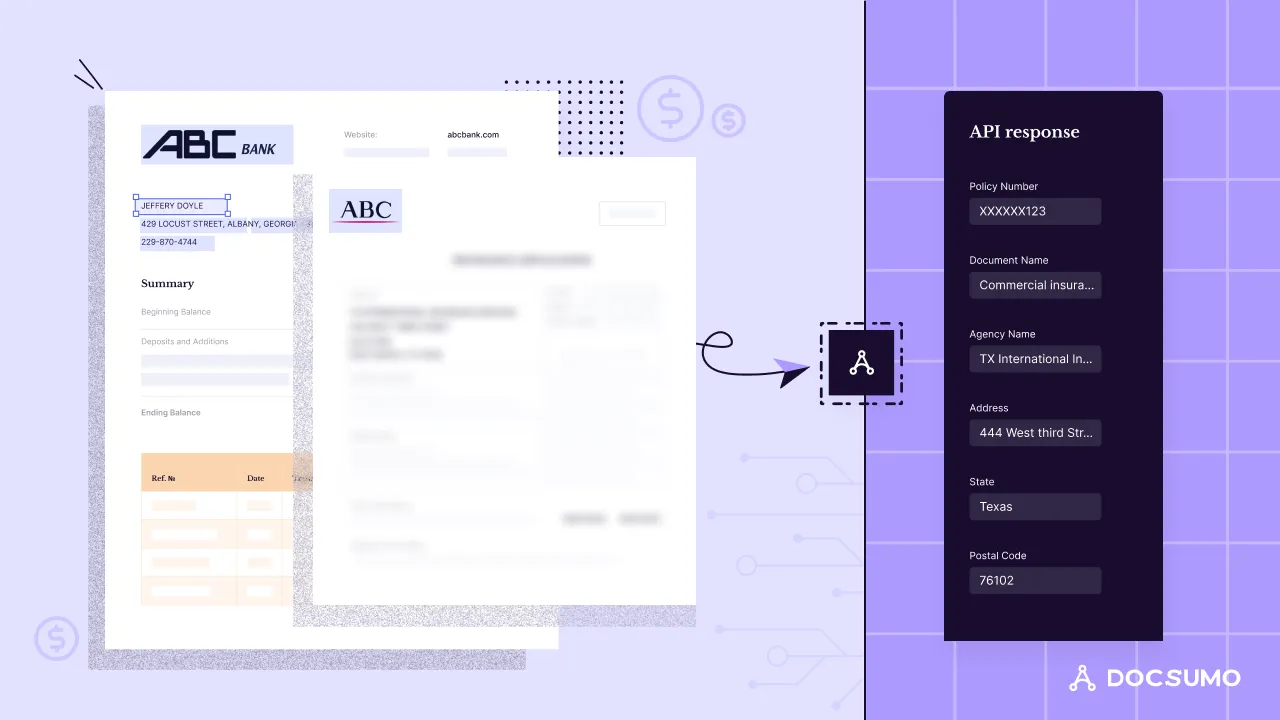
Document intake is where lenders usually start. Docsumo handles document intake. It reads bank statements, pay stubs, tax returns and financial statements. On the Enterprise plan, it also cross-checks them against each other. It doesn't score applications or make credit decisions.
- 99%field-level accuracy across 250+ document types
- <5 minper document, down from 2+ hours
- <1 minper complex bank statement at Grid Finance
AI lending automation by loan type#
Loan automation looks different for each product, because each one arrives with its own documents. The common first step is loan document automation, which means classifying the file, extracting its data and checking it.
| Loan type | Documents | What AI automates |
|---|---|---|
| Consumer personal loans | Pay stubs, bank statements, ID, credit authorization | Income and employment checks, identity match |
| Residential mortgage | Tax returns, W-2s, pay stubs, bank statements, appraisals, title documents | Income and asset verification, debt-to-income inputs |
| Home equity (HELOC) | Proof of income, bank statements, property tax records, title, appraisal | Income and asset checks, equity inputs |
| Auto loans | Driver's license, proof of income, credit authorization, vehicle title | Identity and income checks, stipulation clearing |
| Small business and SBA loans | Business and personal tax returns, bank statements, financial statements, P&Ls | True revenue, cash flow and existing debt payments |
| Commercial real estate | Financial statements, leases, rent rolls, T-12s, appraisals | Rent roll and operating statement extraction, DSCR inputs |
For the document side of mortgage and commercial real estate loans, see income verification and CRE underwriting.
Rules and expectations for AI in lending in 2026#
Adverse action reasons (Regulation B)
When credit is denied, the applicant must receive a statement of the specific principal reasons. If a model can't give clear reasons, a lender can't rely on it alone to deny credit.Fair lending
ECOA and the Fair Housing Act apply to decisions made with AI. Test models for disparate outcomes before and after launch.Freddie Mac AI governance
Guide Bulletin 2025-16, effective March 3, 2026, requires sellers and servicers to have AI governance. That means specific controls and audits. It also means monitoring for bias and for performance degradation, meaning a model that gets less accurate over time.Fannie Mae AI governance
Lender Letter LL-2026-04, effective August 6, 2026, requires a formal, written governance framework for AI and machine learning. The framework covers AI that lenders use in origination or servicing, including vendor-provided systems. Lenders review it annually.
Risks to manage#
Each risk has a control. Check these before any AI lending platform touches a live loan file.
- BiasModels trained on historical decisions can repeat historical bias. Use representative data, test outcomes by group and document the results.
- ExplainabilityPrefer models and tools that show why. For extraction, that means which page and line a value came from. For decisions, it means which factors drove the result.
- Data qualityA decision model is only as good as the data fed to it. Validate extracted data before it reaches the model.
- Privacy and securityLoan files carry Social Security and account numbers. Use vendors with SOC 2 Type 2, HIPAA and GDPR compliance. They should also limit each user's access to what their job needs, and state clearly how long they keep your data.
- Vendor riskKeep an inventory of every AI system, what it does and who owns it. The GSE frameworks require it.
- IntegrationAI that doesn't connect to your LOS or core system creates new manual steps. Check APIs and integrations early.
How to start with AI in lending#
- Pick one product and one bottleneckFor example, bank statement review for small business loans, or income documents for mortgages.
- Measure the baselineMinutes per file, error rate, time to decision, share of files with late conditions.
- Test on your own documentsMeasure field-level accuracy on a few hundred real files, including poor scans.
- Have a person make every decisionHave a person review the low-confidence fields too, at first. Let more files go through with no manual review only while your accuracy and error numbers stay at the level you measured.
- Write it into your governanceAdd the system to your AI inventory, document its purpose, controls and monitoring, and review it at least annually.
- ExpandMove to the next document type or product once the first one is stable.
We'd begin the test on your own documents with the messiest files. Use a phone photo of a pay stub, a long bank statement and a page filled in by hand. A tidy file proves little, because the messy ones are the files your team has to fix today.
Automate the loan file, keep the credit decision#
AI works best in lending when it prepares the file. It turns loan documents into verified data, flags what doesn't fit and gives underwriters a clean file. Start where the manual work is heaviest, keep a person involved in decisions and exceptions, and document your governance. The GSEs and regulators now expect that governance, and it also helps the gains last. Learn more about IDP for lending or financial spreading automation.
Book a demo with a few of your own loan files, or start a free trial.
Frequently asked questions#
How is AI used in lending?
Lenders use AI to classify loan documents and extract their data. It also calculates income and cash flow from bank statements and detects edited documents and identity fraud. It supports credit decisions and prioritizes servicing and collections outreach.
What is AI lending automation?
Lending automation uses software for the steps of making a loan that don't need judgment. These include collecting documents, extracting data, checking it and routing files. AI also handles work that used to need a person to read the document, such as bank statements, pay stubs and tax returns. The lender still makes the credit decision.
Can AI approve loans?
AI can score applications and auto-decide within limits a lender sets, but the lender remains responsible for the decision. Under Regulation B, a lender must give a denied applicant the specific principal reasons. That means the lender must be able to explain why the model gave its result.
What are the risks of AI in lending?
The main risks are biased outcomes, models that can't explain their decisions and errors in the data fed to them. Others are data privacy and security, and vendor risk. The GSEs now expect written governance and monitoring, and inventories of AI systems.
How can a lender use AI to automate underwriting and origination workflows?
Start with document intake for one product, such as bank statements for small business loans or income documents for mortgages. AI classifies and extracts the documents, cross-checks them and sends the data to your loan system, and a person still decides. It's measurable, low risk and removes a large share of manual work. See IDP for lending.
Does AI help with loan fraud?
Yes. AI checks documents for signs of editing, compares values across documents such as pay stubs and bank statements, and flags inconsistencies with the application. Docsumo reports 64% lower fraud with cross-document validation.