1003 mortgage application data extraction: sections, checks and automation
For mortgage lenders, processors and QC teams: what's on the Uniform Residential Loan Application, when a 1003 needs extracting at all, and what to check it against.

Key takeaways
- Form 1003, the Uniform Residential Loan Application (Freddie Mac Form 65), is the standard application for a US home mortgage. The current version, effective January 2021, has nine sections.
- When the application is taken in a loan origination system, the 1003 is already data. Extraction matters when the 1003 is a document: a broker's PDF, a signed copy in a loan file you're reviewing or buying, or a scanned or handwritten application.
- The value is in the cross-checks: income against pay stubs and W-2s, assets against bank statements, real estate owned against mortgage statements, and declarations against the credit report.
- Fannie Mae requires a complete, signed and dated final 1003 in the loan file, showing the income, assets, debts and loan terms used to underwrite the loan.
- Automation extracts every section, runs the cross-checks and sends only the mismatches to a person; the underwriting decision stays with the lender.
On this page
1003 mortgage application data extraction means reading the Uniform Residential Loan Application (Fannie Mae Form 1003, Freddie Mac Form 65) and turning its nine sections into structured data: the borrower, income, assets and debts, real estate owned, the loan and property, and the declarations. When the application is taken in a loan origination system (LOS), that data already exists. Extraction, or parsing, matters when the 1003 arrives as a document, such as a broker's PDF or a signed scan, and has to be checked against the pay stubs, W-2s and bank statements in the file.
This guide covers what's on the 1003, when to parse it instead of pulling it from your LOS, the cross-checks to run and how to automate them.
What is a 1003 in a US mortgage?#
The 1003 is the standard loan application for a home mortgage in the US, published jointly by Fannie Mae and Freddie Mac. The redesigned version, marked "Effective 1/2021", became mandatory for new loans sold to the two agencies on March 1, 2021, and it's still the current form. The borrower answers sections 1 to 8, the loan originator completes section 9, and the lender fills in a separate Lender Loan Information form.
The URLA is a set of forms, not one:
Borrower Information
Sections 1 to 9 for the borrower: the core of the application.Additional Borrower
The same nine sections for each additional borrower.Unmarried Addendum
Used when an unmarried borrower has a partner with property rights similar to a spouse's, such as a civil union or domestic partnership.Lender Loan Information
Sections L1 to L4, completed by the lender: property and loan details, title, the mortgage terms and payment, and the funds needed to close.Continuation Sheet
Extra space when a section runs out of rows.
The 1003 is for a new mortgage. A borrower who already has one and can't keep up with the payments applies for help on a different form, Form 710.
The 9 sections of the 1003, and what to extract#
The numbers on the form follow the rows of the table below, top to bottom.
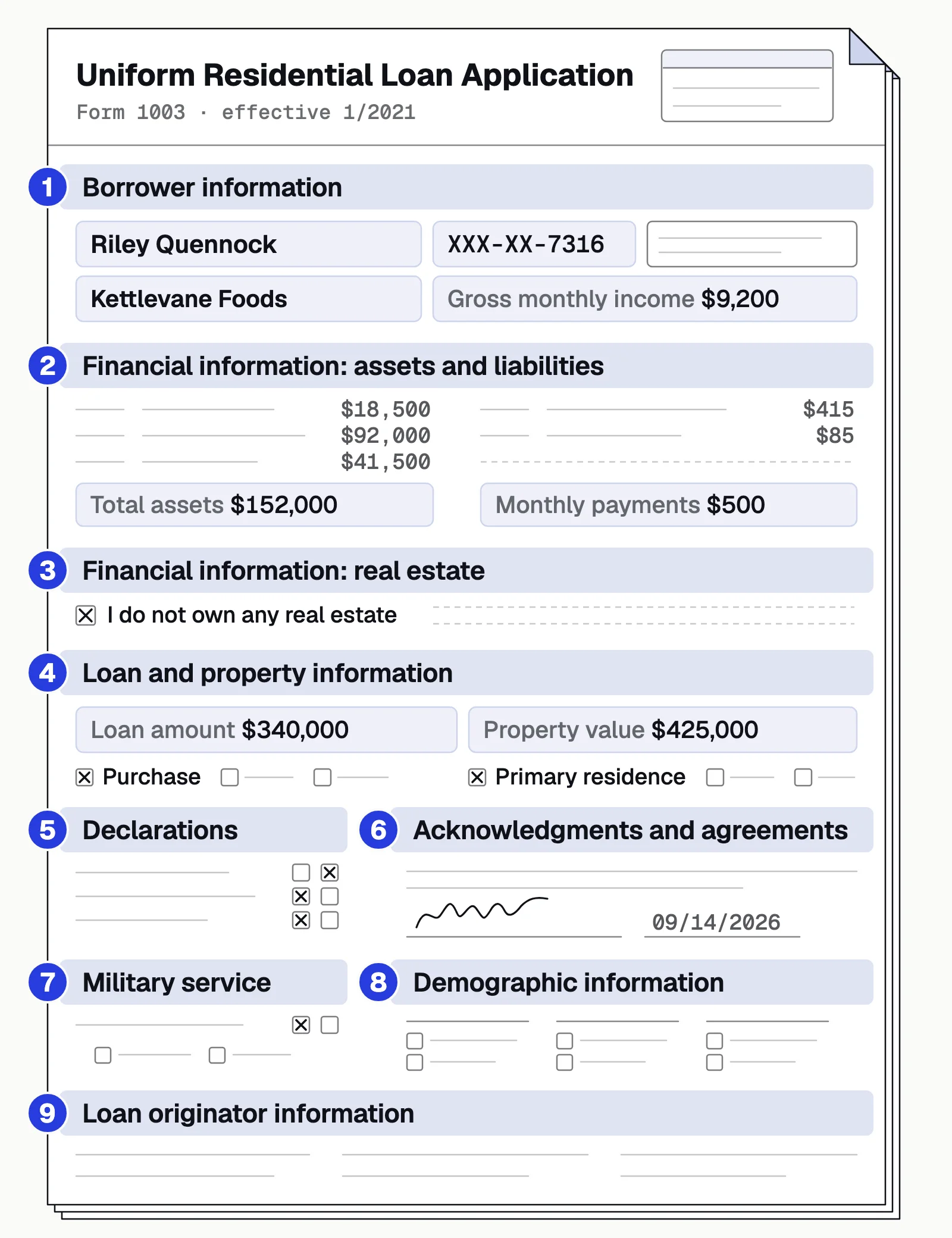
Sections 1 to 4 hold the stated income, assets and debts that the pay stubs, W-2s and bank statements in the file are checked against.
| Section | Key fields | Checked against |
|---|---|---|
| Borrower information | Name, SSN, date of birth, citizenship, marital status, addresses and housing; each employer, start date and gross monthly income (base, overtime, bonus, commission); other income | ID, pay stubs, W-2s, tax returns, verification of employment |
| Assets and liabilities | Each account's institution, number and value; other assets and credits such as earnest money; each debt's balance and monthly payment; alimony and child support | Bank and investment statements, the credit report |
| Real estate | Each property owned: address, value, status (sold, pending sale or retained), occupancy, taxes and insurance, rental income, and its mortgages | Mortgage statements, the credit report, leases |
| Loan and property | Loan amount and purpose, property address, units, value and occupancy; other new mortgages; rental income on the property; gifts and grants | Purchase contract, appraisal, gift documentation |
| Declarations | Yes or no on occupancy, ties to the seller, undisclosed borrowing or credit, priority liens, co-signed debts, judgments, federal debt, lawsuits, and deed-in-lieu, short sale, foreclosure or bankruptcy in the past 7 years | The credit report and the rest of the file |
| Acknowledgments and agreements | Borrower signatures and dates | A signed, dated final 1003 in the file |
| Military service | Service status, end date of active duty, surviving spouse | Program eligibility, for example a VA loan |
| Demographic information | Ethnicity, sex and race, and how they were collected | Fair lending and HMDA reporting |
| Loan originator information | Company and originator names, NMLSR IDs, state license IDs, signature | Licensing records |
When to parse a 1003, and when to pull it from your LOS#
Fannie Mae's Selling Guide calls the version in a lender's LOS or in Desktop Underwriter the online loan application: data collected from the Form 1003. The agencies' underwriting systems take it as a MISMO v3.4 file, so for applications your own staff take in the LOS, there's nothing to extract. Parsing earns its place when the 1003 reaches you as a document.
Where does your 1003 come from?
Cross-checks to run on every 1003#
The 1003 is what the borrower says; the rest of the file is the evidence. Fannie Mae requires the final 1003 to reflect the income, assets, debts and loan terms used to underwrite the loan, so every stated figure should tie to a document.
- Income against pay stubs and W-2sBase, overtime and bonus income match the latest pay stub (dated within 30 days of the application, with year-to-date earnings) and the W-2s for the last one or two years.
- Two years of employmentEmployers and start dates in sections 1b to 1d cover at least two years and agree with the W-2s.
- Assets against statementsEach account in section 2a matches its statement: the borrower as holder, the last 4 digits of the account number and the balance, over the last two months for a purchase or one month for a refinance.
- Debts against the credit reportEvery liability in section 2c appears with the same balance and payment, and nothing on the credit report is missing from the application.
- Real estate owned against mortgage statementsEach property in section 3 has its payment and balance confirmed, with taxes, insurance and dues documented.
- Declarations against the file"No" answers on bankruptcy, foreclosure, judgments and undisclosed debt agree with the credit report.
- Loan and property against the contract and appraisalLoan amount, purpose, occupancy and property value match the purchase contract and the appraisal.
- Signed, dated and consistentThe final 1003 is signed and dated by each borrower, and a 1008 for a manually underwritten loan carries the same figures.
For the asset checks in detail, see mortgage bank statement verification.
How automated 1003 data extraction works#
The hard parts of a 1003 are the repeated rows (several employers, accounts, debts and properties, sometimes spilling onto continuation sheets), checkboxes that carry the meaning, and handwriting on paper applications. A parser has to keep each row's fields together and flag what it isn't sure about.
- Form 1003 PDF or scan
- Pay stubs and W-2s
- Bank statements
- Tax returns
- 01Split and classify the file
- 02Extract every section
- 03Cross-check the documents
- 04Review exceptions
Docsumo is an intelligent document processing (IDP) platform. It takes loan files by email, upload or API, splits and classifies the documents (on the Business plan), and extracts the 1003 alongside pay stubs, tax forms and bank statements, handwritten entries included. Fields it's unsure about go to a reviewer with the source line highlighted, and corrections improve the model. Cross-checks like the ones above run as cross-document validation on the Enterprise plan. It doesn't make the underwriting decision or calculate qualifying income on Fannie Mae Form 1084 or Freddie Mac Form 91; it extracts the income data that goes into them. Results go to your LOS through API and webhooks, or download to Excel. More on the whole file in mortgage document processing.
- 99%field-level accuracy across 250+ document types
- 95%+of documents processed straight through, without manual review
- <5 minper document, down from 2+ hours
The bottom line#
The 1003 is the borrower's account of their finances, and the rest of the loan file is the proof. If you already hold the application as data, check the documents against it; if it arrives as a PDF or scan, extract every section first. Either way, the value is in the cross-checks and in sending people only the fields that don't agree.
Book a demo with a few of your own loan files, or start a free trial.
Frequently asked questions#
What is a 1003 in a US mortgage?
The 1003 is the Uniform Residential Loan Application, the standard form a borrower completes to apply for a home mortgage in the US. Fannie Mae numbers it 1003 and Freddie Mac numbers it 65. It collects the borrower's details, income, assets, debts, real estate owned, the loan and property, and a set of declarations.
What are the 9 sections of Form 1003?
Borrower information; financial information on assets and liabilities; financial information on real estate; loan and property information; declarations; acknowledgments and agreements; military service; demographic information; and loan originator information.
What is the difference between Form 1003 and Form 1008?
The 1003 is the borrower's application. Form 1008 (Freddie Mac Form 1077), the Uniform Underwriting and Transmittal Summary, is the lender's summary of the data used to underwrite the loan. Fannie Mae requires a 1008 in the file for manually underwritten loans; for loans underwritten with Desktop Underwriter it's optional, but the final DU report must be kept.
What is a mortgage application form parser?
Software that reads a 1003 from a PDF or scan and returns each field as structured data, such as JSON for your loan origination system. A good parser keeps repeated rows (several employers, accounts or properties) together and flags values it isn't sure about for a person to check.
Does the 1003 have to be signed?
The final one does. Fannie Mae requires a complete, signed and dated final 1003 in every loan file, and it must reflect the income, assets, debts and final loan terms used to underwrite the loan.
Sources
- Freddie Mac: Uniform Residential Loan Application (URLA) and ULAD
- Freddie Mac Form 65 / Fannie Mae Form 1003: URLA Borrower Information (effective 1/2021)
- Freddie Mac Form 65 / Fannie Mae Form 1003: URLA Lender Loan Information
- Fannie Mae Selling Guide B1-1-01: Contents of the Application Package
- Fannie Mae Selling Guide B3-3.2-01: Standards for Employment and Income Documentation
- Fannie Mae Selling Guide B3-4.2-01: Verification of Deposits and Assets
- Freddie Mac Form 1077 / Fannie Mae Form 1008: Uniform Underwriting and Transmittal Summary
First published . Last updated .