Real estate document management software: what CRE teams need
For CRE lenders, investors, brokers and property managers: what a real estate document management system should do, the kinds of tools on the market, and where storing files stops and reading their data starts.


Key takeaways
- Real estate document management software stores, organizes, secures and tracks the documents behind every property, deal and loan: leases, rent rolls, operating statements, appraisals, title, insurance and closing documents.
- The core features are a central repository, property and deal folders, search, version history, role-based access, audit trails and retention rules.
- The tools come in several kinds: document management systems, file sharing portals, virtual data rooms, CRE deal platforms and property management software. Pick by who needs the documents, and when.
- Storing documents isn't reading them. Data extraction turns rent rolls, T12s and leases into structured data for underwriting and asset management. Docsumo, our product, does the extraction; it isn't a document management system.
- Retention rules apply. In California, for example, brokers must keep transaction records for 3 years from closing (Business and Professions Code 10148).
On this page
Real estate document management software stores, organizes, secures and tracks the documents behind every property, deal and loan in one place: leases, rent rolls, operating statements, appraisals, title, insurance and closing documents. It replaces shared drives and email attachments with property and deal folders, search, version history, access controls and audit trails, and it keeps records for as long as the rules require.
Most of it doesn't read the numbers inside those documents. For CRE lenders and investors, the next step is extraction: turning rent rolls, T12s and leases into data for underwriting and asset management. Docsumo, our product, is that extraction layer, not a document management system.
What real estate document management software does#
A full system covers eight jobs.
Central repository
Every document for a property, deal or loan in one place, not scattered across inboxes and drives.Folders and tags
By property, deal, loan, tenant and document type, often applied automatically.Search
Find a document by name, type or date, or by its content once scans are made searchable with OCR.Version history
The current lease amendment or rent roll on top, with every earlier version kept.Access control
Role-based permissions for your team, investors, lenders and outside counsel.Audit trail
A log of who uploaded, viewed, changed or shared each document.Retention
Each document type kept as long as the rules require, then disposed of on schedule.Sharing
Portals and data rooms for buyers, lenders and investors.
Kinds of real estate document management software#
Pick by who needs the documents, and when. You may need more than one.
Document management systems
Firm-wide records with metadata, version control, workflows and retention. Examples: M-Files, DocuWare.File sharing and client portals
Secure file sharing with clients, lenders and partners, through shared folders or branded portals. Examples: ShareFile, Zoho WorkDrive.Virtual data rooms
A controlled room for due diligence on a deal: title, surveys, leases and environmental reports. Example: Datasite.CRE deal management
An investment team's pipeline, screening and underwriting in one place. Dealpath, for example, pulls data from OMs and broker flyers into each deal.Property management software
Leases and tenant files kept next to rent collection and the property's books.
Most of them don't turn a rent roll into rows your model can use. That's extraction, covered below.
Documents CRE teams manage#
| Stage | Documents | Data teams need from them |
|---|---|---|
| Marketing and acquisition | Offering memorandum, broker package, comps | Asking price, unit mix, in-place and pro forma income |
| Due diligence | Rent roll, T12 operating statement, leases and amendments, estoppels, SNDAs | Unit rents, occupancy, lease expirations, NOI, tenant obligations |
| Third-party reports | Appraisal, property condition report, environmental report, survey | Value, cap rate, deferred maintenance, flags |
| Title and closing | Title commitment, purchase and sale agreement, closing statement | Liens, exceptions, price and credits |
| Financing | Loan agreement, borrower financial statements, tax returns, insurance certificates | Covenants, DSCR, coverage limits and dates |
| Operations | Monthly operating statements, rent rolls, invoices, tax bills, utility bills | Actual income and expenses, variances |
Four documents carry most of the numbers an underwriter or asset manager needs.
Rent rolls
Every unit with its rent, lease dates, deposit and status. Each property management system exports it differently; see rent roll automation.T12 operating statements
Twelve months of income and expenses, down to net operating income. See T12 in real estate.Leases
Rent, escalations, options, expense recoveries and termination rights, often changed by amendments. See lease abstraction.Offering memorandums
The sales package: a starting point until its pro forma is checked against the rent roll and T12. See offering memorandum.
Record retention rules#
Retention depends on your state, license and role. As one example, California Business and Professions Code Section 10148 requires a licensed real estate broker to keep copies of listings, deposit receipts, canceled checks, trust records and other transaction documents for 3 years from the closing date, or from the listing date if the deal doesn't close. Ephemeral electronic messages are excluded. Lenders and investors follow their own regulatory and investor requirements. A document management system should let you set retention by document type and prove what was kept.
From storing documents to using their data#
Document management answers "where is it?" Underwriting and asset management need "what does it say?" That's a different job, and it runs the same way on every deal.
- DMS folders
- Data rooms
- Emailed packages
- 01Classify
- 02Extract
- 03Validate
- 04Map to your template
Validation checks each document, then the documents against each other: the T12's income minus expenses equals its NOI, and the rent roll's monthly rent, times 12, lands close to the T12's gross potential rent.
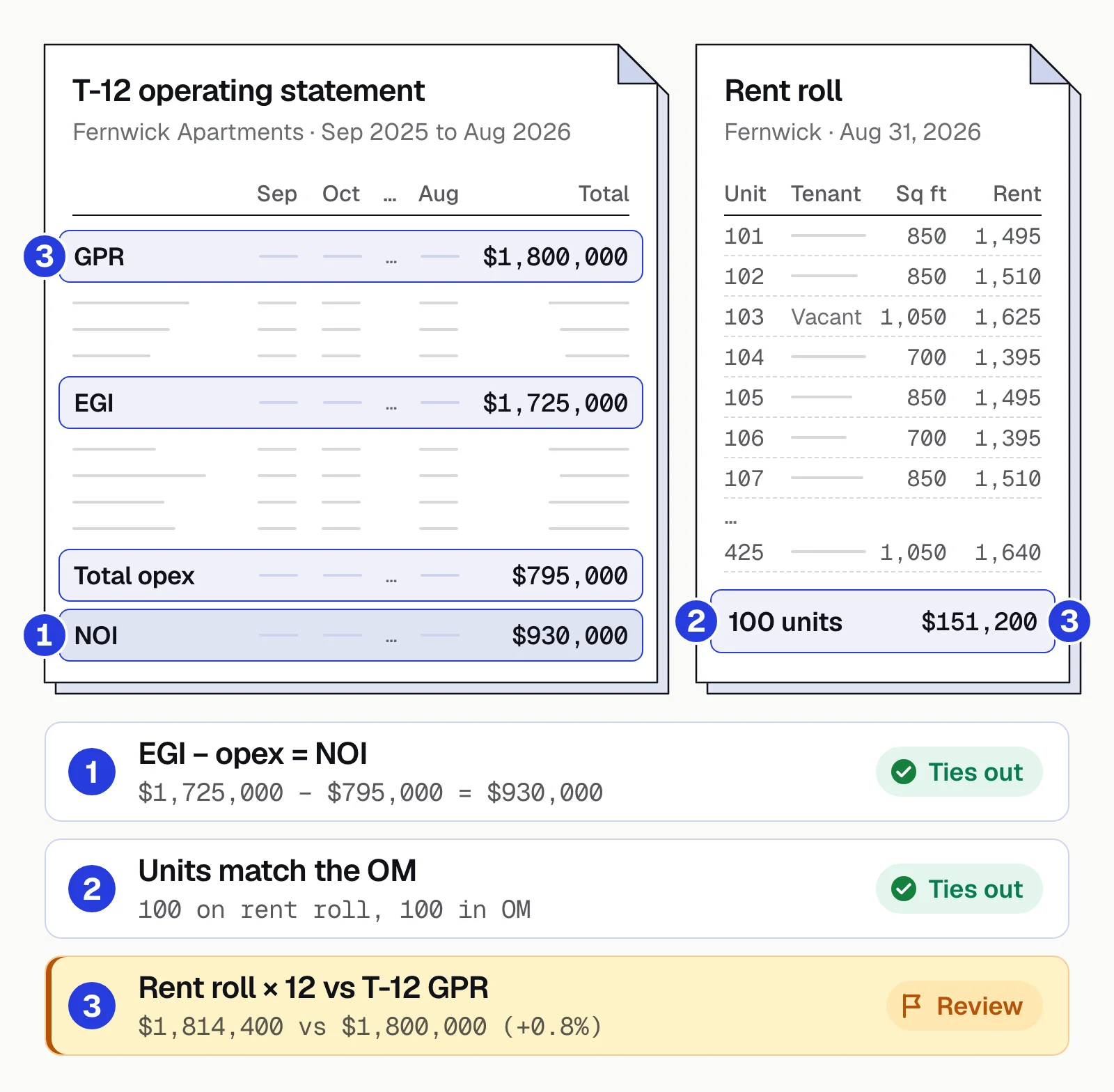
Docsumo does the reading, not the storing. It extracts rent rolls, T12s, leases and borrower financial statements in any layout, scans included, joins tables that run across pages, and sends fields it's unsure about to a reviewer with the source line highlighted. On the Enterprise plan, case management keeps a deal's documents together and cross-document validation checks them against each other. Mapping a property manager's chart of accounts to your template is a step you set up in the workflow. Data goes to your model through the API and webhooks, or downloads to Excel. It isn't a document management system, and it doesn't underwrite the deal. More in CRE underwriting, financial spreading and extracting data from T12s and rent rolls.
How to choose real estate document management software#
Run each check on a real deal folder, not the vendor's demo files.
- StructureOrganizes by property, deal, loan and tenant, the same way every time.
- Search inside scansFull-text search on scanned leases and statements, not just file names.
- Access controlInvestors, lenders and counsel see only their own documents.
- Audit and retentionViews, changes and deletions are logged, and retention is set by document type.
- ConnectionsLinks to your property management, accounting and underwriting tools, or an API.
- ExtractionIt, or a tool you connect to it, reads rent rolls, T12s and leases into data.
- SecurityA SOC 2 Type 2 report, encryption and single sign-on. Docsumo's security page lists its certifications.
The bottom line#
Real estate document management software keeps every property's documents organized, secure and easy to find, and helps you meet retention rules. Most of it doesn't read the numbers inside them. For CRE teams that underwrite and manage properties, pairing it with extraction for rent rolls, T12s, leases and financial statements is what removes the retyping. More in document AI for real estate.
Book a demo with a few of your own rent rolls and T12s, or start a free trial.
Frequently asked questions#
What is real estate document management software?
It's software that stores and organizes the documents behind real estate deals, properties and loans in one place, with search, access controls, version history and retention rules, so teams can find and share the right document quickly.
What is the best document management system for real estate?
It depends on the job. A document management system such as M-Files or DocuWare suits firm-wide records, a portal such as ShareFile suits sharing with clients, a virtual data room such as Datasite suits due diligence on a deal, and a deal platform such as Dealpath suits an investment team's pipeline. Test search and permissions on your own folders before you choose.
What documents do commercial real estate teams manage?
Offering memorandums, purchase and sale agreements, leases and amendments, rent rolls, T12 operating statements, appraisals, environmental and property condition reports, title and survey, insurance certificates, loan documents and tax bills.
What's the difference between document management and data extraction?
Document management stores and organizes files. Data extraction reads them and pulls out the numbers and terms, such as unit rents, lease expirations or NOI, as structured data. Most CRE teams need both: Docsumo does the extraction and works alongside the system that stores the files.
How long must real estate documents be kept?
It depends on the state, the license type and the document. California requires brokers to keep transaction records for 3 years from closing or listing. Lenders and investors follow their own regulatory and investor retention rules. Check with counsel for your situation.
Sources
- California Business and Professions Code, Section 10148
- M-Files: document management system
- DocuWare: document management and workflow automation
- ShareFile: real estate
- Zoho WorkDrive: real estate
- Datasite: virtual data rooms for real estate
- Dealpath: AI Extract and deal screening
First published . Last updated .