Real estate offering memorandum: what's in it and how to read one
For commercial real estate investors, lenders, brokers and analysts: the sections of a CRE offering memorandum, the numbers to verify against the rent roll and T12, and how to get OM data into your model without retyping it.

Key takeaways
- A real estate offering memorandum (OM) is the marketing package a broker prepares to sell a commercial property: it describes the asset, its location, tenants and financial performance.
- Most OMs include an executive summary, property description, location and market overview, tenant and rent roll summary, financial analysis and a confidentiality disclaimer.
- The key figures are asking price, net operating income (NOI), cap rate, occupancy, rent roll and operating expenses. Cap rate = NOI ÷ price.
- An OM is written to sell. Its pro forma numbers are projections; check them against the actual rent roll and trailing 12-month (T12) operating statement.
- In securities, "offering memorandum" can also mean a private placement memorandum for an unregistered investment offering, a different document.
On this page
A real estate offering memorandum (OM) is the marketing document a broker prepares to sell a commercial property. It presents the asset, its location, tenants, market and financial performance so buyers, investors and lenders can decide whether the deal is worth pursuing. Because it's written to sell, an OM is a starting point: its numbers need checking against the property's rent roll and operating statements.
What is an offering memorandum in real estate?#
In commercial real estate (CRE), the listing broker often releases the OM only after a prospective buyer signs a confidentiality agreement. It combines photos, maps, narrative and financial tables, and it's the main document buyers use for a first pass on a deal.
The term has a second meaning in securities, so check which one you're reading:
Real estate OM
The broker's marketing package for a property that's for sale: the asset, its tenants, its market and its financials. This guide is about this one.Private placement memorandum (PPM)
An optional document that describes an unregistered securities offering under Regulation D. The SEC notes that such documents typically aren't reviewed by any regulator and may not present risks in a balanced light.
What's in a real estate offering memorandum?#
Layouts vary by broker, but most OMs cover these sections:
| Section | What it covers | What to look for |
|---|---|---|
| Confidentiality disclaimer | Terms of use and the statement that information isn't guaranteed | Who's responsible for verifying the data (you) |
| Executive summary | The deal in one or two pages: asset, price, headline returns | Asking price, cap rate, NOI, occupancy |
| Property description | Address, year built, size, units or square footage, parking, condition, recent capital work | Deferred maintenance and upcoming capital needs |
| Location and market | Maps, aerial photos, demographics, employers, comparable sales and rents | Whether comps are truly comparable |
| Tenant overview and rent roll summary | Tenants, lease terms, rents, expirations | Rollover risk and below-market or above-market leases |
| Financial analysis | Historical operating statement, pro forma, sometimes a cash flow projection | The gap between actual and pro forma figures |
| Financing (if any) | Assumable debt or suggested loan terms | Rate, term, amortization, prepayment terms |
The numbers that matter#
Price
The asking price, plus price per unit or per square foot for comparing deals.Net operating income (NOI)
Income from the property minus operating expenses, before debt service and capital expenditures.Cap rate
NOI ÷ price. A 6% cap rate on a $10 million price implies $600,000 of NOI, so check whether that NOI is actual or pro forma.Occupancy and leases
Physical and economic occupancy, rent per unit or per square foot, and how much rent expires in the next few years.Operating expenses
Taxes, insurance, utilities, repairs, management and payroll, line by line.Debt terms
Rate, term, amortization and prepayment terms for any loan a buyer can assume.
How to read an OM critically#
- Separate actual from pro formaPro forma figures assume rent growth, lower vacancy or lower expenses. Underwrite from actuals first.
- Rebuild NOI from source documentsRequest the rent roll and the trailing 12-month operating statement (T12), then recompute income and expenses.
- Check the rent roll against the leasesConfirm rents, terms, concessions and expirations for the largest tenants.
- Stress the expensesProperty taxes often reset after a sale, and insurance costs change. Use your own estimates.
- Test the compsCompare with sales and rents for similar properties in the same submarket.
- Look for what's missingNo T12, a short rent roll or a vague capital expenditure history are questions for the broker.
How to make an offering memorandum#
If you're the broker or seller preparing one, make sure it has:
- Executive summaryPrice, NOI, cap rate, occupancy and the investment case, up front.
- Actuals beside pro formaHistorical financials next to any projection, each clearly labeled.
- Rent roll summaryThe current rent roll summary and the major lease terms.
- Property and locationGood photos, an aerial view and a map with nearby employers and amenities.
- Numbers that tie outUnit count, occupancy and NOI that match the rent roll and T12 buyers will ask for in due diligence.
- Disclaimer and contactsA confidentiality disclaimer and clear contact details for next steps.
How to automate offering memorandum data extraction#
An acquisitions or lending team may screen dozens of OMs a month, each in a different layout, then underwrite the promising ones from the rent roll and T12. Retyping price, NOI and unit counts into a model is slow and invites errors. Document AI pulls the figures from all three documents and ties them out first:
- Offering memorandum
- Rent roll
- T12 operating statement
- 01Extract the figures
- 02Cross-check occupancy and NOI
- 03Send gaps to review
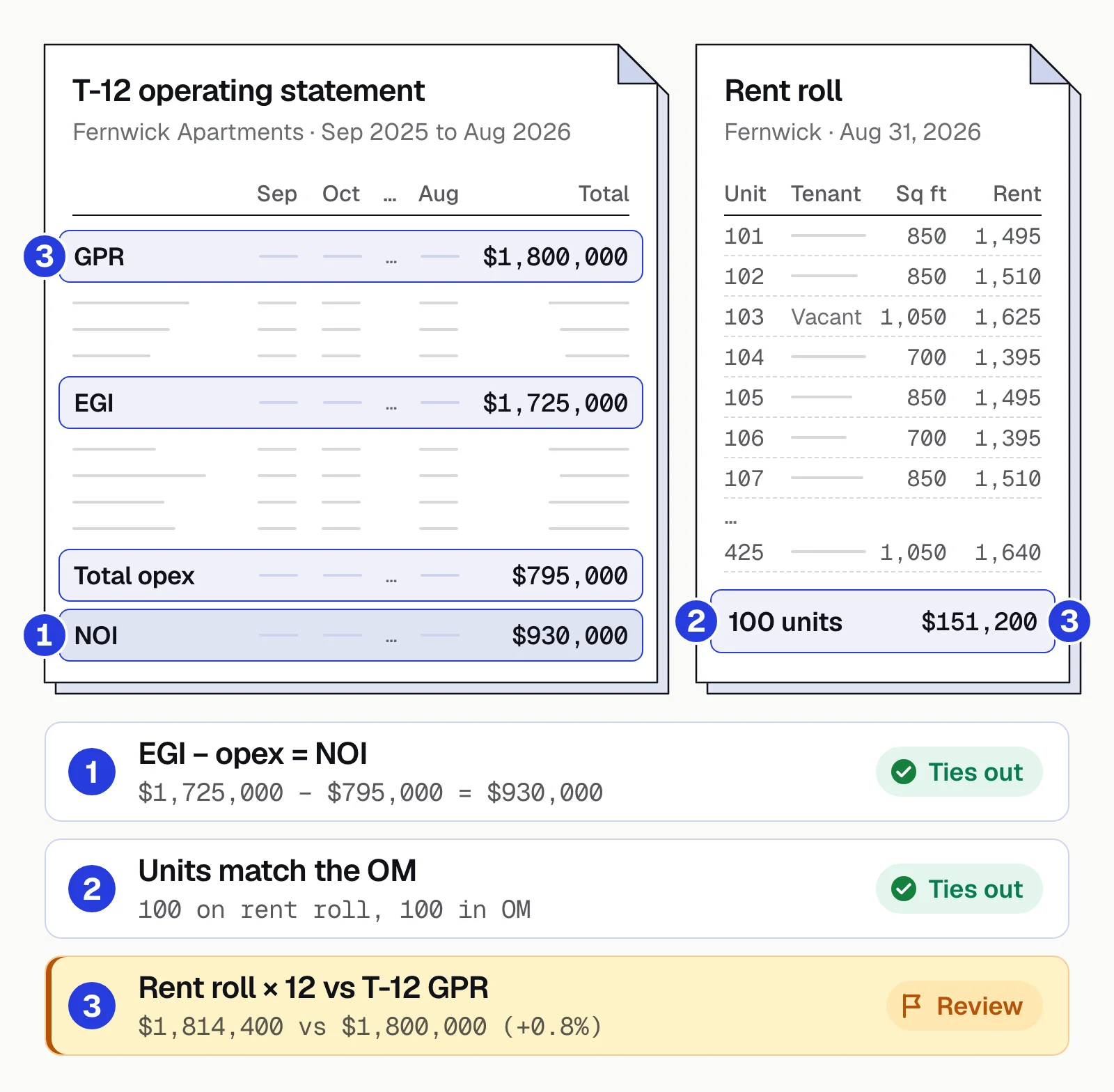
Docsumo is an intelligent document processing (IDP) platform. It reads OMs, rent rolls and T12s in any layout, scans included, and sends fields it's unsure about to your reviewer with the source line highlighted. Cross-document checks, such as the OM's unit count and occupancy against the rent roll, are on the Enterprise plan. Data reaches your model through the API and webhooks, or downloads to Excel. It doesn't make the underwriting call; your analysts do. See CRE underwriting, financial spreading and our guide to rent roll automation.
The bottom line#
An offering memorandum is the seller's case for a property. Use it to decide whether a deal deserves a closer look, then verify every important number against the rent roll, T12 and leases. If your team reviews OMs at volume, automate the data entry so analysts spend their time on the judgment calls.
Book a demo with a few of your own OMs, rent rolls and T12s, or start a free trial.
Frequently asked questions#
What is an offering memorandum in real estate?
It's a document, usually prepared by the seller's broker, that presents a commercial property for sale or investment. It covers the property, location, tenants, market and financials so buyers can decide whether to pursue the deal.
What does an offering memorandum look like?
Usually a designed PDF or printed booklet: a cover with photos of the property, an executive summary, property and location pages with maps, tenant and rent roll summaries, financial tables and a confidentiality disclaimer.
Who prepares an offering memorandum?
Usually the listing broker, working with the seller. Buyers get it from the broker, often after signing a confidentiality agreement. Sponsors raising equity for a syndication prepare a similar document for investors, often alongside a private placement memorandum.
What is the difference between an OM and a PPM?
A real estate OM markets a property. A private placement memorandum (PPM) describes an investment offering in unregistered securities, including risks and terms. The SEC notes that PPMs typically aren't reviewed by any regulator.
How do you verify the numbers in an offering memorandum?
Ask for the rent roll, the trailing 12-month operating statement, leases and recent tax and utility bills, then recompute NOI and occupancy yourself. See our guide to T12s and rent rolls.
How do you automate offering memorandum data extraction?
Document AI pulls the property details, price, NOI, cap rate, occupancy and loan terms from the OM, and the rent roll and T12 lines from their own documents, then checks them against each other before they reach your model. See CRE underwriting.
Sources
First published . Last updated .