ACORD 90 processing: the personal auto application, fields and automation
For personal lines carriers, MGAs and agencies that handle auto applications: what's on an ACORD 90, how state versions differ, and how to process applications without retyping driver and vehicle data.

Key takeaways
- The ACORD 90 is the Personal Auto Application: the standard form an agent completes to apply for a personal auto policy.
- It's state-specific. ACORD's forms index lists 53 versions, one for every state plus DC, Puerto Rico and the US Virgin Islands, each with its own edition date and state coverages.
- The key fields are applicant and residence, vehicles and VINs, use and mileage, coverages and limits by vehicle, drivers and license details, accidents and convictions, prior insurance and additional interests.
- Supplements travel with it: ACORD 91 (good student / driver training), 92 (medical statement), 93 (young driver questionnaire), 99 (accidents / convictions schedule) and 103 (additional resident and driver information).
- It holds sensitive personal data such as license numbers and dates of birth, so automation needs strong access controls as well as accuracy.
On this page
ACORD 90 processing means reading a Personal Auto Application and turning it into structured data a carrier can rate: the applicant, each vehicle and how it's used, the coverages and limits requested, every driver in the household, their accident and violation history, and prior insurance. Carriers, MGAs and agencies automate it because every application carries long vehicle and driver tables that are slow and error-prone to retype.
This guide covers what the form is, why it varies by state, the fields to extract, the checks to run and how to automate processing.
What is an ACORD 90 form?#
ACORD 90 is the standard Personal Auto Application published by ACORD. An agent completes it for a household applying for personal auto coverage and submits it to a carrier.
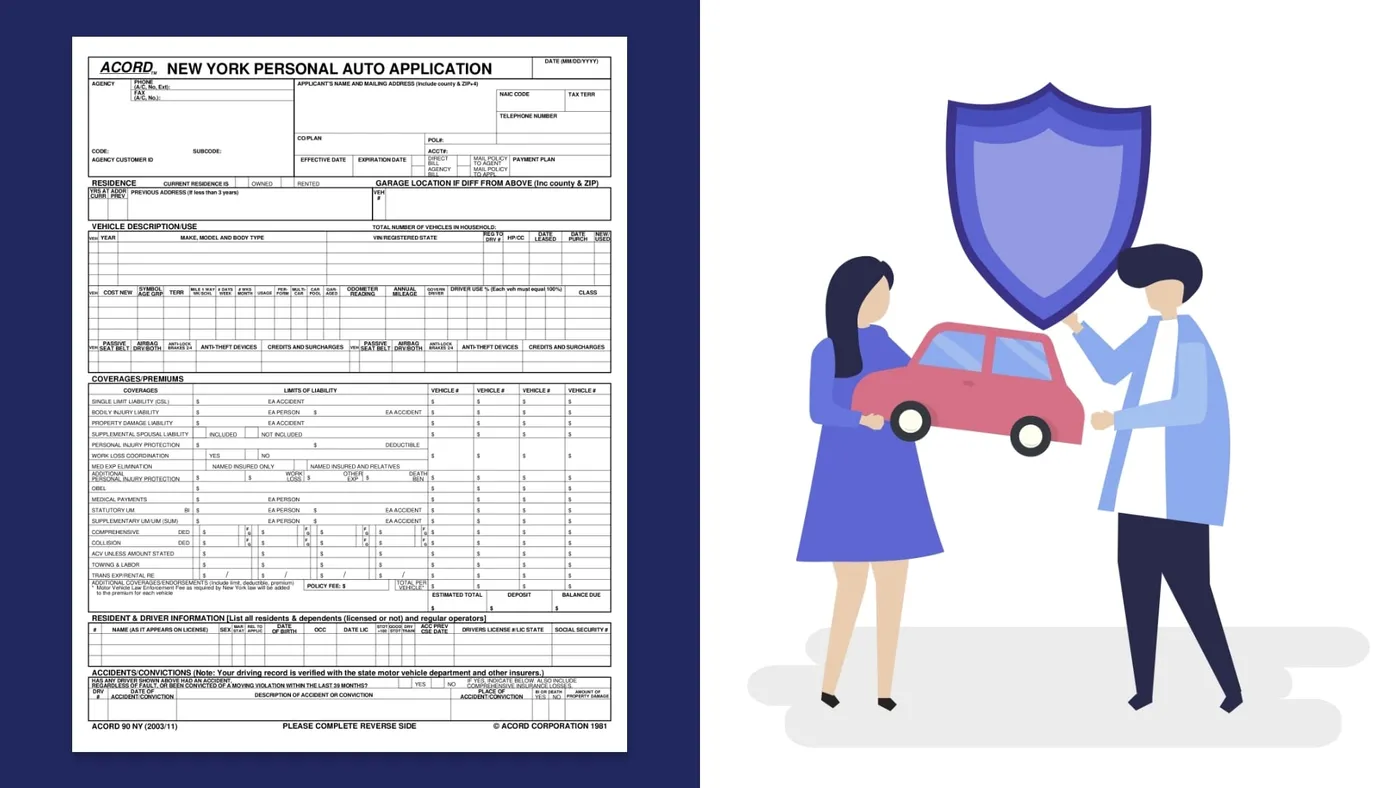
Unlike most ACORD commercial forms, it's state-specific. The header image shows an older New York edition (2003/11); ACORD's forms index, revised September 2026, lists 2023/08 as the current New York edition. The versions, and the supplements that travel with the form:
State versions
53 of them (every state, DC, Puerto Rico and the US Virgin Islands), differing mainly in state coverages such as personal injury protection and uninsured motorist.ACORD 91
Good student and driver training details.ACORD 92
Medical statement for one driver, covering eyesight, hearing and other conditions.ACORD 93
Young driver questionnaire.ACORD 99
Accidents and convictions schedule, for more than the application has room for.ACORD 103
Additional resident and driver information, for larger households.
How an ACORD 90 moves from agent to rating#
Each application and its supplements are classified and read, drivers and vehicles are checked, and clean data goes to rating.
- Agent email
- Portal uploads
- Scanned applications
- 01Classify state version and supplements
- 02Extract vehicle and driver rows
- 03Validate VINs and drivers
- 04Refer exceptions
The sections of an ACORD 90, and what to extract#
| Section | Fields to extract | Used for |
|---|---|---|
| Header | Agency, applicant name and mailing address, company or plan, policy number, effective and expiration dates, billing and payment plan | Setting up the quote |
| Residence | Owned or rented, years at address, previous address, garaging location if different | Territory rating |
| Vehicle description and use | Year, make, model, body type, VIN, registration state, date purchased, new or used, cost new, symbol, territory, miles to work or school, usage, annual mileage, principal driver and driver use, safety and anti-theft devices | Rating each vehicle |
| Coverages and premiums | Liability limits, medical payments or personal injury protection, uninsured and underinsured motorist, comprehensive and collision deductibles, towing, rental; premium by vehicle | Coverage requested |
| Resident and driver information | Name as on license, sex, marital status, relationship, date of birth, occupation, date licensed, driver training and good student, license number and state | Driver eligibility and rating |
| Accidents and convictions | Driver, date, description, at-fault indicators and amounts | Driving record |
| Prior insurance and general questions | Prior carrier, policy dates and limits; yes/no questions with explanations | Eligibility and underwriting |
| Additional interest | Lienholder or lessor name, address and loan number per vehicle | Endorsements and ID cards |
| Signature | Applicant and producer signatures and dates | Completeness |
The checks to run on every ACORD 90#
- State versionThe form matches the state where the vehicles are garaged. If not, request the correct state form.
- VINsEach VIN has 17 characters with no I, O or Q, a valid check digit in position 9, and decodes to the stated year, make and model (NHTSA's free vPIC decoder does the lookup). If not, flag it for review.
- DriversEvery household member of driving age is listed or excluded, each vehicle has a principal driver, and driver use adds up to 100% per vehicle. If not, ask the agent to complete it.
- Driving recordAccidents and convictions match motor vehicle and claims reports. If not, re-rate or refer.
- CoveragesRequired state coverages and minimum limits are present. If not, return the application for correction.
- SupplementsYoung drivers, good student discounts and medical questions have the right supplement attached. If not, request it.
- Additional interestsEvery financed or leased vehicle has a lienholder or lessor. If not, request the details.
Why ACORD 90 is hard to process by hand#
Many layouts
53 versions plus older editions still in use, so fixed templates break.Wide tables
Vehicle and driver rows have dozens of columns and are often handwritten.Sensitive data
License numbers, dates of birth and, on some older versions, Social Security numbers. Retyping them into spreadsheets spreads personal data around. Use a platform with SOC 2 Type 2 and role-based access.Many supplements
Forms for young drivers, good students and extra drivers need to be classified and linked to the right driver.
How to automate ACORD 90 processing#
- Collect applications in one queueBring in agent email and portal uploads, in bulk.
- ClassifyIdentify the ACORD 90 state version and each supplement.
- Extract every vehicle and driver rowKeep each row intact, handwritten entries included. Docsumo reads ACORD forms and any other document type in the file.
- ValidateCheck VINs, driver rules, state coverages and supplements.
- Send exceptions to a personEach flagged field is linked to its place on the page.
- Push the dataSend it to rating, motor vehicle report ordering and policy systems through an API or webhook.
- 99%field-level accuracy on 250+ document types
- 95%+of documents processed straight through, without manual review
- <5 minper document, down from 2+ hours
Docsumo reads completed applications. Classification and splitting are on the Business plan, and checks against other documents, such as motor vehicle reports, are cross-document validation, on the Enterprise plan. For other insurance documents, see insurance automation; for business auto, the ACORD 127 guide.
The bottom line#
The ACORD 90 packs a household's vehicles, drivers, coverages and history into a state-specific form. Classify the state version, extract every row, validate VINs and drivers automatically, protect the personal data, and send underwriters only the applications that need a closer look.
Book a demo with a few of your own applications, or start a free trial.
Frequently asked questions#
What is an ACORD 90 form?
ACORD 90 is the Personal Auto Application, a standard form agents use to apply for personal auto insurance on behalf of a household. It lists the applicant, vehicles, drivers, coverages requested, driving history and prior insurance.
Why are there different ACORD 90 forms for each state?
Auto insurance requirements and coverages, such as personal injury protection and uninsured motorist coverage, differ by state. ACORD publishes a version of the form for every state plus DC, Puerto Rico and the US Virgin Islands, such as ACORD 90 NY or ACORD 90 CA, with the coverages that state requires.
What forms are attached to an ACORD 90?
Depending on the household, the ACORD 91 (good student / driver training), ACORD 92 (medical statement), ACORD 93 (young driver questionnaire), ACORD 99 (accidents / convictions schedule) and ACORD 103 (additional resident and driver information).
Where can I get a fillable ACORD 90?
From ACORD. It offers its forms as printable PDFs, electronic fillable forms and eForms, and you need a subscription to an eligible ACORD forms program to download them. Pick the version for the state where the vehicles are garaged.
What is the difference between ACORD 90 and ACORD 127?
The ACORD 90 is the personal auto application for a household. The ACORD 127 is the business auto section of a commercial submission, attached to the ACORD 125 application: see our ACORD 127 guide.
Can ACORD 90 data be extracted automatically?
Yes. Extraction software can read every state version of the ACORD 90, keep each vehicle and driver row intact, check VINs and drivers, and send the data to a rating or policy system. Docsumo reads ACORD forms, and checks like these run as workflow steps you set up.
Sources
- ACORD Forms Index (rev. 9/8/2026)
- ACORD: Forms library
- eCFR: 49 CFR 565.13, VIN general requirements
- NHTSA: VIN decoder (vPIC)
First published . Last updated .