What is straight-through processing (STP)? Meaning, examples and how to measure it
For operations leaders in banking, lending, insurance and finance: what straight-through processing means, where it's used, how to calculate your STP rate, and what it takes to raise it when documents are involved.

Key takeaways
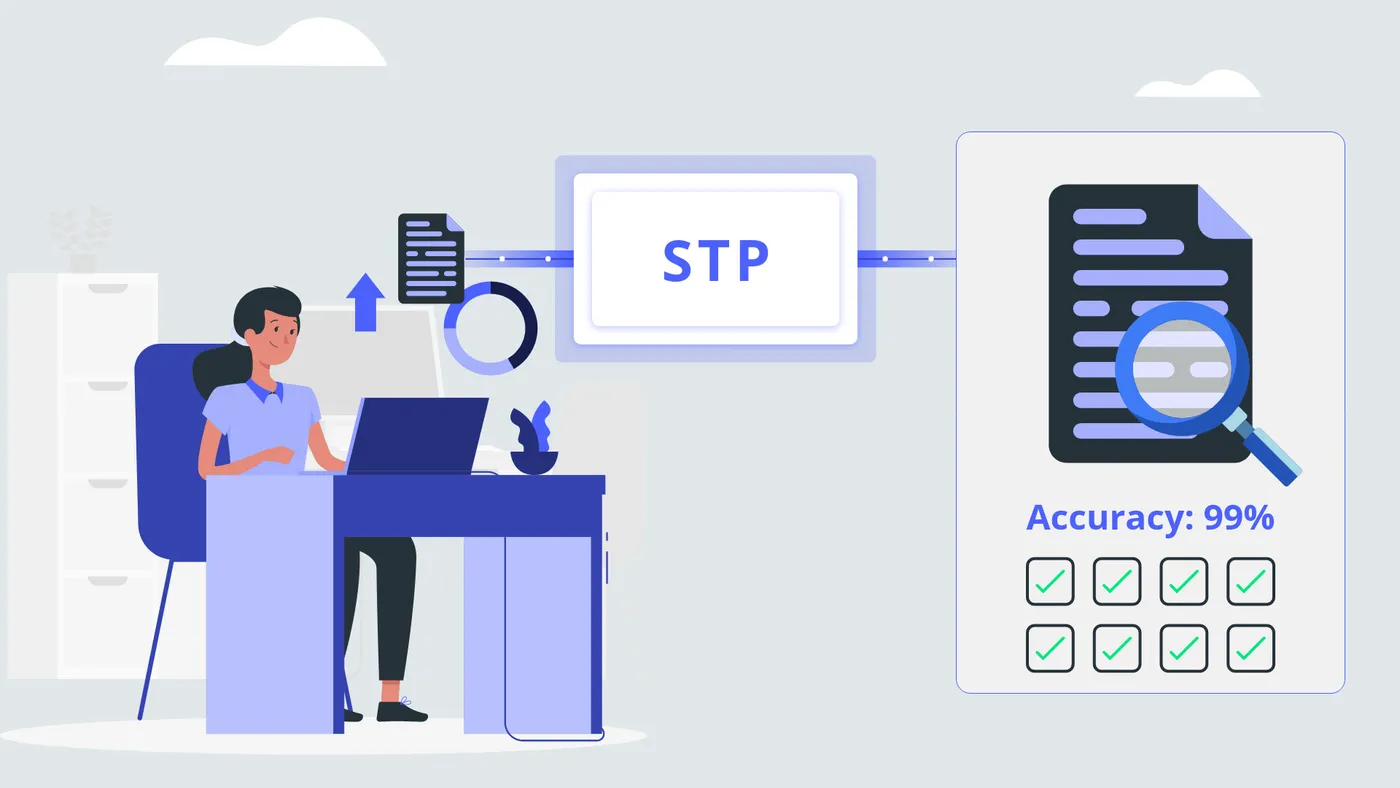
- Straight-through processing (STP) means a transaction, application or document moves from start to finish electronically, with no one re-keying or manually handling it.
- The term comes from securities trading and payments, where STP links trade capture, confirmation, clearing and settlement. The US moved to T+1 settlement on May 28, 2024, which raised the bar for automation.
- In document-heavy work such as lending, insurance and AP, the STP rate is the share of items that go through with no human touch: STP rate = items processed without manual intervention ÷ total items.
- STP isn't about removing people. Good STP sends only exceptions (low-confidence values, failed checks) to a reviewer.
- Raising STP on documents takes accurate extraction, validation rules, cross-document checks and integration into the downstream system.
On this page
Straight-through processing (STP) means a transaction, application or document moves from start to finish electronically, without anyone re-keying data or handling it by hand. The idea started in securities trading and payments, and it now describes any process, such as loan underwriting, claims intake or invoice posting, where items flow through untouched unless something needs a person.
This guide covers what STP means, where it's used, how to calculate your STP rate, and how to raise it when documents are involved.
What is straight-through processing?#
STP is an end-to-end electronic flow: data is captured once, and every later step (validation, approval, posting, settlement) reuses it. An item counts as straight-through only if nothing in the chain needed manual work.
A process with manual breaks
- Someone re-keys a trade into a second system
- Bank statement figures are typed into a spreadsheet
- Invoices are checked against purchase orders by eye
- Every item waits in the same queue
Straight-through processing
- Data is captured once and reused at every step
- Documents are read and checked automatically
- Matching and approvals run on rules
- Only exceptions wait for a person
STP in securities trading#
In capital markets, STP means a trade is captured, matched, confirmed, cleared and settled with no manual step. Shorter settlement makes that urgent: the standard US settlement cycle for most broker-dealer transactions moved from two business days after the trade (T+2) to one (T+1) on May 28, 2024, leaving a day less to fix breaks.
Regulators push for it directly. SEC Rule 17Ad-27 requires clearing agencies that provide a central matching service to have policies and procedures designed to facilitate straight-through processing, and to report on their progress every year.
STP in lending, insurance, AP and payments#
In back-office work, STP usually breaks at the documents, when someone has to read a bank statement, an ACORD form or an invoice and key it into a system.
- Loan files
- Insurance claims
- Invoices
- 01Classify
- 02Extract
- 03Validate
- 04Cross-check
- 05Send exceptions to review
Lending
A loan file goes straight through when its bank statements, pay stubs, tax returns and IDs agree with each other and the application, so only mismatches reach an underwriter. See IDP for lending.Insurance
Simple applications, straightforward claims, policy changes and certificates of insurance go straight through when the documents are read accurately and the rules can settle the case. See insurance automation.Accounts payable
An invoice goes straight through when it's captured, matched to its purchase order and receipt, and posted to the ERP untouched. See AP automation.Payments
A payment goes straight through when it reaches the beneficiary with no manual repair. Paper checks have to be read first: see check processing.
How to calculate your STP rate#
STP rate = items processed with no manual intervention ÷ total items processed
Count an item as straight-through only if no one reviewed, corrected, re-keyed or re-routed it at any step.
Your straight-through processing rate
Straight-through processing (STP) is the share of documents no person touches. Count a document as touched if anyone opened it to fix, check or key a value.
- Straight-through rate
- Hours of hands-on work per month
- Hours per year
How it's worked out
- STP rate = (documents processed − documents touched) ÷ documents processed.
- Hours are touched documents times minutes each. Raising the rate by cutting touches is where the hours come back.
Track cost per item too, and break the rate down to find the fixes:
By document type
Bank statements and pay stubs behave differently, so measure each one.By source
A few senders, banks or brokers usually cause most exceptions.By reason
Low extraction confidence, failed validation, missing documents and integration errors each have their own fix.
Benefits of straight-through processing#
Items that skip the queue finish faster, cost less and are keyed only once, so there are fewer errors, and staff spend their time on the exceptions that need judgment. Results for teams on Docsumo:
- 95%+of documents processed straight through, without manual review
- <5 minper document, down from 2+ hours
- $15saved per processed document
- 95%straight-through on debt settlement at National Debt Relief
How to raise your STP rate#
- BaselineMeasure today's STP rate, time per item and top exception reasons.
- Fix intakeRoute email, portal and API uploads into one queue, and flag missing documents on arrival.
- Automate extractionUse document AI with models for your document types.
- Write the checks down as rulesWhat reviewers check by eye becomes automated validation.
- Validate across documentsCompare income with deposits, names across IDs, and limits with contract minimums.
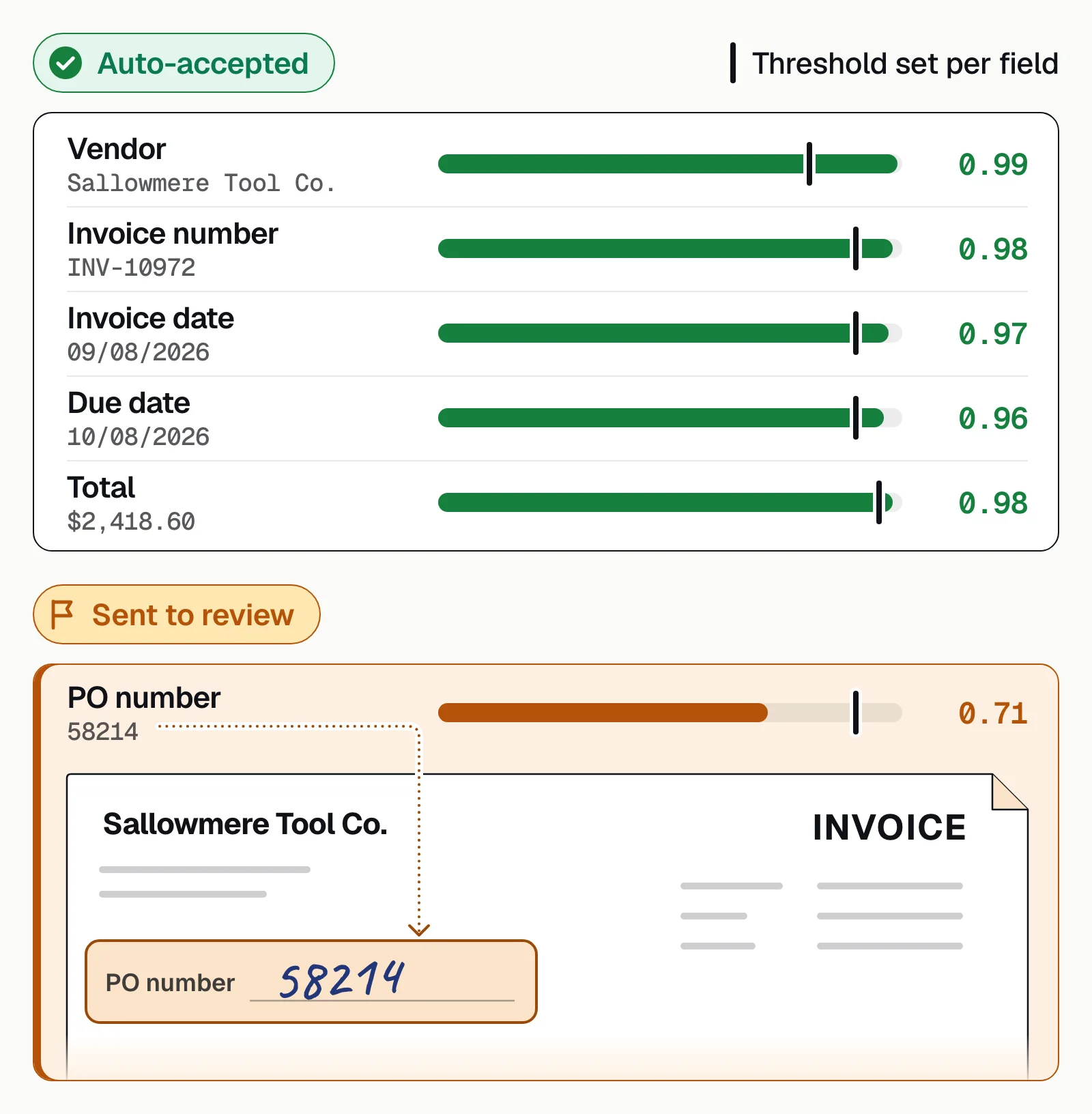
- Set confidence thresholds per fieldValues that clear their threshold and pass every rule go straight through; the rest go to review.
- IntegratePush results into the system of record through an API and webhooks.
- Review exceptions weeklyFix the top cause each week, whether a new layout, a strict rule or a missing integration. See exception handling.
Here's step 6 on a single invoice:
The bottom line#
STP means work flows end to end without manual handling, and people see only the exceptions. It began in trading and payments, and it's now the standard for document-heavy operations. Measure your STP rate honestly, find the top reasons items fall out, and fix them one at a time.
Book a demo to see what STP looks like on your own documents, or start a free trial.
Frequently asked questions#
What does STP stand for in banking?
STP stands for straight-through processing: a payment, trade or document moves from start to finish electronically, with no manual step. In banking it describes payments that reach the beneficiary without manual repair and trades that are confirmed, cleared and settled automatically.
How do you calculate the STP rate?
Divide the number of items processed with no manual intervention by the total number of items, over a set period. If 950 of 1,000 invoices post without anyone reviewing or correcting them, the STP rate is 95%.
What is a good STP rate?
It depends on the process and document mix. For document workflows, Docsumo customers see 95%+ straight-through processing. Track it by document type and sender, since a few difficult sources usually drag the average down.
What is the difference between STP and automation?
Automation can cover a single step. STP describes the whole flow: an item counts as straight-through only if every step, from intake to posting, happens without manual work.
Does STP remove the need for human review?
No. It removes review for items that pass every check and sends the rest to a person with the reason attached. See human-in-the-loop systems.
What is straight-through processing in insurance?
It's when an application, claim or policy change is processed from intake to decision with no manual step, because the documents were read accurately and every rule passed. Insurers use it most for simple policies, straightforward claims and certificate checks.