Data Extraction in Tax and Accounting: Use Cases, Documents, Best Practices
Tax and accounting firms are swimming in data, but manually extracting it can be a time-consuming nightmare. Enter data extraction! This powerful technology automates the process, freeing up professionals to focus on what matters most – strategic analysis and client service.

On this page
- Understanding Data Extraction in Accounting
- Documents used in accounting for data extraction
- Challenges in Data Extraction for the Accounting Industry
- Key tools and technologies for accounting data extraction
- Best practices for Data Extraction in Accounting
- Operational improvements through effective Data Extraction
- Conclusion: Enhancing accounting operations through advanced data extraction
Managing the vast volume of financial documents in tax and accounting processes poses a significant challenge. Manually processing invoices, receipts, and tax statements is inefficient and time-consuming.
This inefficiency can severely impede productivity, as professionals spend excessive hours on data entry rather than strategic financial activities. Automating data extraction offers a solution, streamlining operations, reducing errors, and freeing valuable time for more critical tasks.
In this article, we will learn about the key types of documents essential for data extraction and best practices for implementing effective data extraction technologies.
Understanding Data Extraction in Accounting#
Data extraction involves retrieving data from various sources, like financial statements and invoices. It organizes this data into a structured format for analysis and further use.
This process is vital in accounting for accurate financial analysis and strategic decision-making. It helps accountants manage large data volumes and maintain financial record integrity. However, manual data extraction requires human effort to gather and input data into systems. This method is often slow, susceptible to errors, and less efficient.
On the other hand, automated data extractionutilizes software tools to collect and store data from various sources. This approach enhances accuracy, reduces the time spent on data processing, and minimizes errors. It is ideal for managing huge volumes of data.
Documents used in accounting for data extraction#
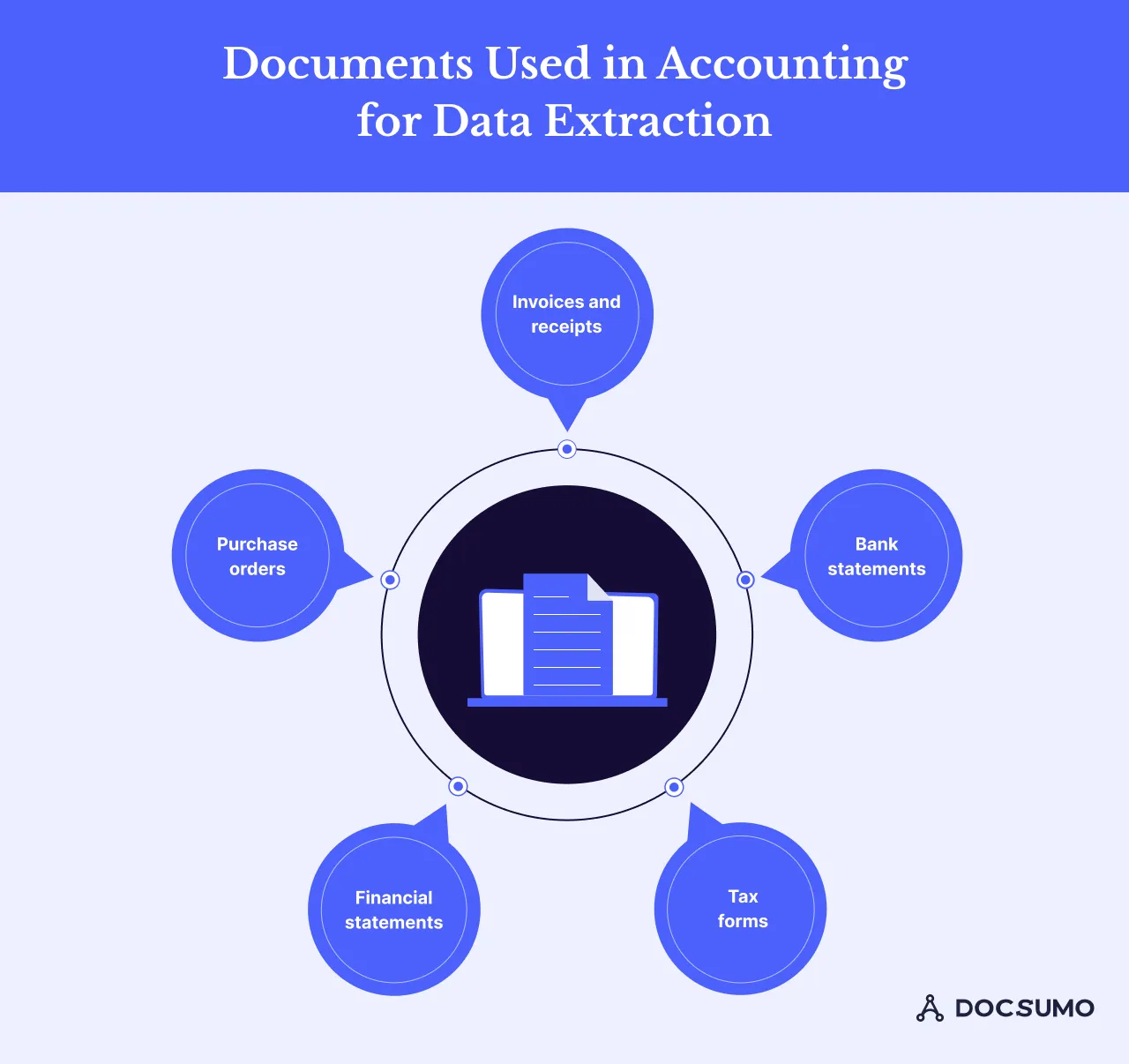
In accounting, various documents are integral to the data extraction process. Each document type serves specific purposes and supports different aspects of accounting workflows.
- Invoices and receipts: These documents are crucial for recording transactions from invoices. They provide detailed information about sales, services rendered, and payments made, which is essential for accurate financial tracking and reporting.
- Bank statements: These are important for verifying a business's actual cash flow. They help match recorded transactions with real account balances, ensuring accurate financial reports.
- Tax forms: These forms are important for compliance with tax regulations. They contain data needed to calculate tax obligations. This data also helps verify financial disclosures to tax authorities.
- Financial statements: These are comprehensive reports on a company’s financial performance. They are useful for internal decision-making and external reporting to stakeholders like investors.
- Purchase orders: These documents provide proof of purchases for goods and services. They match invoices for payment processing, which is crucial for managing expenditures and budgeting.
Challenges in Data Extraction for the Accounting Industry#
Here are some common issues faced by accounting professionals in the field:
- High volume of data: Accountants often face the challenge of managing large documents. This can slow down the data extraction process and increase the risk of errors.
- Data quality and accuracy: It is crucial to ensure the accuracy and reliability of extracted data. Errors in data can lead to incorrect financial reporting and decision-making.
- Integration with existing systems: Integrating new data extraction technologies with financial software can be complex, often causing issues with data transfer and system compatibility.
- Regulatory compliance: Staying compliant with changing financial regulations requires accurate data extraction. This can be challenging when dealing with diverse data sources and formats.
- Cost of implementation: Implementing automated data extraction systems involves significant costs. These include purchasing software, training staff, and ongoing maintenance.
- Security concerns: Protecting sensitive financial data during extraction is critical. Security breaches can lead to data loss and damage a company’s reputation.
Key tools and technologies for accounting data extraction#
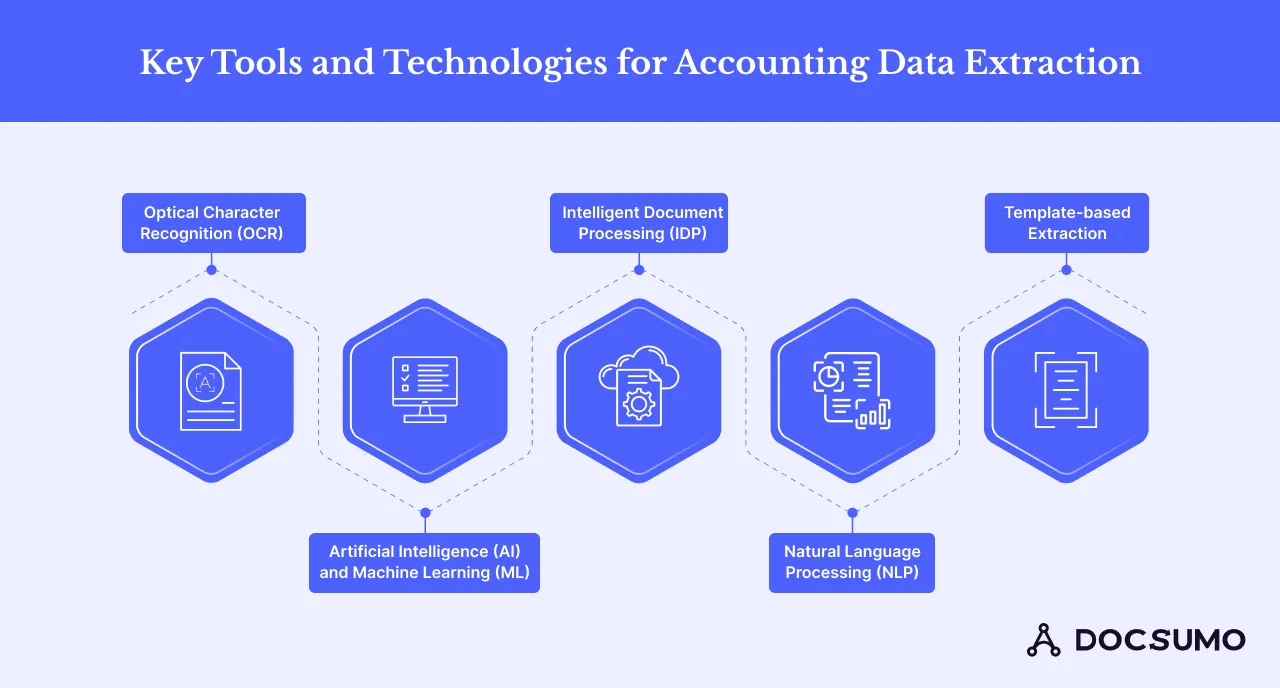
Advancements in technology have transformed data extraction in accounting, making it faster and more accurate. Here are some key tools and technologies that aid efficient data extraction:
- Optical Character Recognition (OCR): Optical Character Recognition technology changes images of text into readable text. Adobe Acrobat and Docsumo are popular accounting OCR tools. They turn PDFs and scanned documents into editable formats, helping to convert paper records into digital ones quickly.
- Artificial Intelligence (AI) and Machine Learning (ML): AI and ML help make data extraction faster and more accurate. Tools like Kofax and IBM Watson use these technologies. They process complex documents efficiently. Over time, they learn from data and improve at their tasks.
- Intelligent Document Processing (IDP): IDP uses AI to automate data extraction. UiPath automates repetitive data entry tasks. Automation Anywhere provides tools that analyze extracted data for insights, which helps in making informed decisions.
- Natural Language Processing (NLP): NLP understands human language in documents. Rossum uses NLP to automatically extract data from invoices. It does this without needing predefined rules. This makes it adaptable to various document formats.
- Template-based Extraction: This method uses specific templates to extract data. Docparser lets users set custom rules to extract data from structured documents like forms. This is useful for efficiently processing large volumes of similar documents.
Best practices for Data Extraction in Accounting#
Effective data extraction is key for precise financial management. Here are simplified best practices to improve data extraction in accounting:
- Establish clear objectives: Clearly define your data extraction goals. Know what data you need and why to make the process smoother and more focused.
- Regularly update extraction rules: Regularly update your data extraction rules with changes in data formats and sources. This helps avoid errors and keeps the process efficient.
- Ensure data security: Use strong security measures to protect sensitive financial data. This includes encryption, secure access protocols, and regular security checks.
- Validate and verify data: Always check the data for accuracy and completeness. Regular checks help identify and fix errors early, ensuring correct financial reports.
- Train personnel: Train your team on the latest tools and best practices in data extraction. A well-trained team can more effectively manage complex tasks.
- Integrate extracted data into existing systems: Make sure to integrate the data you extract into your existing accounting systems smoothly. This will improve the usefulness of the data and support better decision-making.
Operational improvements through effective Data Extraction#
Improved data extraction processes can significantly enhance various aspects of accounting operations:
- Improved decision-making: With precise and timely data, businesses can make well-informed decisions. This helps in planning strategies more effectively and allocating resources wisely. It supports better forecasting and helps anticipate future business needs.
- Enhanced efficiency: By streamlining data extraction processes, businesses can process transactions faster and prepare financial reports more quickly. This efficiency saves valuable time and reduces the workload, allowing staff to focus on other critical tasks.
- Cost reduction: When data extraction is efficient, it reduces the need for manual data entry, which is often slow and prone to errors. Reducing errors means spending less money on correcting them, thus lowering overall operational costs.
- Better compliance: Accurate and reliable data extraction ensures that financial records are kept precise. This is crucial for complying with legal and financial regulations. Good compliance helps avoid costly penalties and fines, and it maintains a company's reputation.
- Enhanced customer satisfaction: Faster and more accurate data processing means businesses can respond more swiftly to customer inquiries and issues. This leads to improved service quality and higher customer satisfaction, as clients feel valued and supported.
Conclusion: Enhancing accounting operations through advanced data extraction#
Advanced data extraction improves accounting by making processes faster and more accurate. It reduces the need for manual work, cuts costs, and helps avoid mistakes. This ensures that financial reports comply with laws and consider customer interests. Using modern tools and following best practices in data extraction gives businesses a competitive advantage.
Docsumo is an intelligent document processing platform that uses advanced OCR and AI technologies to ensure precise and secure data extraction. With Docsumo, companies can easily handle and seamlessly integrate large amounts of data into their existing systems.
Try the Docsumo for Data Extraction today for better efficiency and accuracy in accounting.
First published .