Purchase order automation for suppliers: automate PO data entry into sales orders
For order management, customer service and sales operations teams at suppliers, distributors and manufacturers: how to stop retyping customer purchase orders, the checks to run, and how to roll it out.

Key takeaways
- For suppliers, purchase order automation usually means order entry automation: reading customer POs that arrive by email and PDF and creating sales orders without retyping.
- Customer POs come in every customer's own layout, often with item codes, units and ship-to details that don't match yours.
- The key steps are extract, map customer items to your SKUs, check prices and terms, and create the sales order in your ERP.
- Checks catch the costly errors: wrong price, unknown item, duplicate PO, wrong ship-to or unit of measure.
- Faster, cleaner order entry means quicker order acknowledgments and fewer invoice disputes later.
On this page
For suppliers, distributors and manufacturers, purchase order automation usually means automating PO data entry: reading the purchase orders customers send by email, PDF or EDI, extracting the items, quantities, prices and delivery details, checking them and creating sales orders in the ERP without retyping. It speeds up order acknowledgments and catches price and item errors before they turn into shipping mistakes and invoice disputes.
This guide covers why customer POs are hard to process, the automated order entry workflow, the checks to run and how to roll it out. For the buyer's side, see purchase order automation for procurement.
Why customer purchase orders are hard to process#
Each error here costs later: wrong items shipped, credits issued, and invoices disputed because the invoice price doesn't match the customer's PO.
Every customer has its own format
Layouts, field names and PO numbering differ by customer, and sometimes by buyer.Customer item codes aren't yours
Customers order by their own part numbers or descriptions.Units don't match
A customer orders cases when you sell each, or the other way round.Channels are mixed
EDI for large accounts, PDFs by email for most, the odd scan.Changes and duplicates
Revised POs, the same PO sent twice, order changes by email.Volume spikes
Seasonal peaks and promotions swamp the order desk.
The automated order entry workflow#
- Email inbox
- Portal uploads
- EDI
- 01Classify
- 02Extract
- 03Map SKUs
- 04Check
- CollectOrders from a shared inbox, portal uploads and EDI land in one queue. EDI orders are already structured and skip extraction.
- ClassifyEach document is sorted: new PO, PO change, cancellation, or something else such as a quote request.
- ExtractThe header (customer, PO number, dates, ship-to, bill-to, terms) and every line (customer part number, description, quantity, unit, price).
- MapCustomer part numbers are looked up in your cross-reference table, with suggestions for lines that don't match.
- CheckThe order runs through the checks below; failures go to the order desk with the problem highlighted on the PO.
- CreateClean orders go to the ERP or order management system through its API, which creates the sales order and sends the acknowledgment.
Checks to run before creating the order#
- Customer and ship-toUnknown customer, or a new or mistyped delivery address.
- Duplicate PO numberThe same order sent twice.
- Item mappingCustomer part numbers missing from the cross-reference.
- Unit of measureCases vs each, or a pack-size mismatch.
- PricePO price different from the price list or contract.
- Quantity and minimumsBelow the minimum order, or an unusual quantity.
- DatesRequested delivery earlier than lead time allows.
- TermsPayment or shipping terms different from the account's.
Price deserves the most attention. If the order ships at your price but the customer's AP team matches your invoice to their PO price, the invoice is held. On the customer's side, exceptions like this are common. Ardent Partners' State of ePayables 2025, a sponsored analyst report, puts the average invoice exception rate at 18.4%. The same report puts the average cost to process an invoice at $9.84.
What to extract from a customer PO#
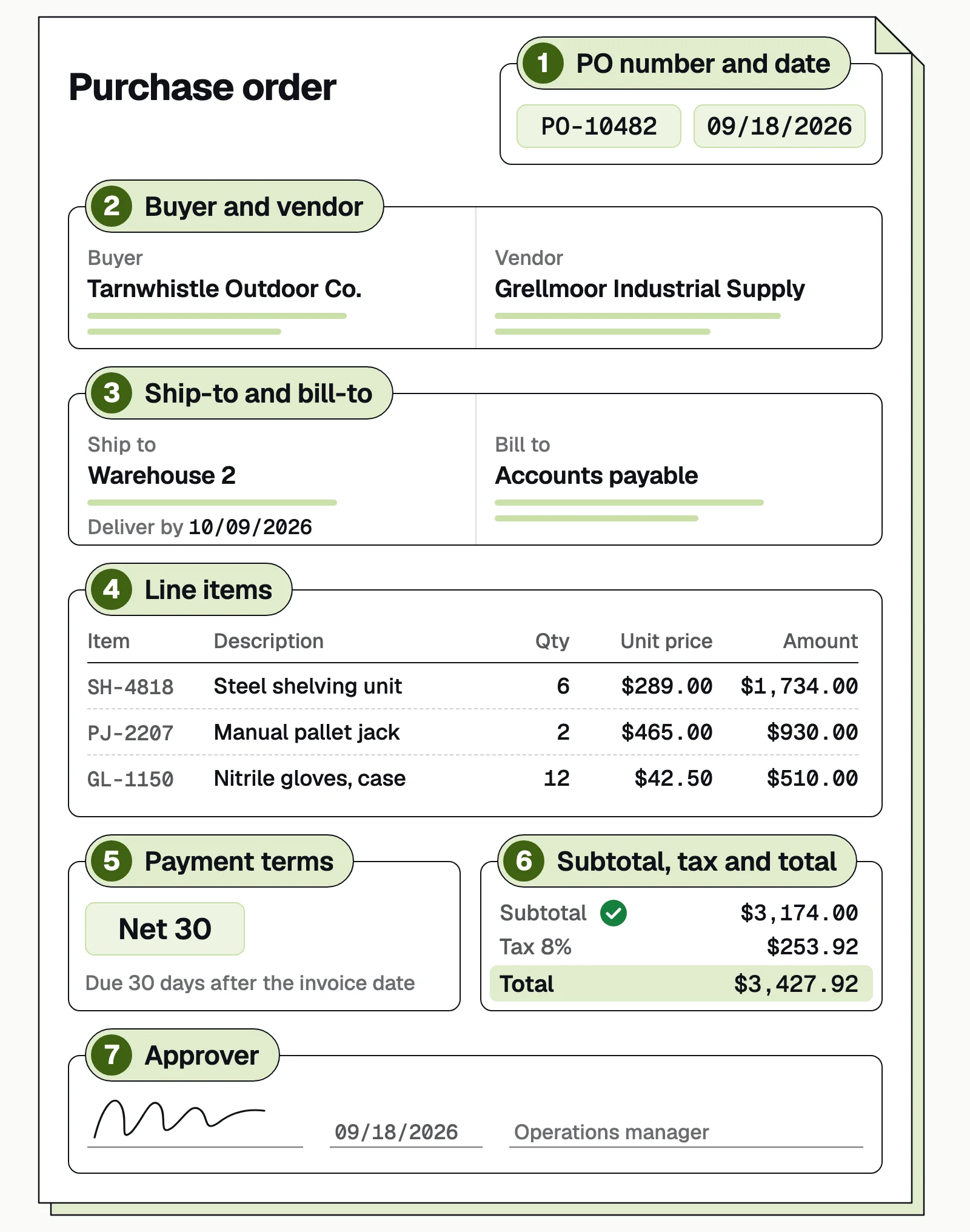
- Header: customer and account, PO number and date, buyer contact, bill-to and ship-to, requested delivery date, shipping method, payment terms, currency.
- Lines: line number, customer part number, your SKU if given, description, quantity, unit of measure, unit price, extended amount.
- Totals and notes: order total, tax and freight if stated, special instructions.
Docsumo reads purchase orders from email, uploads or its API with 99% field-level accuracy across 250+ document types, and joins line-item tables that run across pages into one table. Data goes to your ERP through API and webhooks, and the same platform reads the invoices in your order-to-cash and procure-to-pay flows. It doesn't create POs or sales orders itself: your ERP does, from the data Docsumo sends.
How to roll it out#
- Pick your top customers by PDF order volumeand collect a few hundred recent POs.
- Build the item cross-referencefrom past orders.
- Test extraction accuracyon the sample, line items included.
- Set the checksand decide which failures block the order and which only warn.
- Connect the ERPand test order creation in a sandbox.
- Go live with a person reviewing every order,then let clean orders flow straight through as accuracy holds.
Docsumo reports 95%+ straight-through processing and under 5 minutes per document, down from more than 2 hours. See how document workflows are built on the platform.
The bottom line#
For suppliers, purchase order automation is about getting customer orders into the ERP quickly and correctly. Extract every PO, map customer items to your SKUs, check price, units and duplicates, and let the order desk focus on exceptions and customers. For how the buyer handles the same PO, see the purchase order process.
Book a demo with a few of your own purchase orders, or start a free trial.
Frequently asked questions#
What is purchase order automation for suppliers?
It's automating the entry of customer purchase orders into your order management or ERP system. Software reads each PO, extracts the customer, items, quantities, prices and delivery details, checks them and creates a sales order.
How is this different from procurement PO automation?
Procurement PO automation helps the buyer create and approve POs and match them with invoices. Order entry automation helps the supplier process the POs it receives. See purchase order automation for the buyer side.
How do you automate PDF purchase order data entry?
Send PDF and emailed POs to one inbox, use document AI to extract the header and every line item, map customer part numbers to your SKUs, run price, unit and duplicate checks, and pass clean orders to your ERP through its API. People review only the orders that fail a check.
Can PO automation handle EDI and PDF orders together?
Yes. EDI orders are already structured and go straight in; PDF, scanned and email orders are extracted with document AI so all orders land in the same queue.
How do you map a customer's item codes to your SKUs?
Keep a cross-reference table of customer part numbers to your SKUs, and use descriptions to suggest matches for new items. Unmatched items go to a person, and confirmed matches are added to the table.
What should be checked before creating a sales order?
The customer account, ship-to address, item mapping, unit of measure, price against the price list or contract, requested dates, payment terms and whether the PO number was already received.
Sources
First published . Last updated .