AI invoice processing and AI in accounts payable: how it works and where it helps
For AP managers and controllers weighing AI for invoices and the rest of accounts payable. Follow an invoice through each step, then see where AI helps, from general ledger (GL) coding to vendor statements.

Key takeaways
- AI invoice processing uses machine learning to read invoices in any layout and extract header and line-item data. Unlike template-based OCR, it needs no template for each vendor, so a new supplier or a changed layout doesn't break the process.
- Validation is worth more than reading the data. Checks catch errors before payment. They test the totals and tax and look up the vendor. They also find duplicates and match the invoice to the PO and receipt.
- AI in accounts payable does more than read invoices. It suggests general ledger (GL) codes and checks invoices against POs and receipts. It sends exceptions to a reviewer and the other invoices to approvers. It can also match vendor statements to the ledger. In Ardent Partners' State of AP 2026, a sponsored analyst report, 58% of AP organizations use or pilot AI.
- Ardent Partners' State of ePayables 2025, a sponsored analyst report, puts the average cost to process an invoice at $9.84. The average processing time is 8.2 days. The AP teams Ardent rates as top performers process invoices at 79% lower cost and 79% faster than their peers.
- E-invoicing mandates change what AI does, but AP teams still need AI. E-invoices arrive as data but still need matching and checks. Other suppliers still send PDFs.
On this page
- What is AI invoice processing?
- Manual entry vs template OCR vs AI
- How AI invoice processing works
- AI in accounts payable, from GL coding to vendor statements
- What the numbers look like
- What to measure
- How to choose a tool and roll out AI invoice processing
- AI and e-invoice compliance
- Count the fixes before you count the savings
- Frequently asked questions
AI invoice processing uses machine learning to read supplier invoices in any layout. It pulls out the header and line-item data and checks it against purchase orders and vendor records. Only the exceptions go to a person. It replaces manual keying and template-based OCR, which breaks every time a vendor changes its invoice format.
Below, we follow an invoice through each step. Then we look at AI in accounts payable as a whole, from general ledger (GL) coding to vendor statements, and at what to measure.
What is AI invoice processing?
AI invoice processing automates four jobs between receiving an invoice and recording it in your accounting system. It uses two kinds of software. One reads the text in an image. A language model then works out what the text means.
Read
Turns PDFs, scans, photos and email attachments into text, including tables and handwriting.Understand
Finds the invoice number, due date and line items on layouts it hasn't seen before.Check
Reconciles totals and tax, looks up the vendor, catches duplicates and matches lines to POs.Route
Sends clean invoices for approval and exceptions to a reviewer.
Software that reads and understands documents is called intelligent document processing. Software that also checks and routes invoices is called accounts payable automation.
Manual entry vs template OCR vs AI
| Manual entry | Template OCR | AI invoice processing | |
|---|---|---|---|
| New vendor layout | No setup, but slow | Needs a new template | Handled without a template |
| Line items | Keyed by hand | Only if the template maps them | Extracted as a table |
| Scans and photos | Readable by people | Accuracy drops on skewed or poor scans | Reads scans; flags low-confidence fields |
| Validation | Depends on the reviewer | Usually none | Rules, PO matching and duplicate checks |
How AI invoice processing works
Every invoice takes the same path, whatever channel it arrives through.
- AP inbox
- Supplier portal
- Scanned paper
- 01Classify
- 02Extract
- 03Validate
- 04Route
The software first sorts each document by type, so invoices are separated from credit memos, statements and receipts. It then reads the header fields and line items and gives each a confidence score, which shows how sure it is. Docsumo reaches 99% field-level accuracy across 250+ document types, invoices included.
Validation comes next. The software checks the totals and looks up the vendor. It also looks for duplicates and runs the 2-way or 3-way match. Clean invoices go for approval. Exceptions go to a reviewer, with the field that failed the check highlighted. Approved data then goes to the ERP by API. The reviewers' corrections improve the model.
AI in accounts payable, from GL coding to vendor statements
AI in accounts payable does more than read invoices. It suggests general ledger (GL) codes and matches each invoice to its purchase order and receipt. Invoices that fail a check go to a reviewer, and the rest are routed for approval. Some tools also match vendor statements to your ledger. People still settle the exceptions and approve the spend.
Most AP teams are already trying it. In Ardent Partners' State of AP 2026, a sponsored analyst report, 58% of AP organizations use or pilot AI. The survey asked 194 accounts payable, procure-to-pay and finance leaders. Today, teams use AI most for invoice capture and data extraction. Over the next 12 months, teams plan to add AI to invoice coding, approval routing, supplier inquiries and payment optimization.
The table follows the accounts payable process from the moment an invoice arrives.
| Step | What AI does | Still with your team |
|---|---|---|
| Capture | Reads invoices in any layout and separates them from credit memos and statements | Checks the fields the AI is unsure of |
| GL coding | Suggests a GL code for each invoice line | Owns the chart of accounts and the coding rules |
| Matching | Compares each invoice line with the PO and the goods receipt | Settles price and quantity differences |
| Exceptions | Sends each invoice that fails a check to a reviewer, with the failed field marked | Decides the fix, often with the person who ordered the goods or with the vendor |
| Approval | Routes each invoice to an approver by your rules and follows up on late approvals | Approves the spend |
| Vendor statements | Matches each statement line to the AP ledger and lists what doesn't match | Confirms the balance with the supplier |
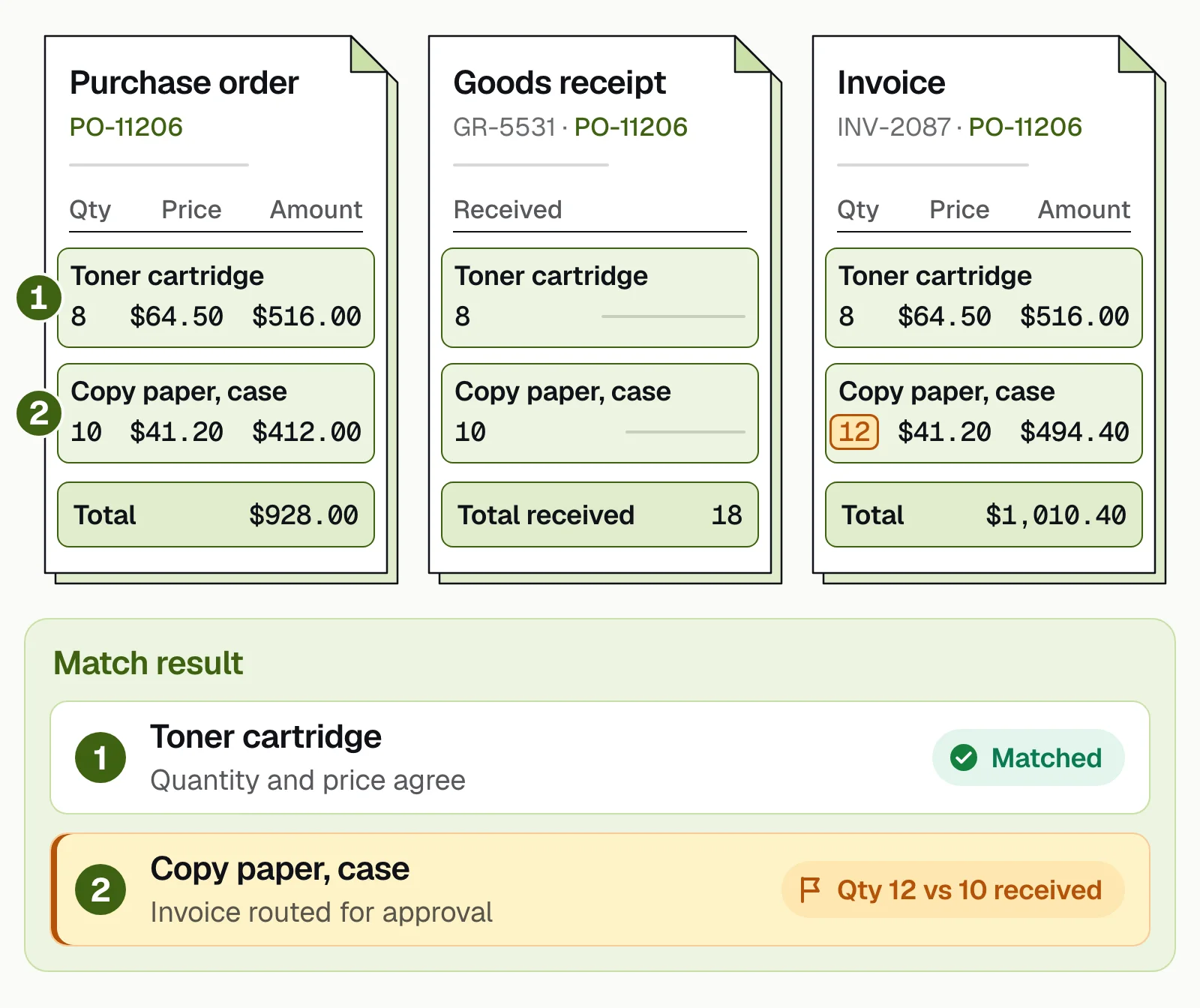
Matching stops you paying for overbilling, or for goods that were billed but not delivered. In the example below, the toner line matches. The invoice bills 12 cases of copy paper when 10 were received, so it's routed for approval. Your rules decide whether a failed match goes to a reviewer first or straight to an approver, as here.
Where Docsumo fits
Invoices reach Docsumo by email to its inbox, by upload or through the API. Docsumo reads any document type and flags invoices that duplicate one already received. Fields it's unsure of go to a person, who clicks a field to see the line on the invoice it came from.
For GL coding, you can add a workflow step that suggests GL codes. Our guide to invoice coding lists the rules to write before you automate it. On the Enterprise plan, Docsumo matches invoice lines to the PO and the goods receipt. On the Business plan, it routes invoices for approval by the rules you set. An invoice not approved within the time you set is escalated.
Docsumo also matches vendor statements to the ledger. Our guide to vendor statement reconciliation reconciles one statement, step by step. If a file is missing a document, Docsumo's Document Collection and Email agents can email the person who sent the file to ask for it. Checked data goes to your ERP through the API and webhooks. Docsumo doesn't create POs or pay vendors, so payments still go out from your own systems.
What the numbers look like
Ardent Partners' State of ePayables 2025, a sponsored analyst report, puts the average cost to process an invoice at $9.84. The same report puts the average processing time at 8.2 days and the average invoice exception rate at 18.4%. The AP teams Ardent rates as top performers process invoices at 79% lower cost and 79% faster than their peers.
Put your own volume and cost into the calculator below.
What invoice processing costs you
Put in your own numbers. The cost and exception-rate defaults are the 2025 averages across AP teams.
- Cost today, per month
- Cost with automation, per month
- Difference per month
- Difference per year
How it's worked out
- Cost today is invoices per month times the cost of one invoice.
- With automation, an invoice that still needs a person costs what it costs today, and the rest cost only the software.
- It leaves out late-payment fees and missed early-payment discounts, which usually make the gap bigger.
Source: Ardent Partners, State of ePayables 2025: AP benchmarks (sponsored analyst report, Jan 2026)
Here are Docsumo's own results, including at Valtatech.
- 95%+of documents processed straight through, without manual review
- <5 minper document, down from 2+ hours
- 65%+lower costs at Valtatech
- 99%+of invoices processed touchless at Valtatech
What to measure
Take a baseline before the rollout and track the same numbers after.
- Straight-through rateInvoices posted with no human touch.
- Field-level accuracyExtracted fields that were right, on your own invoices.
- Codes changedInvoice lines where a person changed the suggested GL code.
- Exception rate by reasonNo PO, price variance, missing approver, low confidence.
- Cycle timeReceipt to approval, and receipt to payment.
- Cost per invoiceFully loaded AP cost divided by invoices processed.
- Duplicates caughtDuplicate and wrong payments stopped before they go out.
Where we land. Judge an AI invoice tool by what your team had to fix, not by the accuracy figure on a vendor's page. Run your own invoices through a trial, then count every field a person corrected and every invoice that needed a touch. A vendor that shows you that count on day one is easier to trust than one that quotes a headline number.
How to choose a tool and roll out AI invoice processing
Test any invoice processing software on your own invoices, then roll it out one part at a time.
- Map the processList invoice sources, volumes, PO share, approval rules and your ERP.
- Build a test setPull a few hundred real invoices. Include your top vendors, vendors who send only a few invoices, and some bad scans.
- Run a trialMeasure field-level accuracy on that set, line items included.
- Write the rulesStart with totals, duplicates, vendor checks and PO matching. Add GL coding and approval rules next.
- Connect the ERPPull vendors and POs in, push approved invoices out, and test on a sandbox first.
- Start with one partGo live with one legal entity or one vendor group, and have a person review every exception.
- Review monthlyFix the biggest exception reason and approve more invoices automatically once the numbers stay steady.
Invoices carry bank details, so check security too. Docsumo is SOC 2 Type 2, HIPAA and GDPR compliant and ISO 27001 certified.
AI and e-invoice compliance
An e-invoice carries its data in a structured format, such as XML, that the buyer's system reads directly. More countries are making e-invoicing mandatory. The EU's VAT in the Digital Age rules, in force since April 2025, let member states make e-invoicing mandatory. From July 1, 2030, the EU requires digital reporting of cross-border B2B transactions. In France, since September 1, 2026, every business in scope must be able to receive e-invoices. Large and mid-sized companies must issue them too. Smaller companies must issue them from September 1, 2027.
E-invoicing changes what AI does, not whether you need AI. Suppliers outside a mandate still send PDFs and scans, and AI reads those. A valid e-invoice can still bill the wrong quantity or repeat an earlier invoice, so AI checks what each one says. E-invoices and PDFs then go through the same checks and approvals, in one queue.
Your e-invoicing platform handles format and delivery. AI invoice processing checks the content.
Count the fixes before you count the savings
AI invoice processing pays off when it does more than read the invoice. Reading any layout removes the keying. Checks and matching stop bad payments. Sending only exceptions to people lowers the cost per invoice. Test it on your own invoices first. Once the numbers stay steady, use it for GL coding and vendor statements too.
Book a demo with a batch of your own invoices, or start a free trial.
Frequently asked questions
How is AI used in invoice processing?
AI reads incoming invoices and identifies fields such as vendor, invoice number, dates and line items, plus tax and totals. It checks them against purchase orders and receipts, and against vendor records. It flags duplicates and mismatches and routes clean invoices for approval and posting.
What is AI used for in accounts payable?
Beyond reading invoices, AI suggests general ledger (GL) codes and matches invoices to purchase orders and receipts. It sends invoices that fail a check to a person and routes the rest for approval. Some tools also match vendor statements to the ledger. People still decide the exceptions and approve the spend.
What is the difference between OCR and AI invoice processing?
OCR converts an image into text. AI invoice processing also works out which text is which field, handles layouts it hasn't seen before, validates the values and learns from corrections. Template OCR needs a template for every vendor layout.
Can AI approve invoices automatically?
Yes, within rules you set. An invoice that meets them can be approved without a person. For example, a rule can approve an invoice from a known vendor that is under a set amount and passes the 3-way match. The rest go to an approver. Most teams start with human approval and widen the rules as accuracy is proven.
Will AI replace accounts payable jobs?
AI replaces tasks more than whole jobs, though some AP leaders also aim to cut headcount. It takes over typing in invoice data and the first checks, while people settle exceptions, approve spend and answer vendors. In Ardent Partners' State of AP 2026, a sponsored analyst report, 74% of AP leaders put automating tasks in their top two goals for AI. 46% include efficiency gains through budget and headcount reduction.
How accurate is AI invoice data extraction?
It depends on the model and the documents, so measure it at the field level on your own invoices during a trial. Docsumo reports 99% field-level accuracy across 250+ document types.
Does AI invoice processing work with my ERP?
Usually. AI invoice platforms push validated invoice data to ERPs and accounting systems through APIs and webhooks, and pull vendor and PO data back for matching. Docsumo connects through its API and webhooks, and that's also how it connects to SAP. For SAP teams, vendor invoice management explains where Docsumo fits next to VIM.
Can AI help with e-invoice compliance?
Partly. Your e-invoicing platform handles the format and delivery rules. AI invoice processing checks what each invoice says, such as the PO match and the totals, and whether it repeats an earlier invoice. It also reads the invoices that still arrive as PDFs or scans.
Sources
- Ardent Partners: State of ePayables 2025, AP benchmarks and best-in-class performance (sponsored analyst report, Jan 2026)
- Ardent Partners: The State of AP 2026 Pt. 5, the AP AI maturity curve (sponsored analyst report, Aug 18, 2026)
- Ardent Partners: The State of AP 2026 Pt. 6, how AP leaders view AI (sponsored analyst report, Sep 1, 2026)
- Ardent Partners: The State of AP 2026 Pt. 8, AP AI in action (sponsored analyst report, Sep 15, 2026)
- European Commission: VAT in the Digital Age (ViDA)
- French tax administration (DGFiP): Fiche 3, when a business must receive and issue e-invoices (updated October 2026)
First published . Last updated .