ACORD 27: the evidence of property insurance, field by field
For mortgage lenders, loan servicers and insurance tracking teams: what an ACORD 27 shows, what to check it against, and how to stop keying it by hand.

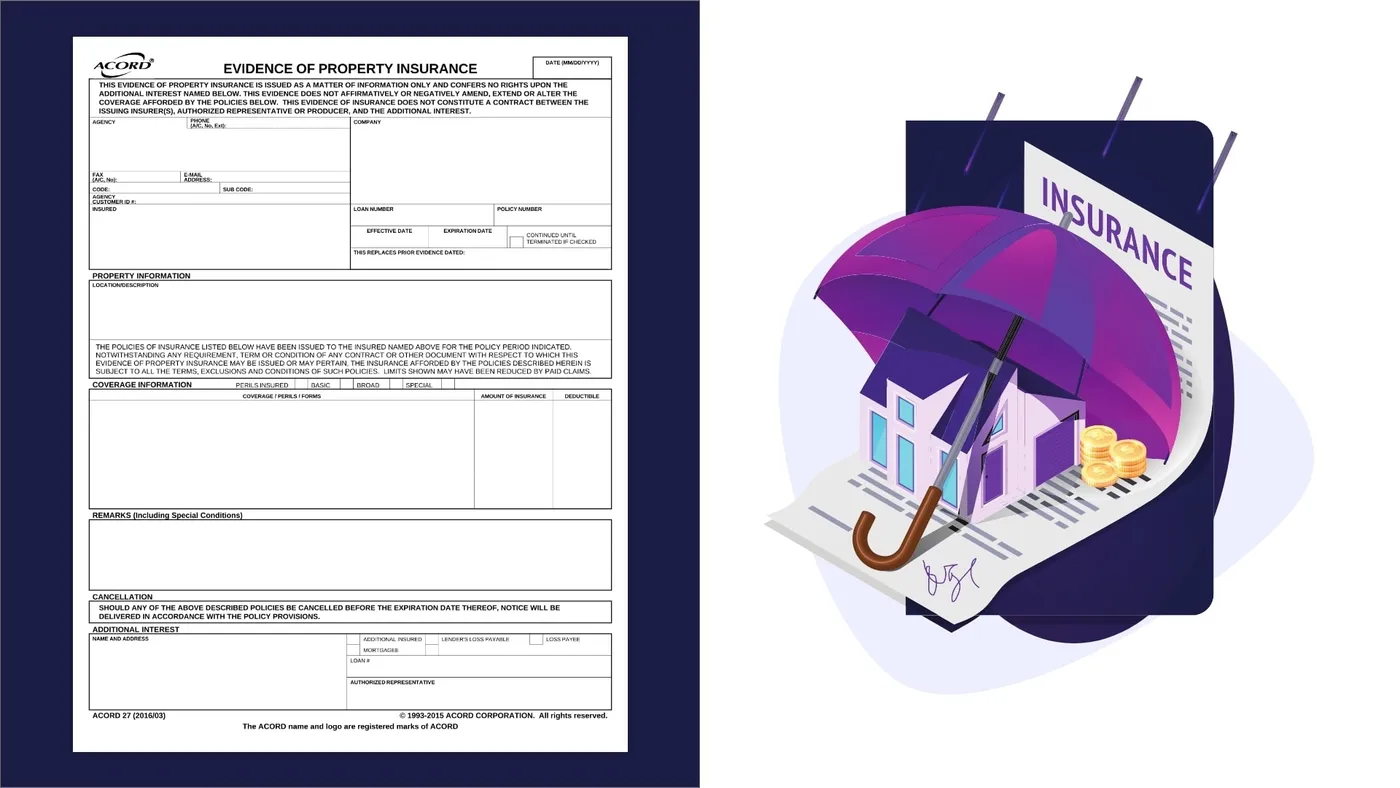
Key takeaways
- The ACORD 27 is the Evidence of Property Insurance: a one-page form an agent or broker sends to a lender or other party with a financial interest in a property, typically when a mortgage closes and at each renewal.
- It shows the property, each coverage line with its amount of insurance and deductible, the perils insured, and the additional interest: the lender as mortgagee or loss payee, with its loan number.
- The ACORD 28 is the commercial property version, with set yes/no coverage questions. The ACORD 27 lists coverages as free-form lines.
- It's evidence, not coverage. The form is issued as a matter of information only and doesn't change the policy, which governs.
- The checks compare it with the loan: valuation, perils, deductibles, flood, the mortgagee clause and loan number, the named insured and the dates. Automating them leaves people only the forms that fail.
On this page
ACORD 27 is the Evidence of Property Insurance: a one-page form an insurance agent or broker issues to a mortgage lender, loss payee or other party with a financial interest in a property, to show that a property policy is in force. It lists the property, each coverage with its amount of insurance and deductible, and the lender's interest and loan number. The ACORD 28 does the same job for commercial property, with set questions on coverages such as business income, flood and wind.
This guide covers who the form is for, how it moves from agent to lender, the fields section by section, the checks to run against the loan and how to automate the review.
What is an ACORD 27 form used for?#
ACORD, the nonprofit that maintains the insurance industry's standard forms, publishes the ACORD 27 as a certificate of insurance. The ACORD 27 and 28 go to parties with a financial interest in the property, usually lenders, who prefer the title "Evidence of" to "Certificate of". The current edition is ACORD 27 (2016/03), per ACORD's forms index of September 8, 2026.
ACORD's field instructions use a one-family dwelling and a homeowners (HO-3) policy as examples. The additional interest box names who the form is for:
Mortgage lender or servicer
Marked as mortgagee, with the loan number. Lenders ask for evidence when the loan closes and again at each renewal.Loss payee
Marked as loss payee or lender's loss payable, such as an owner of leased equipment who wants it insured while the client has it.Additional insured or other
The same box can mark an additional insured or describe any other interest.
It's often confused with three other ACORD forms:
ACORD 28: evidence of commercial property insurance
For commercial property, with the insurer's NAIC number and yes/no questions on business income, replacement cost, coinsurance, flood, wind and named storm. See our ACORD 28 guide.ACORD 24: certificate of property insurance
Property coverage reported to a certificate holder, laid out like the ACORD 25, with up to six insurers.ACORD 25: certificate of liability insurance
Liability, not property: general liability, auto, umbrella and workers' compensation. See our ACORD 25 guide.
How an ACORD 27 moves from agent to lender#
The borrower's agent completes the form from the policy and sends it to the lender or its servicer, which checks it against the loan's insurance requirements. A new form usually comes at each renewal, and its "this replaces prior evidence dated" box gives the date of the form it replaces. The check matters: Fannie Mae won't buy a loan if the lender can't tell whether the policy meets its requirements.
- Agent's email
- Servicing portal upload
- Scanned mail
- 01Classify the packet
- 02Read every field
- 03Check against the loan
- 04Review exceptions
The sections of an ACORD 27, and what to extract#
The 2016/03 edition fits on one page. The numbers on the map match the rows of the table; the cancellation box is printed text only.
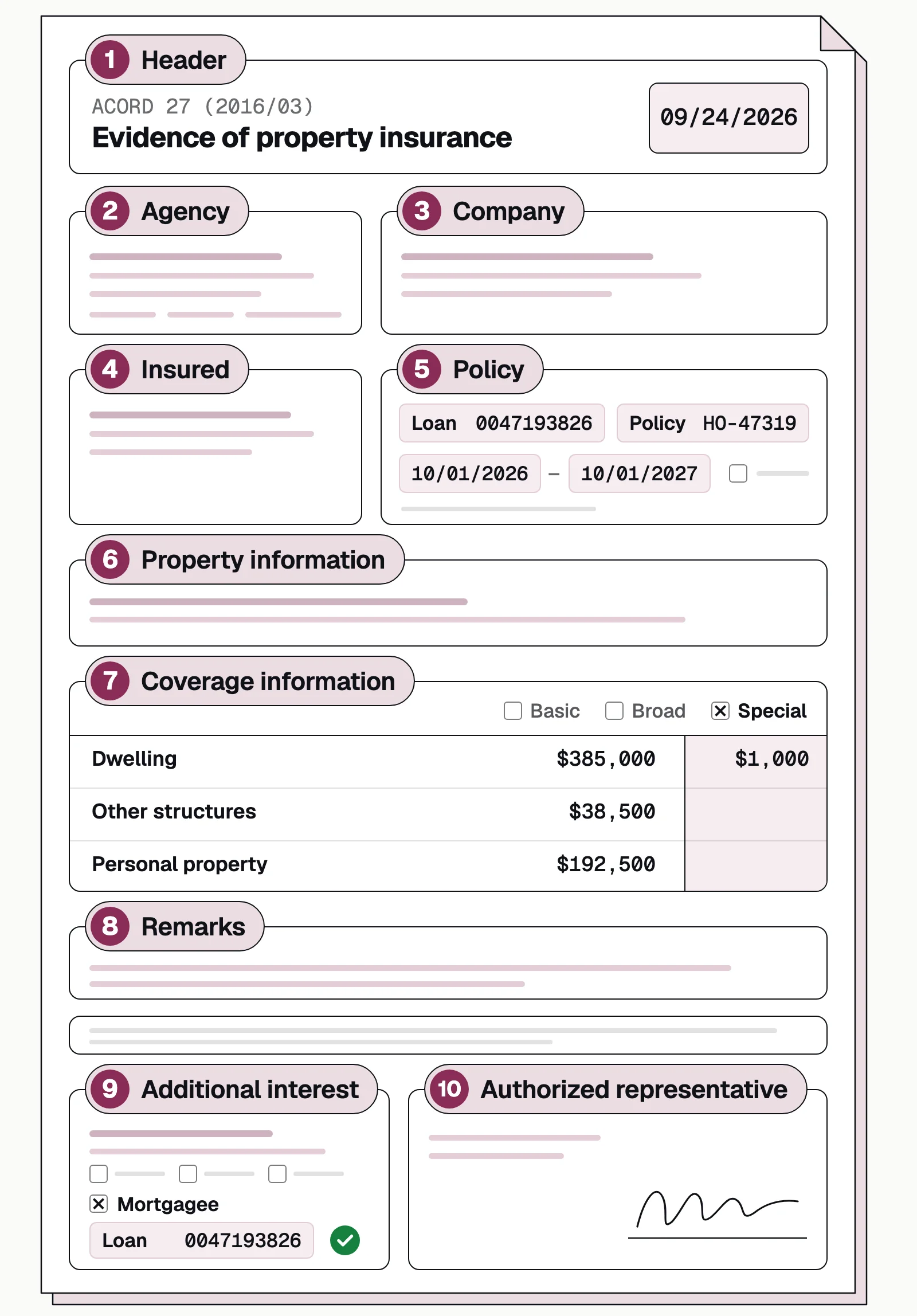
| Section | Fields to extract | Used for |
|---|---|---|
| Header | Date issued | Knowing which evidence is current |
| Agency | Agency name and address, phone, fax, email, agency code, sub code and customer ID | Requesting corrections |
| Company | Insurer's legal name (not the group or trade name) and address; there's no NAIC number box | Checking the insurer's rating |
| Insured | Named insured and mailing address | Matching the borrowers on title |
| Policy | Loan number, policy number, effective and expiration dates, "continued until terminated", "this replaces prior evidence dated" | Linking the form to the loan; dates |
| Property information | Location and description | Matching the collateral |
| Coverage information | Perils insured (basic, broad or special); each coverage line with its form, amount of insurance and deductible | The core coverage check |
| Remarks | Special conditions; an attached ACORD 101 if more room was needed | Conditions that change the check |
| Additional interest | Name and address; mortgagee, lender's loss payable, loss payee, additional insured or other; loan number | The mortgagee clause check |
| Authorized representative | Signature | Validity |
The checks to run against the loan#
Each check compares the form with the insurance requirements in the loan documents. The rules below are Fannie Mae's for one- to four-unit homes, as an example; your investor and loan documents set yours.
- Valuation and amountThe dwelling line shows an amount of insurance, and the coverage lines or remarks show replacement cost terms. Fannie Mae requires replacement cost coverage, except on roofs.
- Perils insuredSpecial is checked, or the policy covers every peril your investor lists; basic and broad cover only the perils they name. If a required peril such as wind is excluded, ask for evidence of the separate policy.
- DeductiblesEach deductible is within your limit. Fannie Mae caps it at 5% of the coverage amount, and a separate wind or wildfire deductible can't exceed 5% either.
- FloodMost homeowners policies don't cover flood. If the home is in a flood zone starting with A or V, Fannie Mae requires flood insurance and accepts the flood policy's declarations page as evidence. ACORD's evidence form for flood is the ACORD 29.
- Mortgagee clause and loan numberMortgagee is checked, not loss payee or lender's loss payable: Fannie Mae doesn't accept a loss payable clause in place of a mortgagee clause. The name matches your clause, such as the servicer followed by "its successors and/or assigns", MERS isn't named, and both loan numbers match.
- Named insuredEveryone on title appears as a named insured.
- Dates and signatureThe policy is in force at closing, its expiration is tracked for renewal evidence, and the form is signed. Fannie Mae accepts a certificate in place of the policy only if the insurer signs it.
For example, the amount, perils and deductible pass, but the lender is marked as loss payee instead of mortgagee. The form goes to a person, who asks the agent for a corrected ACORD 27.
How to automate ACORD 27 review#
- Collect evidence in one queueRoute the insurance inbox, portal uploads and scans to one place.
- Classify and splitSeparate the ACORD 27 from declarations pages, flood evidence and ACORD 101 remarks pages. Docsumo classifies and splits mixed packets on its Business plan.
- Extract every fieldEach coverage line with its amount and deductible, the perils box and the additional interest. Docsumo reads ACORD forms, scans and handwriting included, and reports 99% field-level accuracy across 250+ document types.
- Check against the loanRun the checks above against each loan's requirements, as workflow steps you set up: an AI step or your own Python code. Comparing the form with other documents in the loan file, such as the declarations page, is cross-document validation, on Docsumo's Enterprise plan.
- Review exceptionsFields the model is unsure about go to a person, and clicking a field highlights where it sits on the page.
- Send the data onPush it to your servicing or insurance tracking system through the API and webhooks, or export it to Excel, and track expiration dates there.
Docsumo reads the evidence and runs the checks you set up. Follow-ups with agents stay in your servicing or tracking system. Vertikal RMS uses Docsumo for COI verification through ACORD capture, and Arbor reached 99% accuracy on insurance compliance documents with it.
- 99%field-level accuracy across 250+ document types
- 95%+of documents processed straight through, without manual review
- <5 minper document, down from 2+ hours
The bottom line#
An ACORD 27 is the lender's one-page summary of a property policy, and it's only useful once it's checked against the loan. Read every field, run the same checks on every form, and let people handle only the ones that fail.
Book a demo with a few of your own ACORD 27s, or start a free trial.
Frequently asked questions#
What is an ACORD 27 form used for?
It shows a lender, loss payee or other party with a financial interest in a property that a property policy is in force: the property, the amounts of insurance, the deductibles and the party's own interest and loan number. Lenders usually ask for one when a mortgage closes and again at each renewal.
What is the difference between ACORD 27 and ACORD 28?
Both are evidence forms for parties with a financial interest in a property. The ACORD 27 lists coverages as free-form lines with a remarks box, and ACORD's instructions for it give a homeowners policy as an example. The ACORD 28 is built for commercial property, with the insurer's NAIC number and set questions on business income, replacement cost, coinsurance, flood, wind and named storm. See our ACORD 28 guide.
What is the difference between ACORD 25 and ACORD 27?
ACORD 25 is the certificate of liability insurance, issued to a certificate holder such as a building owner or general contractor. ACORD 27 is evidence of property insurance, issued to a party with a financial interest in the property, usually a lender. ACORD keeps them apart because a property policy typically obliges the insurer to notify the mortgage holder of a cancellation, while a liability policy notifies only the first named insured.
How do you fill out an ACORD 27?
The insured's agent or broker completes it from the policy: agency, insurer, named insured, loan and policy numbers, dates, the property, each coverage with its amount and deductible, remarks and the additional interest. An authorized representative signs it. The lender supplies its mortgagee clause and loan number.
Where can I get an ACORD 27 PDF?
Ask the insured's agent or broker, who issues it: ACORD doesn't issue certificates itself. Blank forms come from ACORD, which requires a subscription to an eligible forms program to download them.
Is an ACORD 27 proof of insurance?
It's evidence, not a contract. It's issued as a matter of information only, confers no rights on the additional interest and doesn't change the policy. Fannie Mae lets lenders accept a certificate of property insurance in place of the full policy if the insurer signs it and it shows everything needed to confirm the policy meets Fannie Mae's requirements.
Sources
- ACORD: About ACORD
- ACORD: Certificates of insurance, frequently asked questions
- ACORD Forms Index (rev. 9/8/2026)
- ACORD: Forms library
- NY DFS: Approved certificate of insurance, ACORD 27 (2016/03) Evidence of Property Insurance
- ACORD 27 (2016/03) fillable form with ACORD's field instructions (NYC Department of Design and Construction)
- ACORD 28 (2016/03) Evidence of Commercial Property Insurance, blank form (NYC Department of Design and Construction)
- ACORD 24 (2016/03) Certificate of Property Insurance (Texas Department of Insurance)
- Fannie Mae Selling Guide B7-3-02: Property insurance requirements for one- to four-unit properties (08/05/2026)
- Fannie Mae Selling Guide B7-3-06: Flood insurance requirements for all property types
- Fannie Mae Selling Guide B7-3-07: Evidence of property insurance (08/05/2026)
- Fannie Mae Selling Guide B7-3-08: Mortgagee clause, named insured and notice of cancellation requirements
- FEMA FloodSmart: The National Flood Insurance Program
- IRMI: Causes of loss forms
First published . Last updated .