Mortgage document processing: how AI automates the loan file
For mortgage lenders, processors and operations leads: what's in a loan file, where manual review slows it down, and how to automate classification, extraction and checks.

Key takeaways
- Mortgage document processing is collecting, classifying, extracting and verifying the documents in a loan file, from the Form 1003 to pay stubs, W-2s, tax returns, bank statements, the appraisal and title.
- Cost is a real lever: the MBA reports total loan production expenses of $10,936 per loan at independent mortgage banks in Q2 2026, against an average of $7,945 since 2008.
- Mortgage OCR only turns pages into text. Intelligent document processing adds classification, field extraction and cross-checks against the 1003, so processors work only the exceptions.
- Fannie Mae asks for the most recent full two months of bank statements on purchase loans, so extraction has to capture every transaction, not just the balance.
On this page
- How mortgage document processing works
- Documents in a mortgage loan file
- Where manual processing slows lenders down
- Mortgage OCR vs intelligent document processing
- How to automate mortgage document processing with AI
- Checks to run on every loan file
- Where automation still needs people
- How to roll it out
- How to choose a mortgage document processing tool
- The bottom line
- Frequently asked questions
Mortgage document processing is the work of collecting, classifying, extracting and verifying the documents in a loan file, from the Form 1003 application to pay stubs, W-2s, tax returns, bank statements, the appraisal and title, so an underwriter can decide. Lenders automate it with AI-based intelligent document processing (IDP), which reads each document, pulls out the data and checks it against the rest of the file.
How mortgage document processing works#
A loan file arrives from the borrower, their employer and bank, the IRS, the appraiser and the title company.
- Application (1003)
- Pay stubs and W-2s
- Bank statements
- Tax returns
- Appraisal and title
- 01Classify every page
- 02Extract the fields
- 03Cross-check against the 1003
- 04Clear conditions
Documents in a mortgage loan file#
| Category | Documents | Data lenders extract |
|---|---|---|
| Application | Form 1003 (URLA) | Borrower, employment, stated income, assets, liabilities, property and loan terms |
| Income | Pay stubs, W-2s, 1099s, tax returns, verification of employment, P&Ls | Base pay, overtime, bonus, year-to-date earnings, employer, self-employment income |
| Assets | Bank, investment and retirement statements, gift letters | Account holder, balances, deposits, large deposits, overdrafts |
| Credit | Credit report, letters of explanation | Scores, tradelines, monthly obligations |
| Property | Purchase contract, appraisal, title commitment, homeowners insurance | Price, appraised value, liens, coverage, mortgagee clause |
| Other | ID, divorce decree, rental history, bankruptcy records | Identity data, child support or alimony |
The 1003 is the reference every other document is checked against (see 1003 data extraction).
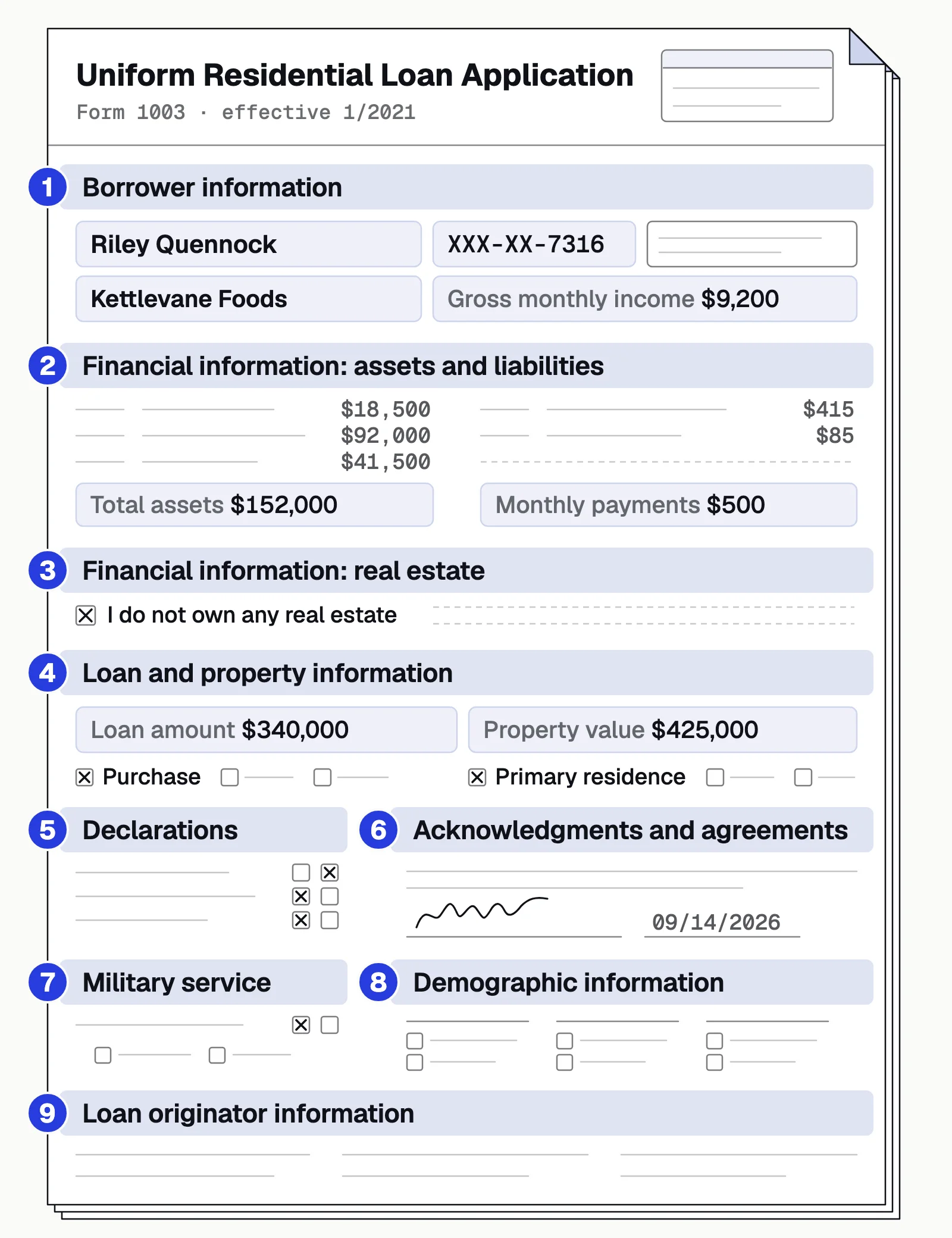
Income drives debt-to-income, so pay stubs, W-2s and tax returns get the most scrutiny. Assets need every transaction: for purchase loans, Fannie Mae asks for the most recent full two months of bank statements, so large deposits can be sourced.
Where manual processing slows lenders down#
Manual file prep
- Someone sorts an 80-page upload or 40 phone photos by hand
- Income and asset figures are typed into the LOS, then into worksheets
- The employer on the pay stub, W-2 and 1003 is compared by eye
- Problems surface at underwriting and send the file back
Automated file prep
- Every page is classified and the package split into documents
- Fields are extracted once and sent to the LOS by API
- Cross-document checks run on every file
- Gaps are flagged while the borrower can still fix them
Mortgage OCR vs intelligent document processing#
Mortgage OCR turns scanned loan documents into machine-readable text. That's the first step of mortgage data extraction, not the whole job: underwriting needs each document identified, the right fields pulled out and values checked against the 1003. Template-based OCR finds values by position or a nearby label, so it breaks when a layout changes; IDP reads the context instead.
| What you get | Mortgage OCR | Intelligent document processing |
|---|---|---|
| Output | Text from each page | Named fields and tables, such as year-to-date pay and every transaction |
| Loan packages | Sorted by hand first | Pages classified and split |
| New layouts | A template per layout | Read from context |
| Checks | None | Against the 1003 and the other documents |
| Unsure values | Pass through unflagged | Sent to a person for review |
On a pay stub, IDP's output is named fields for this period and year to date, not a page of text:
| Field | Extracted value | Confidence |
|---|---|---|
| Employer | Northfield Freight LLC | |
| Employer EIN | ••-•••3082 | |
| Employee | Aisha K. Warren | |
| Employee ID | 20417 | |
| Period start | 2026-08-17 | |
| Period end | 2026-08-30 | |
| Pay date | 2026-09-04 | |
| Pay frequency | Biweekly |
| Field | Extracted value | Confidence |
|---|---|---|
| Regular hours | 80.00 | |
| Regular rate | 30.00 | |
| Regular pay | 2,400.00 | |
| Overtime hours | 4.00 | |
| Overtime rate | 45.00 | |
| Overtime pay | 180.00 | |
| Gross pay | 2,580.00 |
| Field | Extracted value | Confidence |
|---|---|---|
| Federal income tax | 227.98 | |
| Social Security | 159.96 | |
| Medicare | 37.41 | |
| State income tax | 122.14 | |
| Roth 401(k) | 129.00 | |
| Total deductions | 676.49 | |
| Net pay | 1,903.51 |
| Field | Extracted value | Confidence |
|---|---|---|
| YTD regular hours | 1,440.00 | |
| YTD gross pay | 44,910.00 | |
| YTD federal income tax | 3,927.46 | |
| YTD Social Security | 2,784.42 | |
| YTD Medicare | 651.20 | |
| YTD total deductions | 11,731.39 | |
| YTD net pay | 33,178.61 |
How to automate mortgage document processing with AI#
Automation starts by turning a loan package into labeled documents.
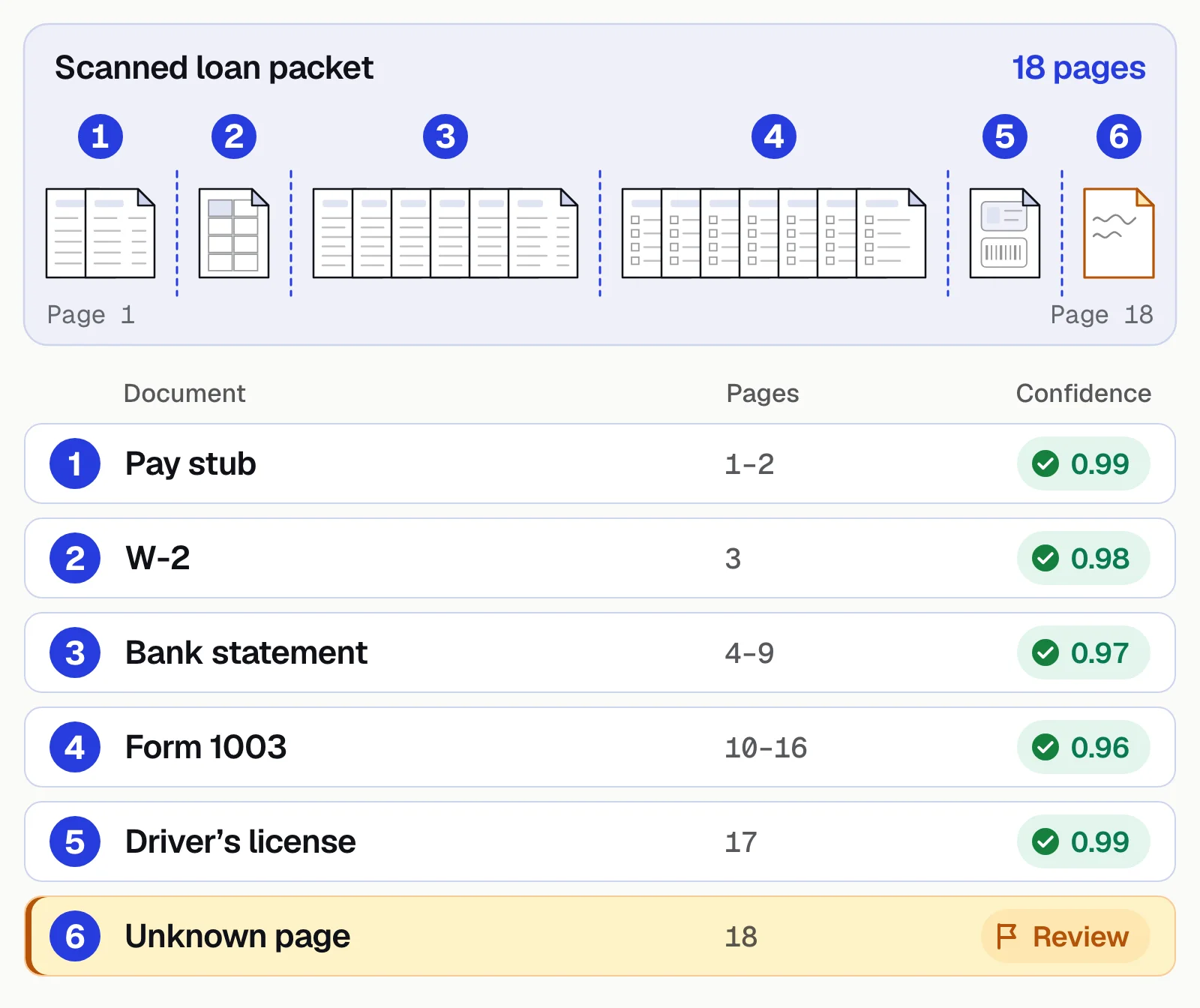
Each document then yields its fields, such as year-to-date pay and every transaction, with a confidence score and a link to its place on the page. Unsure fields go to a processor; clean data goes to the LOS by API or webhook.
Docsumo classifies and splits packages on the Business plan and keeps each loan's documents together in case management on the Enterprise plan. It extracts income data but doesn't produce Form 1084 or Form 91 income calculations or make the credit decision.
- 99%field-level accuracy on 250+ document types
- 95%+of documents processed straight through, without manual review
- <5 minper document, down from 2+ hours
Checks to run on every loan file#
- IdentityThe borrower's name and address match across the 1003, pay stubs, W-2s and bank statements.
- Income consistencyYear-to-date pay fits the pay frequency and prior-year W-2s, and supports the income on the 1003.
- Asset sufficiencyBalances cover the down payment and closing costs, and large deposits are flagged for sourcing.
- Math and continuityStatement balances agree with the transactions, and pay stub gross pay reconciles to net.
- RecencyDocument dates fall within the lender's and investor's age limits.
The income check saves the most rework: line up the 1003, the W-2, the latest pay stub and the bank deposits, and flag any gap with the figures side by side, so the processor asks the borrower now, not weeks later. For assets, see bank statement verification for mortgage lending. Docsumo reports 64% lower fraud with cross-document validation, which is on the Enterprise plan.
Where automation still needs people#
Automation prepares the file; it doesn't make underwriting judgments. Salaried W-2 files pass straight through far more often than these:
Self-employed borrowers
1040s, Schedule C, K-1s and P&Ls can be extracted; which income is stable is an underwriter's call.Variable income
Bonus, commission, overtime and rental income show up on pay stubs and returns; whether they'll continue is a judgment.Poor document quality
Faded copies and sideways photos lower confidence. Ask for clear, complete pages up front.Edge cases
Several employers, amended W-2s, business deposits in a personal account, or insurance that doesn't name the lender.
How to roll it out#
- Measure today's manual workHours spent sorting, re-keying and chasing documents, and how many files come back with conditions.
- Start with the highest-volume documentsUsually pay stubs, W-2s and bank statements. Pilot self-employed loans separately.
- Map the LOS integrationTest in a sandbox with real samples, including a missing required field.
- Run a parallel pilotProcess a few hundred files both ways and compare accuracy, exceptions and cycle time.
- Add checks and routingLow-confidence fields go to processors, inconsistencies to senior processors, outliers to underwriters.
How to choose a mortgage document processing tool#
Test it on real loan packages, phone photos and scanned tax returns included, and measure field-level accuracy. Then check how it splits a 100-page upload, whether it validates documents against each other, whether processors see unsure fields on the source page, and whether it has an API for your LOS and SOC 2 Type 2 compliance. For vendors, see the best mortgage document automation software.
The bottom line#
Mortgage document processing is mostly classification, extraction and cross-checking, and all three can be automated. Start with income and asset documents, run the same checks on every file and keep processors on the exceptions. See IDP for lending.
Book a demo with a few of your own loan files, or start a free trial.
Frequently asked questions#
What documents are needed to process a mortgage?
The Form 1003 application, pay stubs, W-2s or 1099s, tax returns, bank and investment statements, a credit report, the purchase contract, an appraisal, title documents and proof of homeowners insurance. Requirements vary by loan program and investor.
What is mortgage OCR, and is it enough for underwriting?
Mortgage OCR (optical character recognition) turns scanned loan documents into text, but it doesn't know which number is year-to-date pay or which deposit needs sourcing. Intelligent document processing adds classification, field extraction, cross-checks against the application and review of low-confidence fields.
How does AI help in mortgage document processing?
AI classifies the pages in a loan package, extracts fields such as income, balances and deposits, and checks them against the application and each other. Processors then work the exceptions instead of keying data.
What should lenders automate first?
Bank statements, pay stubs and W-2s. They take the most processor time, follow predictable patterns and feed the income and asset checks.
Does mortgage document automation replace underwriters?
No. It prepares a clean, verified file faster. Underwriters still make the credit decision and clear conditions.
What happens when a document doesn't extract correctly?
Low-confidence fields go to a review queue, where a processor checks them against the source page or asks the borrower for a clearer copy. Everything else continues through the workflow.